PublicSphere Live
Opinion
Nigeria At 66: Six Decades After Independence, What Do the Numbers Say About the Nation?
On October 1, 1960, when the Union Jack was lowered and the green-white-green flag was raised over an independent Nigeria, the country's first generation of political leaders inherited a nation that was already being described as a country of extraordinary possibilities.
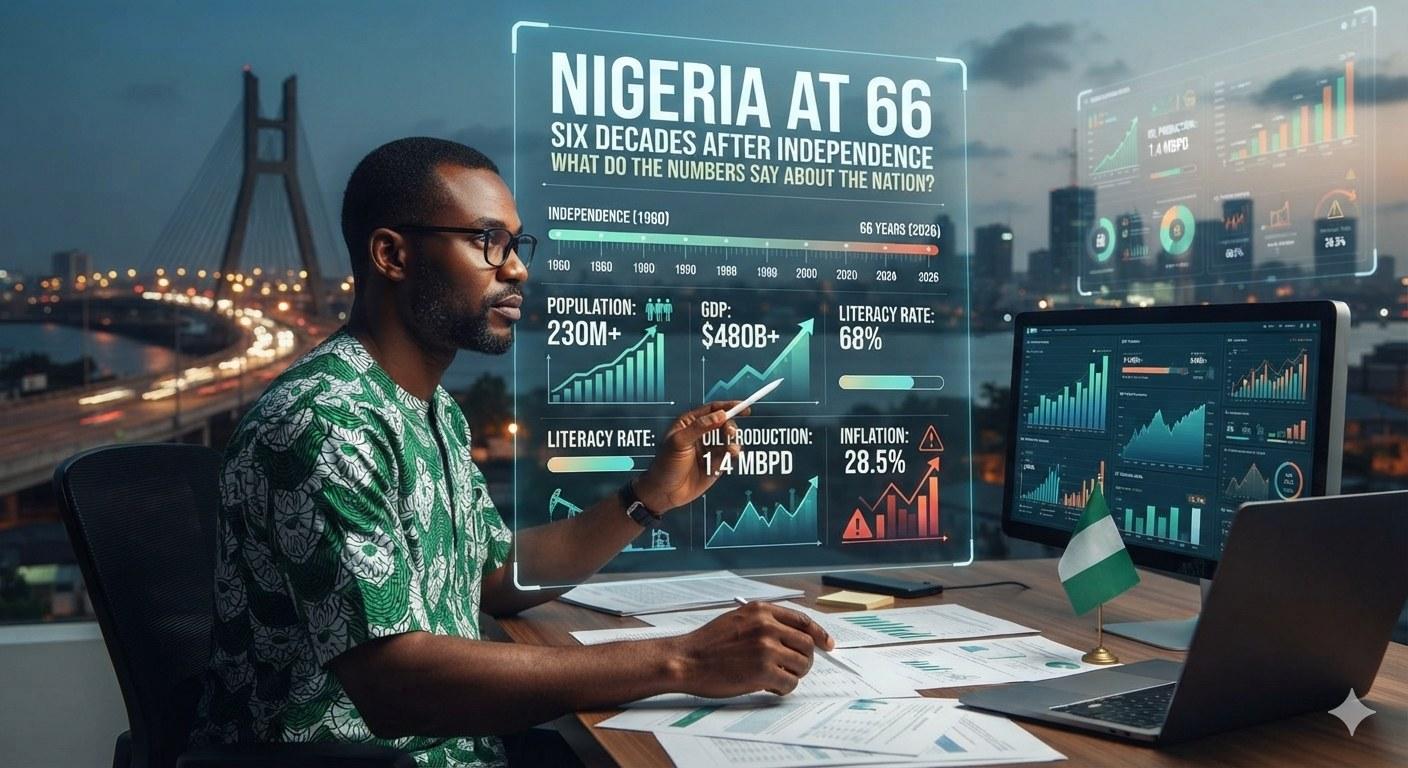
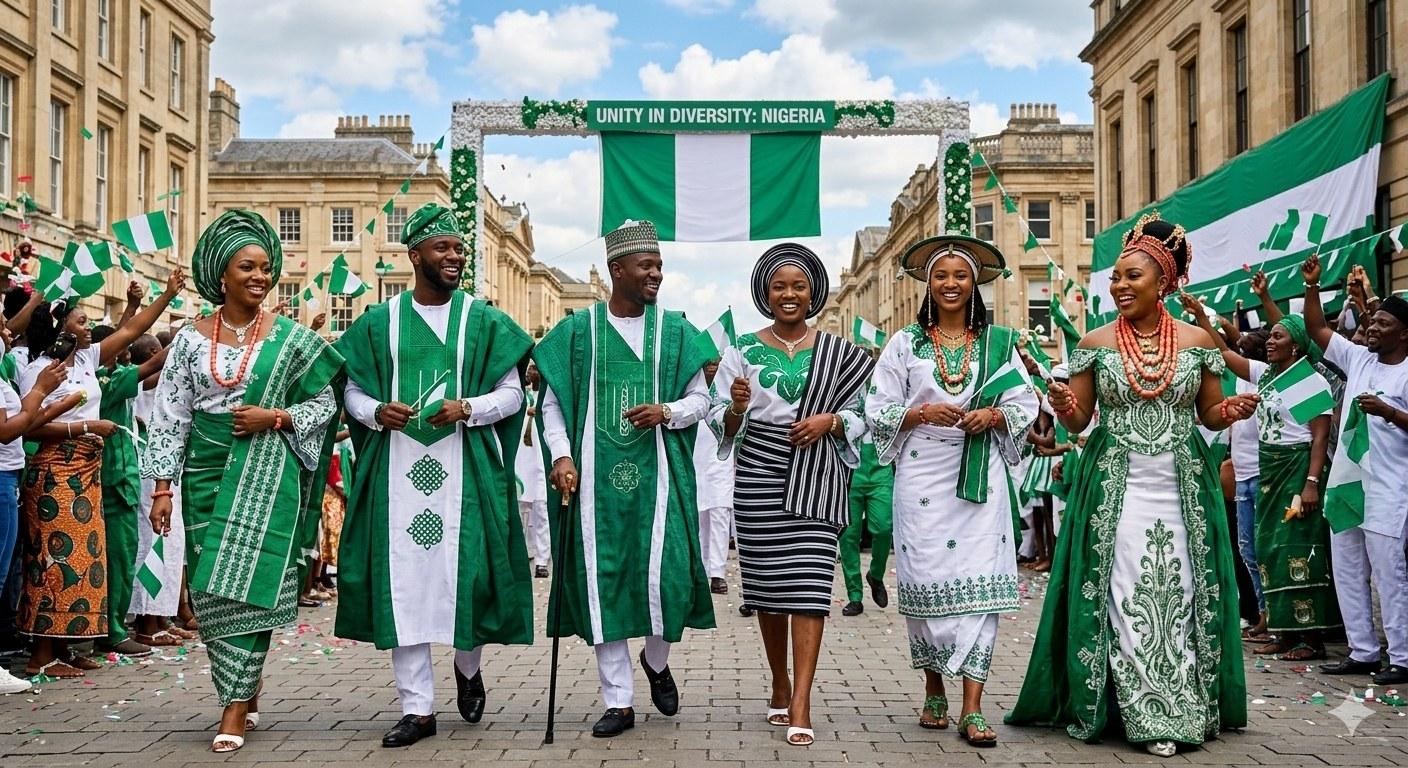
From the promise of a prosperous, united and democratic nation in 1960 to an economy still struggling to translate growth into better living standards, Nigeria's 66th anniversary is being marked against a sobering international assessment of poverty, human development, insecurity, governance and democratic institutions.
On October 1, 1960, when the Union Jack was lowered and the green-white-green flag was raised over an independent Nigeria, the country's first generation of political leaders inherited a nation that was already being described as a country of extraordinary possibilities.
The promise was enormous.
Prime Minister Sir Abubakar Tafawa Balewa and other nationalist leaders spoke of a Nigeria that would be united despite its enormous ethnic, religious and regional diversity; a country that would develop its resources for the benefit of its people; a nation that would defend democracy and human rights; and a country that would take its rightful place in Africa and the wider international community.
The vision was not merely about political independence.
It was about human dignity.
It was about transforming freedom from colonial rule into better lives for ordinary Nigerians.
It was about education, healthcare, infrastructure, economic opportunity and social advancement. It was about building a nation capable of standing on its own feet.
Sixty-six years later, Nigeria remains one of Africa's most important countries. It has the continent's largest or one of its largest economies, a huge population, enormous oil and gas reserves, an increasingly sophisticated financial sector, a globally influential entertainment industry and one of Africa's most important diplomatic voices.
But the international development institutions examining Nigeria in 2026 are presenting a complicated picture.
There are signs of economic stabilisation.
There are also signs that the benefits of that stabilisation have yet to reach millions of households.

That contradiction defines Nigeria at 66.
The World Bank says the economy has made meaningful progress in restoring macroeconomic stability. The IMF says reforms have strengthened resilience. The African Development Bank reports stronger growth and improved macroeconomic indicators.
But the same institutions warn that poverty remains high, household incomes remain under pressure, food insecurity is severe and growth has not yet created enough productive employment to transform living standards.
The question confronting Nigeria on its 66th anniversary is therefore not whether the country has grown.
It has.
The harder question is whether Nigeria has developed.
The Economy: Growth Without Enough Prosperity
Nigeria's economic story since independence has been one of extraordinary potential repeatedly interrupted by structural weaknesses.
Agriculture dominated the economy in the early years of independence. Cocoa, groundnuts, palm produce and other agricultural commodities generated substantial export earnings. Regional governments used revenues to finance infrastructure, education and development.
The oil boom changed the trajectory.
Petroleum became the dominant source of foreign exchange and government revenue, while agriculture and manufacturing gradually lost their relative importance.
The consequence was an economy capable of producing considerable national wealth but vulnerable to oil-price movements, production disruptions, foreign-exchange shortages and weak diversification.
The latest international figures show that Nigeria is still trying to escape that structural problem.
The African Development Bank's 2026 Country Focus Report says real GDP grew by 4 per cent in 2025, supported by services, oil and gas, agriculture, trade and real estate.
The bank projects growth of about 4.1 per cent in 2026 and 3.7 per cent in 2027.
The World Bank's latest assessment is also relatively positive on growth. It says real GDP expanded by 4.2 per cent in the first half of 2026, compared with 3.9 per cent a year earlier, driven largely by services and stronger agricultural performance.
But these figures come with an important qualification.
Growth of around four per cent may be insufficient for a country with Nigeria's population growth and development needs.
The World Bank's assessment is blunt: economic growth remains insufficient to generate enough productive jobs and materially reduce poverty.
That distinction is crucial.
A country can record positive GDP growth while the average household feels poorer because population growth, inflation and weak real incomes consume the gains.
This is one of the central contradictions of Nigeria at 66.
The economy is growing, but millions of Nigerians are still struggling to afford food, transportation, housing, healthcare and education.
The Poverty Numbers Tell a Different Story
Perhaps nowhere is the contradiction between macroeconomic improvement and household hardship more visible than in the poverty figures.
The World Bank estimates that in 2025 about 69.6 per cent of Nigerians lived below the lower-middle-income poverty line of $4.20 a day.
Even more strikingly, it estimates that 50.8 per cent, equivalent to about 123 million people, lived below the international extreme-poverty threshold.
These figures should be read carefully because poverty estimates depend on the poverty line used.
The IMF, using Nigeria's national poverty line, reported in June 2026 that poverty had reached 63 per cent.
The different figures are not necessarily contradictory. They reflect different methodologies and thresholds.
But they point in the same direction: poverty remains one of Nigeria's most serious development problems.
This is particularly important at an anniversary when attention naturally turns towards the promises made at independence.
The founders envisaged economic development that would improve the lives of ordinary citizens.
Six decades later, poverty remains sufficiently widespread that economic growth alone cannot be regarded as an adequate measure of national progress.
The World Bank says household incomes have not yet recovered fully despite improvements in macroeconomic conditions.
That warning goes to the heart of the country's economic debate.
Nigeria has spent years debating GDP growth, exchange rates, oil production and government revenues.
But for the ordinary citizen, development is ultimately experienced differently.
It is experienced in the price of a bag of rice.
It is experienced in the cost of transport.
It is experienced when a family can pay school fees.
It is experienced when electricity is available.
It is experienced when a sick child can receive treatment without a family being pushed deeper into poverty.
It is experienced when a young graduate can find productive employment.
The distance between national statistics and household experience is therefore one of the most important measures of Nigeria's development at 66.
Inflation: The Number May Be Falling, But the Memory of Prices Remains
Inflation has been one of the biggest pressures on Nigerian households in recent years.
The African Development Bank reports that annual inflation declined from 33.2 per cent in 2024 to 23 per cent in 2025.
The World Bank says headline inflation subsequently fell from 27.4 per cent in March 2025 to 15.1 per cent in February 2026.
That is significant progress.
But falling inflation does not mean falling prices.
It means prices are rising more slowly.
For families whose incomes have already been weakened by years of rapid price increases, that distinction is critical.
The World Bank reported that inflation averaged 15.7 per cent between March and July 2026, while food inflation reached 20.3 per cent in July.
The IMF similarly warned in June that higher international fuel, food and fertiliser prices could put renewed pressure on inflation and poverty.
It projected Nigeria's economic growth at 4.1 per cent in 2026, but warned that higher food and transport costs could weigh on economic activity.
The economic reform story, therefore, remains incomplete.
Stabilisation is necessary.
But stabilisation must eventually translate into stronger purchasing power.
That is the test ordinary Nigerians will apply to the reforms.
The Reforms: A Stronger Macroeconomic Foundation
International institutions are not dismissing the reforms undertaken since 2023.
Far from it.
The IMF says reforms over the past three years have produced improved macroeconomic outcomes and strengthened resilience.
It specifically points to the removal of fuel subsidies, the end of deficit monetisation and exchange-rate liberalisation as measures that have reduced fiscal vulnerabilities, rebuilt external buffers and improved foreign-exchange market functioning.
The World Bank similarly says reforms have improved macroeconomic stability, increased revenues and reserves, and strengthened policy credibility.
The African Development Bank reports that Nigeria's foreign-exchange position improved, with gross official reserves reaching about $45 billion at the end of 2025, equivalent to roughly 11 months of import cover according to its methodology.
The World Bank later put gross reserves at $51.9 billion at the end of July 2026.
These are important achievements.
But they also demonstrate the difficult nature of economic reform.
Policies designed to correct long-standing structural distortions can impose immediate costs before their benefits become visible.
The removal of petrol subsidies is a classic example.
It reduced a major fiscal burden but simultaneously contributed to higher transportation and living costs.
Exchange-rate reforms improved market functioning and helped rebuild foreign-exchange buffers, but the naira adjustment increased the local-currency cost of imports.
Nigeria's challenge at 66 is therefore to move from stabilisation to transformation.
The first task is to prevent economic collapse.
The second is to make the economy work better.
The third—and perhaps most difficult—is to ensure that ordinary citizens actually experience the benefits.
Debt And the Cost of Government
Another issue highlighted by the IMF is the cost of servicing public debt.
The IMF estimates Nigeria's public gross debt at around 35.4 per cent of GDP in 2025 and projects about 36.7 per cent in 2026.
At first glance, the ratio may appear moderate compared with many countries.
But the IMF highlights a more important issue: the burden of debt service relative to government revenue.
It estimates Federal Government interest payments at more than half of federal revenue in 2025 and projects the ratio at about 52.4 per cent in 2026.
That means the problem is not simply how much Nigeria owes.
It is how much government revenue is absorbed by servicing the debt.
This matters because every naira committed to debt service is a naira that cannot simultaneously finance roads, schools, hospitals, security, water systems and other public services.
The African Development Bank has similarly identified development financing as a major challenge.
Its 2025 country analysis estimated a development financing gap of $31.5 billion, linked partly to low domestic resource mobilisation and continued dependence on oil revenues.
At 66, Nigeria therefore faces a fiscal paradox.
The country needs massive investment to close its infrastructure and human-capital gaps, yet public finances remain constrained by weak revenue mobilisation and high financing costs.
Food Security: When Poverty Becomes Hunger
If poverty measures the capacity to afford basic necessities, food insecurity reveals what happens when that capacity breaks down.
The World Food Programme currently estimates that about 35 million Nigerians face acute food insecurity.
It identifies conflict, climate shocks, displacement and the weakening of local food systems as major drivers.
The WFP says nearly 5.8 million people in Borno, Adamawa and Yobe face severe food insecurity in 2026, with thousands in Borno expected to face catastrophic hunger or famine-like conditions.
The IMF had earlier estimated that 27 million Nigerians faced food insecurity in the autumn of 2025.
Again, the figures come from different periods and methodologies, but together they reveal the scale of the problem.
Food insecurity is not simply an agricultural issue.
It is connected to security.
It is connected to inflation.
It is connected to rural poverty.
It is connected to climate change.
It is connected to displacement.
And it is connected to the inability of families to generate stable incomes.
A country approaching seven decades of independence cannot assess development solely through oil production, GDP or foreign reserves while millions remain vulnerable to hunger.
Education: The Future Of 66 Years
Perhaps the most consequential question for Nigeria's future is what happens to its children.
UNICEF reports that approximately 10.5 million Nigerian children aged 5 to 14 are not in school.
It also says only 61 per cent of children aged six to 11 regularly attend primary school.
The organisation notes that one in every five out-of-school children worldwide is in Nigeria.
The problem is not merely access.
It is also learning.
A September 2026 UNICEF assessment of public financing for basic education reports that 49 per cent of Primary 3 pupils, 67 per cent of Primary 5 pupils and 86 per cent of Junior Secondary 2 pupils failed to reach minimum proficiency in mathematics in the relevant 2022 assessment.
The report says government education expenditure fell from 9.3 per cent of total government spending in 2015 to 3.6 per cent in 2023, well below the international benchmark of 15 to 20 per cent.
UNICEF's 2026 assessment of children in Nigeria also reports that infant mortality remains high at 104 deaths per 1,000 live births and that 40 per cent of children under five are affected by stunting.
These numbers transform education and healthcare from abstract policy debates into questions about Nigeria's future productive capacity.
The Nigeria of 2060 will be shaped by the quality of the children being educated—or left without adequate education—in 2026.
The failure to invest sufficiently in human capital is therefore not merely a present problem.
It is a deferred national crisis.
Healthcare: The Cost of Surviving
The health statistics are equally sobering.
The World Health Organisation estimates Nigeria's maternal mortality ratio at about 1,000 deaths per 100,000 live births in 2023.
Its data also put the under-five mortality rate at 108.1 deaths per 1,000 live births in 2022.
Nigeria's health expenditure structure remains another concern.
WHO data show current health expenditure at about 4.08 per cent of GDP in 2021.
The implication is that millions of Nigerians continue to face significant out-of-pocket healthcare costs.
The result is a vicious circle.
Poor families delay treatment because they cannot afford it.
Untreated illnesses reduce productivity.
Medical costs consume household resources.
Families become poorer.
And poverty itself increases vulnerability to disease.
At 66, the country's development challenge is therefore not simply to build more hospitals.
It is to build a health system capable of providing affordable and effective care before illness becomes catastrophic for households.
Electricity And Infrastructure: The Development Gap
Infrastructure remains another major measure of the distance between Nigeria's potential and reality.
World Bank data show that access to electricity stood at about 62.5 per cent of the population in 2024.
That means tens of millions of Nigerians remained without formal access to electricity.
For businesses, electricity is a production issue.
For households, it is a quality-of-life issue.
For hospitals, schools and telecommunications infrastructure, it is a basic operating requirement.
Nigeria's infrastructure deficit consequently has a multiplier effect across the economy.
Poor electricity supply increases production costs.
Poor transport infrastructure raises logistics costs.
Weak water and sanitation systems worsen health outcomes.
Insufficient digital and physical infrastructure limits productivity.
The country cannot achieve sustained industrialisation without resolving these bottlenecks.
Human Development: The Bigger Picture
The UNDP offers perhaps the broadest measure of Nigeria's progress because its Human Development Index does not focus exclusively on economic output.
It combines indicators relating to health, education and income.
The latest UNDP assessment available for Nigeria places the country in the low human-development category, with an HDI of 0.548 in the 2023/2024 assessment framework cited by UNDP Nigeria.
UNDP says Nigeria's HDI increased by 22 per cent between 2003 and 2022, but that inequality produces a substantial loss in human-development achievement.
This is an important reminder that Nigeria has made genuine progress.
The country today is not the Nigeria of 1960.
There are vastly more universities, hospitals, roads, businesses, banks, telecommunications networks, technology companies and professional institutions.
Millions of Nigerians have access to digital technology unimaginable to the independence generation.
Nigerian entrepreneurs operate across global markets.
Nigerian professionals work in virtually every major international city.
Nollywood and Afrobeats have become global cultural forces.
The country's financial technology industry is among Africa's most dynamic.
Nigeria has therefore expanded enormously.
The problem is that human development has not expanded at the same speed or with sufficient equality.
The Democratic Question
The independence promise was also political.
Nigeria was expected to operate as a democratic nation governed through institutions, constitutionalism and respect for rights.
The political record since independence has been turbulent.
The First Republic collapsed into military rule.
A civil war followed.
Military interventions interrupted democratic government repeatedly.
Civilian rule returned in 1979, was again interrupted, and finally returned in 1999.
Nigeria has now enjoyed more than a quarter-century of uninterrupted civilian government.
That is itself a significant achievement.
But international democracy assessments continue to identify weaknesses.
International IDEA's Global State of Democracy assessment places Nigeria in the middle range in representation, rights and participation but in the low range for rule of law.
Its 2025 country assessment places Nigeria at 96th of 173 countries in representation, 75th in rights, 122nd in rule of law and 95th in participation.
The organisation identifies corruption, credible elections, human rights and security as areas requiring continued attention.
Freedom House's 2026 assessment gives Nigeria a global freedom score of 44 out of 100 and classifies it as “Partly Free.”
Its assessment says Nigeria has made improvements in the quality of elections since the return to civilian rule in 1999, but continues to experience electoral irregularities, security challenges, corruption and pressure on civil liberties.
These assessments do not mean that Nigeria is not a democracy.
Rather, they illustrate the distinction between having democratic institutions and ensuring that those institutions consistently deliver credible elections, accountability, rights and rule of law.
Corruption And Public Trust
Corruption remains one of the most persistent criticisms of the Nigerian state.
Transparency International's 2025 Corruption Perceptions Index gives Nigeria a score of 26 out of 100 and places the country 142nd among 182 countries.
The index measures perceptions of public-sector corruption rather than calculating the total amount of money lost to corruption.
Afrobarometer's public-opinion evidence provides another dimension.
In its 2025 reporting, eight out of 10 Nigerians—80 per cent—said corruption had increased somewhat or a lot during the previous year.
Seventy per cent perceived most or all police officials as involved in corruption.
The corresponding figures were 65 per cent for Parliament, 62 per cent for the Presidency and 54 per cent for judges and magistrates.
These are perceptions, not judicial findings of wrongdoing by those institutions.
But they matter because public confidence is itself a component of governance.
A democratic state cannot depend exclusively on constitutional structures.
It also requires citizens to believe that institutions can work fairly.
Security: The Unfinished National Question
Security is perhaps the most painful reminder that the independence promise remains unfinished.
Nigeria has confronted insurgency in the North-East, banditry and mass kidnapping in parts of the North-West and North-Central zones, communal violence, separatist agitation and other forms of insecurity.
The consequences extend far beyond the immediate victims.
Farmers abandon land.
Children are unable to attend school.
Businesses close.
Investment is discouraged.
Communities are displaced.
Food production falls.
Public resources are diverted from development towards security.
International IDEA identifies personal integrity and security as important areas to watch.
Freedom House gives Nigeria zero out of four on its assessment of protection from illegitimate use of physical force and freedom from war and insurgencies.
The country therefore confronts a paradox: it has preserved its territorial integrity and remained a major regional power, yet large numbers of citizens still live with significant insecurity.
But Nigeria Has Also Achieved Something Remarkable
Any assessment of Nigeria at 66 that focuses only on its failures would be incomplete.
The country has survived crises that could have destroyed less resilient states.
It survived a civil war.
It survived decades of military rule.
It returned to democracy.
It has maintained national territorial integrity.
It remains a major force within ECOWAS and Africa.
It played important roles in African liberation struggles and the fight against apartheid.
Its armed forces and diplomatic institutions have participated in peacekeeping operations across Africa.
Its population has created a cultural influence far beyond the country's borders.
Afrobeats, Nollywood, Nigerian literature, fashion, cuisine, sports and the Nigerian diaspora have transformed the country's international image.
The Nigerian technology sector has also demonstrated that the country's young population can create globally relevant businesses.
The international assessments therefore do not describe a failed nation.
They describe a country with extraordinary assets struggling to convert them into broad-based human development.
The Children Are The Real Scorecard
Perhaps the most revealing statistic for Nigeria at 66 is not GDP.
It is the condition of its children.
UNICEF's 2025 reporting says two out of every three Nigerian children live in multidimensional poverty.
Its analysis covers deprivation in areas such as health, education, nutrition, water, sanitation and protection.
The figure illustrates why GDP growth alone cannot provide a complete assessment of Nigeria's development.
A child does not experience GDP.
A child experiences whether there is food at home.
Whether school is available.
Whether there is clean water.
Whether the nearest health facility works.
Whether the family can afford medicine.
Whether the community is safe.
Whether there is electricity.
Whether the child has a realistic pathway into adulthood.
That is where the meaning of independence becomes concrete.
Sixty-Six Years On, The Central Contradiction Remains
Nigeria has grown enormously since 1960.
Its population has multiplied.
Its economy has expanded.
Its cities have transformed.
Its universities have multiplied.
Its businesses have become more sophisticated.
Its technology sector has emerged.
Its cultural influence has become global.
Its democratic experience, despite repeated setbacks, has now lasted longer than any previous uninterrupted civilian period.
But the international data reveal a second Nigeria.
It is a Nigeria in which roughly half the population may be living in extreme poverty under the World Bank's $4.20 poverty line.
It is a Nigeria in which food insecurity affects tens of millions.
It is a Nigeria in which more than 10 million primary-school-age children remain outside school.
It is a Nigeria in which learning outcomes are weak.
It is a Nigeria in which maternal and child mortality remain exceptionally high.
It is a Nigeria in which electricity access remains incomplete.
It is a Nigeria in which corruption perceptions remain severe.
It is a Nigeria in which democratic institutions exist but rule-of-law and security concerns remain substantial.
The anniversary therefore presents neither an entirely gloomy picture nor an occasion for easy triumphalism.
The evidence is more complicated.
Nigeria has made progress.
But its progress has been uneven.
It has built scale without always building capacity.
It has generated wealth without distributing opportunity widely enough.
It has achieved macroeconomic stabilisation without yet achieving household prosperity.
It has established democratic institutions without fully resolving questions of electoral credibility, accountability, rights and rule of law.
It has produced a globally influential culture while millions of its citizens continue to struggle with basic necessities.
From Independence To Development
The founding generation's promise was ultimately about people.
That is the standard against which 66 years should be measured.
The task before Nigeria is no longer simply to demonstrate that it can survive.
It must demonstrate that it can prosper inclusively.
The international institutions examining Nigeria in 2026 are, in their different ways, pointing towards the same broad challenge.
The IMF is calling attention to the need to preserve macroeconomic stability while making growth more inclusive.
The World Bank is emphasising the conversion of stabilisation into better livelihoods, stronger human capital and productive employment.
The African Development Bank is highlighting the need to mobilise development finance, strengthen domestic revenue and reduce structural vulnerabilities.
UNDP's human-development framework points beyond GDP towards health, education and living standards.
UNICEF's evidence shows the urgency of investing in children.
WHO's figures demonstrate the enormous health burden.
WFP's data expose the scale of food insecurity.
International IDEA and Freedom House highlight weaknesses in rule of law, political rights and civil liberties.
Transparency International and Afrobarometer point to the corrosive effect of corruption and declining public confidence.
Taken together, these assessments form a picture far more complex than either celebration or condemnation.
Nigeria at 66 is a country in transition.
Its economic reforms may be laying the foundations for a more stable economy.
Its enormous young population may become its greatest productive asset.
Its technology and creative sectors demonstrate extraordinary entrepreneurial capacity.
Its natural resources remain substantial.
Its diplomatic and cultural influence remains significant.
But these advantages will matter only if they are converted into improvements in the daily lives of citizens.
The Next 34 Years
Nigeria will turn 100 in 2060.
That date is already visible on the national horizon.
The generation that will celebrate the centenary is being born today.
That makes the 66th anniversary more than a commemoration of the past.
It is a test of preparation for the future.
If Nigeria can translate macroeconomic stability into jobs, reduce poverty, improve education, strengthen healthcare, expand electricity access, secure communities and deepen accountable democratic institutions, the country's enormous potential could become measurable human prosperity.
If it cannot, the country may continue producing impressive headline economic statistics while millions remain trapped in economic insecurity.
The most important lesson from the international assessments is therefore straightforward.
Nigeria does not suffer from a shortage of potential.
It suffers from the difficulty of converting potential into broad-based outcomes.
That is the unfinished business of independence.
In 1960, Nigeria became politically independent.
At 66, the larger challenge is economic and human independence: the ability of citizens to live with dignity, earn productive incomes, educate their children, access healthcare, live safely, trust public institutions and participate meaningfully in the democratic process.
The Union Jack came down 66 years ago.
The work of building the nation that independence promised is still underway.
And the statistics from the world's major development institutions suggest that the next chapter will be judged not by the size of Nigeria's economy alone, but by whether the ordinary Nigerian finally feels that the country's enormous promise belongs to them.