 PublicSphere Live
International Finance
IMF Warns Tinubu Government Against Restoring Petrol Subsidy, Urges Targeted Relief for Poor Nigerians
The Fund says blanket fuel subsidies place pressure on public finances and disproportionately benefit wealthier consumers, as Atiku Abubakar renews calls for targeted support tied to locally refined petroleum products ahead of the 2027 elections.
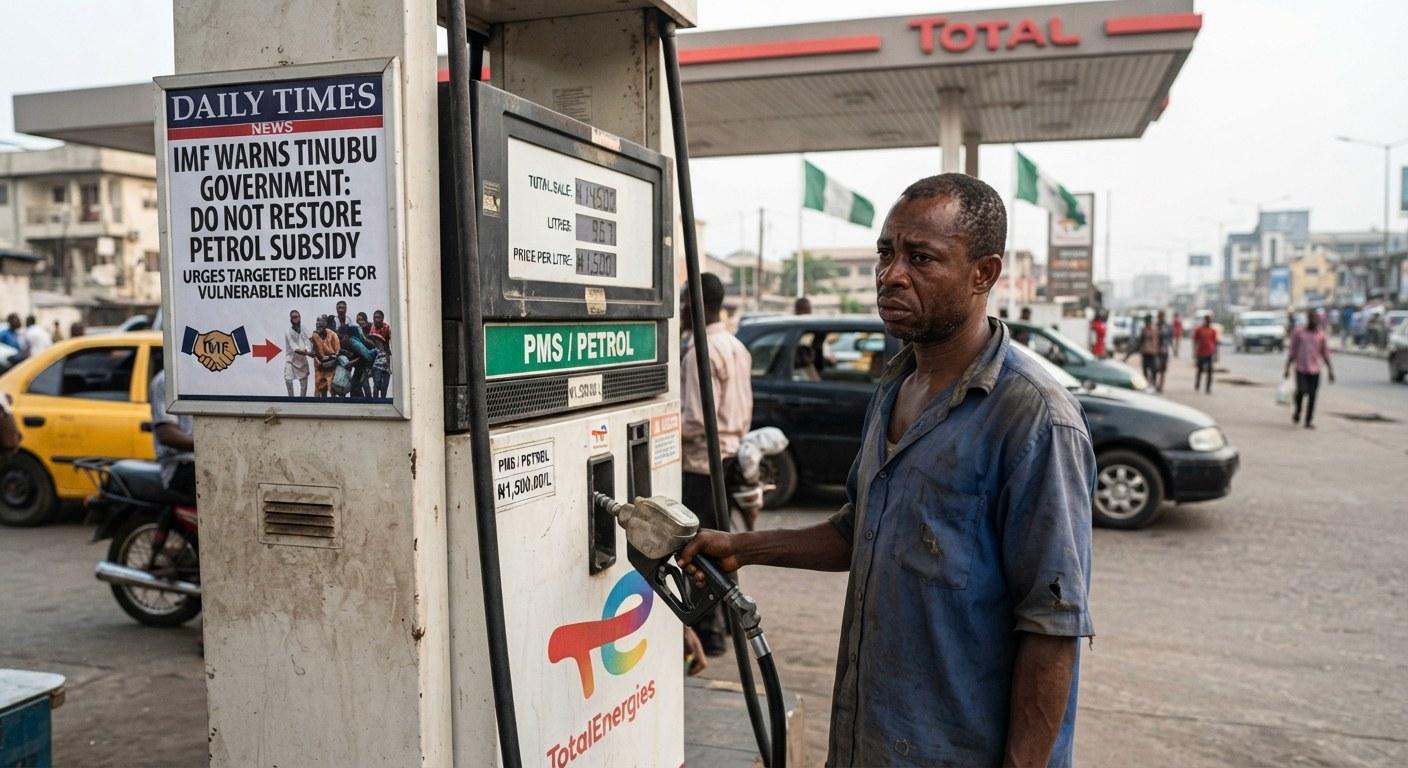
The International Monetary Fund (IMF) has cautioned the Federal Government against restoring a broad-based petrol subsidy, urging the authorities to adopt targeted support measures that protect vulnerable Nigerians from rising energy costs without undermining fiscal stability.
The warning comes amid growing public dissatisfaction over the high cost of petrol, transportation and food, as households continue to grapple with the effects of the removal of the petrol subsidy by President Bola Tinubu in May 2023.
It also comes as the debate over fuel affordability gathers momentum ahead of the 2027 general elections, with former Vice President Atiku Abubakar advocating a targeted subsidy if elected president, while questioning the effectiveness of the Federal Government's recently announced 30-day petrol discount at Nigerian National Petroleum Company Limited (NNPC) retail stations.
The IMF maintained that although governments have a responsibility to shield citizens from economic shocks, keeping fuel prices artificially low for all consumers is an expensive and potentially inefficient way of achieving that objective.
The Director of the IMF's Fiscal Affairs Department, Mr Rodrigo Valdés, stated the Fund's position during a press briefing on the Fiscal Monitor at the 2026 IMF and World Bank Annual Meetings in Bangkok, Thailand.
Responding to concerns that allowing fuel prices to reflect market conditions could increase transportation costs, worsen inflation and deepen poverty, Valdés drew a distinction between protecting households and subsidising the prices of petroleum products.
“Protecting people is not the same as protecting the price of fuels,” he said.
The statement reinforces the IMF's longstanding argument that governments should concentrate limited public resources on households most affected by economic shocks instead of maintaining subsidies that benefit consumers regardless of their income levels.
According to Valdés, fuel subsidies and other interventions designed to prevent energy prices from fully adjusting to supply shocks cost countries between one and 1.5 per cent of gross domestic product in 2026.
The Fund warned that such expenditure could place additional pressure on public finances, particularly at a time when governments are confronting rising borrowing costs and competing demands for infrastructure, healthcare, education and social protection.
It recommended the use of social safety nets and household data to identify vulnerable citizens and direct assistance to them, rather than subsidising petrol prices across the board.
IMF Questions Efficiency of Universal Fuel Subsidies
At the centre of the IMF's argument is the question of whether a government should spend scarce public resources reducing the price of a commodity for everybody or concentrate assistance on those who cannot afford the full market price.
Under a broad-based petrol subsidy, the government absorbs some of the cost of fuel, allowing consumers to purchase it below the price that would otherwise prevail. Although the arrangement can provide immediate relief, its benefits are not necessarily distributed according to economic need.
Households that own several vehicles, businesses with large vehicle fleets and other heavy fuel consumers may receive substantial benefits simply because they purchase more petrol. Poorer households, including those without private vehicles, may receive less direct assistance even though they remain exposed to higher transport fares and the increased cost of moving food and other essential goods.
This is the principal concern behind the IMF's opposition to a blanket subsidy.
However, the argument does not mean that fuel price increases have no social consequences or that the removal of subsidies automatically improves the welfare of ordinary citizens.
In Nigeria, the relationship between petrol prices and the wider cost of living is particularly significant because road transportation plays a major role in the movement of people, agricultural produce, manufactured goods and essential services.
When petrol prices rise, commercial transport operators face higher operating expenses. Some of those costs are transferred to passengers through higher fares, while traders and distributors may pass increased logistics expenses to consumers.
The result can be a chain reaction that affects food prices, school transportation, small businesses and household purchasing power.
Consequently, the policy challenge facing the Federal Government is not simply whether to maintain or remove petrol subsidies. It is how to ensure that the economic benefits expected from subsidy reform translate into tangible improvements in the lives of Nigerians.
The IMF's recommendation is that governments should separate the objective of protecting vulnerable households from the mechanism of keeping fuel prices low for the entire population.
Under this approach, assistance could be delivered through targeted cash transfers, transport support, social protection programmes and other interventions designed around verified household needs.
The effectiveness of such measures, however, depends on the accuracy of beneficiary records, the adequacy of funding, the speed of disbursement and the government's ability to prevent fraud, exclusion and political interference.
Atiku Advocates Targeted Subsidy Tied To Local Refining
The IMF's position comes amid renewed calls by Atiku Abubakar, presidential candidate of the African Democratic Congress (ADC), for the restoration of a targeted petrol subsidy to cushion Nigerians against the rising cost of living.
Atiku has argued that the removal of the subsidy, without sufficient and sustainable measures to protect household purchasing power, has imposed a heavy burden on citizens already struggling with higher transportation costs and food prices.
However, his proposal differs from the previous subsidy arrangement in an important respect: he has advocated government support directed towards domestically refined petroleum products rather than a return to a system heavily dependent on imported petrol.
The former vice president's proposal includes a capped intervention, transparent budgetary provisions and independent auditing, with assistance linked to local production.
The stated objective is to lower energy costs for consumers while supporting domestic refining and strengthening the capacity of Nigeria's petroleum industry.
Such a framework would seek to combine consumer protection with the development of domestic productive capacity. Rather than spending public money primarily to bridge the gap between international fuel costs and domestic pump prices for imported products, the government would seek to design assistance around locally produced petroleum products.
The proposal raises important questions about how the intervention would be funded, how its benefits would be distributed, how the price reduction would be calculated and whether the arrangement could be sustained without creating new fiscal liabilities.
A subsidy linked to local refining would also require clear rules governing eligibility, the volume of products covered, the relationship between refiners and marketers, and the mechanism for determining the final price paid by consumers.
Without such safeguards, even a programme intended to be targeted could become difficult to monitor or vulnerable to inflated claims, opaque pricing and the accumulation of unpaid government obligations.
Atiku's proposal therefore places the debate beyond the simple question of whether subsidies should return. It raises the question of whether a redesigned intervention can deliver measurable relief while avoiding the financial and administrative weaknesses associated with the previous regime.
The difference between the two positions is also significant politically. While the IMF is emphasising fiscal discipline and targeted social protection, Atiku is arguing for an intervention that links consumer relief to the development of domestic refining.
Both approaches recognise the pressure on households, but they place different emphasis on how government support should be structured and how closely it should be tied to the price of petrol.
Atiku Questions Tinubu's 30-Day Petrol Discount
On October 9, Atiku criticised the Federal Government's recently announced 30-day petrol discount at NNPC retail stations, questioning whether the temporary arrangement would provide meaningful and lasting relief for Nigerians.
He argued that a short-term discount could not resolve the structural pressures driving up transportation fares, food prices and the general cost of living.
The criticism has drawn attention to a central weakness of temporary interventions: their benefits may disappear when the programme expires, while the economic pressures that prompted the intervention remain.
The Federal Government announced the discount as a measure intended to ease the burden on consumers, with public transport operators receiving priority.
Finance Minister and Coordinating Minister of the Economy, Mr Taiwo Oyedele, described the arrangement as a sale of petrol at cost rather than a restoration of the subsidy regime.
That distinction is important to the government's position. A temporary sale at cost, as described by the minister, is not necessarily equivalent to a continuing government commitment to absorb the difference between the market price and a lower regulated price.
Nevertheless, the practical effect on consumers will depend on the size of the discount, the quantity of petrol available under the arrangement, the number of participating stations, the duration of the programme and the extent to which transport operators pass the savings to passengers.
Giving priority to public transport operators could help extend the benefits beyond individual motorists because buses and other commercial vehicles carry multiple passengers. But the outcome would depend on whether operators participate widely and whether the reduction in their fuel costs translates into lower fares.
If the discount benefits only a limited number of operators or stations, its impact on transportation costs across the country could be modest.
Similarly, even where the price reduction reaches consumers, a 30-day programme may offer only temporary relief unless it forms part of a broader strategy addressing the cost of transportation, food distribution and household energy consumption.
The government therefore faces the task of demonstrating that the intervention has delivered measurable savings rather than relying solely on the announcement of a discount as evidence of relief.
The Fiscal Dilemma Facing The Federal Government
The IMF's warning highlights the difficult balance confronting the Tinubu administration as it seeks to maintain the fiscal gains expected from subsidy removal while responding to the continuing financial pressure on households.
The removal of the petrol subsidy in May 2023 represented a major change in Nigeria's economic policy. Successive governments had struggled with the financial burden of subsidising petrol, including the cost of maintaining lower domestic prices and the challenges associated with importing and distributing fuel.
The Tinubu administration argued that removing the subsidy would reduce pressure on public finances and free resources for other priorities.
However, the immediate consequences for consumers have remained contentious. Petrol prices increased, transportation became more expensive and the higher cost of moving goods contributed to pressure on household budgets.
The reform's long-term benefits therefore need to be assessed alongside its social costs and the government's capacity to manage the transition.
A reduction in subsidy expenditure does not automatically translate into improved living standards. The benefits depend on what happens to the resources released, whether government expenditure becomes more productive, whether revenue collection improves and whether economic growth generates jobs and higher incomes.
If savings are absorbed by other expenditure pressures, inefficient projects or rising debt-service obligations, households may see little improvement despite the removal of a major subsidy.
Conversely, if the government channels the resources into effective public transportation, reliable electricity, healthcare, education, social protection and infrastructure, the benefits could extend beyond the immediate price of petrol.
This is why the IMF has emphasised expenditure quality and revenue collection alongside its opposition to blanket subsidies. Fiscal reform is not merely about reducing expenditure; it is also about ensuring that available resources produce meaningful economic and social outcomes.
The challenge becomes more complicated when borrowing costs rise. A government that finances a broad subsidy through additional borrowing may reduce the immediate burden on consumers while transferring part of the cost to future budgets.
That could narrow the resources available for public investment and social programmes, particularly if debt servicing consumes an increasing share of government revenue.
Yet the opposite risk must also be recognised: removing price support without effective protection for vulnerable citizens can weaken purchasing power, increase hardship and undermine public confidence in economic reforms.
The sustainability of subsidy reform consequently depends not only on the savings it produces but also on the quality of the measures introduced to protect citizens.
Why Targeted Support Could Be More Difficult To Implement
Although targeted assistance appears attractive in principle, its success is not guaranteed.
The government must first identify the households most exposed to rising energy costs. This can be difficult in an economy with a substantial informal sector, irregular incomes and households whose financial circumstances may not be adequately captured by existing records.
An assistance programme that relies on incomplete or outdated databases could exclude deserving beneficiaries while allowing some people who do not need support to receive payments.
The government must also determine whether cash transfers alone would be sufficient.
For a low-income household, additional cash may help pay for food, transport and other essentials. But if petrol prices rise sharply and the cost of moving goods increases, the amount transferred may quickly lose its purchasing power.
A properly designed intervention would therefore require periodic reviews to ensure that assistance reflects changing prices and household needs.
Public transportation presents another opportunity for targeted support. Assistance directed at mass transit, commercial buses and other essential transport services could spread the benefits across many passengers rather than subsidising private motorists indiscriminately.
However, such a programme would require clear eligibility standards, transparent records of fuel purchases and safeguards against operators collecting discounted fuel without passing the benefits to passengers.
The government could also consider support for small businesses whose operations depend heavily on transportation and energy, provided the programme is properly targeted and its costs are publicly disclosed.
The central requirement is accountability. Nigerians would need to know how much the programme costs, who qualifies, how beneficiaries are selected and what measurable relief the intervention delivers.
Without these elements, a targeted subsidy could reproduce some of the problems associated with a broad subsidy while creating an additional administrative burden.
Domestic Refining and The Dangote Refinery Factor
Atiku's emphasis on domestically refined petroleum products brings the future of Nigeria's refining industry into the wider debate.
The emergence of large-scale domestic refining capacity, particularly through the Dangote Petroleum Refinery, has altered the context in which fuel policy is being discussed.
Domestic refining creates opportunities to reduce dependence on imported finished petroleum products, strengthen industrial capacity and potentially improve the resilience of the domestic fuel supply chain.
It also creates the possibility of retaining more economic activity within Nigeria, including employment, logistics, engineering, distribution and related industrial services.
However, domestic refining does not automatically guarantee low petrol prices.
The price paid by consumers still depends on several factors, including crude oil costs, exchange-rate movements, refining expenses, financing costs, distribution margins and prevailing market conditions.
The terms under which crude oil is supplied to domestic refineries, including the practical operation of any naira-denominated arrangements, can also influence the industry's costs and working-capital requirements.
A refinery may operate within Nigeria while still facing internationally influenced input costs. Consequently, local production and affordable retail prices are related objectives, but they are not identical.
A government subsidy tied to domestic production would need to establish how the benefit is calculated and how the final reduction reaches consumers without creating distortions that discourage investment or undermine competition.
If the state guarantees an artificially low purchase price without clearly funding the difference, refiners or marketers could accumulate unpaid claims or face pressure on their cash flows.
If support is provided through a transparent budgetary allocation, the government would still need to demonstrate that the resulting consumer benefits justify the expenditure.
There is also a question of market structure. A policy that supports domestic refining should be designed to encourage sustainable investment, reliable supply and fair competition rather than simply transferring public resources to particular market participants.
For the Dangote Refinery, a carefully structured intervention could potentially support domestic demand and reinforce the role of local refining in Nigeria's energy security. But an intervention poorly designed around administered prices could create uncertainty over pricing, government obligations and the commercial incentives required to expand production.
The appropriate policy question is therefore not whether domestic refining should be supported at any cost, but how Nigeria can strengthen local production while ensuring that consumers obtain meaningful benefits and public finances remain sustainable.
The 2027 Elections and The Politics Of Fuel Prices
The debate over petrol subsidies is also becoming an important issue ahead of the 2027 general elections.
Fuel prices have become closely associated with the broader economic experience of Nigerians under the current administration. For many households, the cost of petrol is not an isolated expense but a factor influencing transportation, food, education, healthcare and the survival of small businesses.
It is therefore understandable that opposition politicians are calling for alternative measures to reduce the pressure on consumers.
Atiku's proposal presents a different approach to the question of fuel affordability, while the IMF's warning reinforces the argument that universal price subsidies can be costly and poorly targeted.
The Federal Government, for its part, must demonstrate that its decision to remove the subsidy can deliver benefits beyond the reduction of government expenditure.
The electoral significance of the issue should not obscure the need to evaluate competing proposals on their economic merits. A subsidy proposal cannot be judged solely by the immediate relief it promises, just as subsidy removal cannot be judged solely by the savings claimed by government.
Both require scrutiny of their costs, distributional effects, financing arrangements and long-term consequences.
For Atiku's proposal, the key questions concern the definition of eligible consumers or products, the funding limit, the auditing process and the method for ensuring that assistance linked to local refining reaches households.
For the Tinubu administration, the questions include the scale and durability of savings from subsidy removal, the effectiveness of existing social protection programmes and the extent to which the temporary petrol discount reduces the cost of transportation.
For both sides, the broader test is whether the proposed policy can improve living standards without creating unsustainable financial obligations.
The Way Forward
The IMF's warning does not eliminate the need for government intervention in an economy where fuel prices can affect the cost of essential goods and services. Rather, it places the emphasis on the design, financing and delivery of that intervention.
Nigeria needs a credible framework that combines fiscal discipline with measurable protection for vulnerable households.
Such a framework would require transparent budgeting, reliable beneficiary records, independent auditing and regular public reporting on the number of people reached and the amount of assistance delivered.
It would also require government to assess the performance of temporary measures, including the 30-day petrol discount, using evidence of actual savings to transport operators and passengers rather than announcements alone.
At the same time, the government should pay attention to alternatives that can reduce the economy's exposure to petrol costs over the longer term. More efficient mass transportation, improved public infrastructure, reliable electricity and stronger domestic industrial capacity could help households and businesses reduce their dependence on expensive fuel.
Domestic refining can contribute to energy security, but it must operate within a framework that supports investment, competition and transparent pricing.
Ultimately, the disagreement over petrol subsidies reflects a larger challenge in economic management: how to distribute the costs of reform fairly while preserving the resources needed for sustainable development.
The IMF is warning that a blanket subsidy could place renewed pressure on public finances and deliver disproportionate benefits to higher-income consumers. Atiku is advocating a more targeted intervention linked to local refining, while criticising the limited duration of the government's latest relief measure.
The Federal Government must now demonstrate that its alternative can provide meaningful and lasting protection for citizens.
For Nigerians struggling with the cost of living, the decisive issue is not the terminology attached to a policy—whether subsidy, discount, cash transfer or social protection—but whether it reduces the real cost of daily life, reaches those who need help and can be sustained without imposing a greater burden on the economy in the future.