PublicSphere Live
Politics
INEC Explains Omission of Some Candidates from 2027 Governorship List, Sets October 24 Deadline
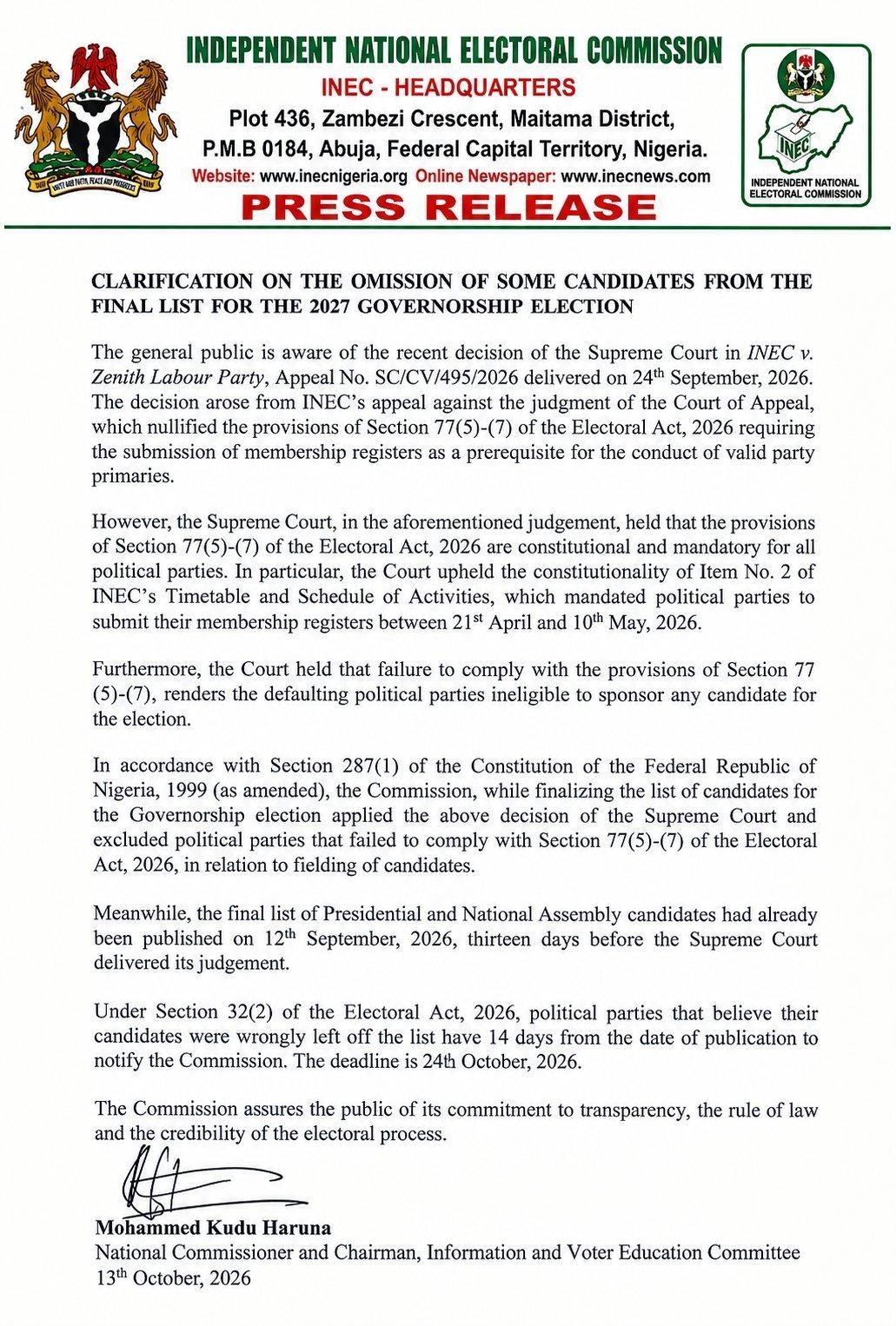
The commission said it excluded candidates sponsored by political parties that failed to submit their membership registers as required by Section 77(5)-(7) of the Electoral Act, 2026, following a Supreme Court judgment affirming the constitutionality and mandatory nature of the provisions.
The Independent National Electoral Commission (INEC) has explained the omission of some candidates from the final list for the 2027 governorship elections, attributing the decision to political parties’ failure to comply with statutory requirements on the submission of membership registers.
The commission said it excluded candidates sponsored by political parties that failed to submit their membership registers as required by Section 77(5)-(7) of the Electoral Act, 2026, following a Supreme Court judgment affirming the constitutionality and mandatory nature of the provisions.
INEC, in a press statement issued on Tuesday, October 13, and signed by its National Commissioner and Chairman of the Information and Voter Education Committee, Mohammed Kudu Haruna, said the action was taken in compliance with the apex court’s judgment in INEC v. Zenith Labour Party, Appeal No. SC/CV/495/2026, delivered on September 24, 2026.
The commission explained that the Supreme Court judgment overturned the legal position arising from an earlier Court of Appeal ruling, which had nullified the provisions requiring political parties to submit their membership registers as a prerequisite for conducting valid party primaries.
According to INEC, the Supreme Court upheld the provisions of Section 77(5)-(7) of the Electoral Act, 2026, declaring them constitutional and mandatory for all political parties.
The court also upheld Item 2 of INEC’s timetable and schedule of activities, which required political parties to submit their membership registers between April 21 and May 10, 2026.
INEC said the Supreme Court further ruled that any political party that failed to comply with the statutory requirements would be ineligible to sponsor candidates for the relevant election.
“In accordance with Section 287(1) of the Constitution of the Federal Republic of Nigeria, 1999 (as amended), the Commission, while finalising the list of candidates for the Governorship election applied the above decision of the Supreme Court and excluded political parties that failed to comply with Section 77(5)-(7) of the Electoral Act, 2026, in relation to fielding of candidates,” the statement said.
The commission’s clarification comes amid concerns over the absence of some candidates from the final list of contenders for the 2027 governorship elections.
The development raises the prospect of further disputes involving affected political parties, particularly those that may challenge INEC’s application of the Supreme Court judgment to their nominations.
However, the commission pointed out that the timing of the judgment was significant in determining how the ruling affected the publication of candidates’ names for different categories of elections.
INEC noted that the final list of candidates for the presidential and National Assembly elections had already been published on September 12, 2026, 13 days before the Supreme Court delivered its judgment.
The commission’s statement suggests that the timing of the ruling influenced its application to the finalisation of the governorship candidates’ list, which was still being processed after the judgment.
INEC also drew attention to Section 32(2) of the Electoral Act, 2026, which provides a window for political parties to notify the commission if they believe their candidates were wrongly excluded from the published list.
It said affected political parties have 14 days from the date of publication of the list to formally notify the commission of any alleged omission.
According to INEC, the deadline for submitting such notifications is October 24, 2026.
The deadline provides an opportunity for political parties to bring alleged errors or wrongful omissions to the commission’s attention within the period prescribed by law.
INEC, however, did not identify the affected candidates or political parties in the statement, nor did it provide details of individual cases in which the membership-register requirement was deemed not to have been met.
The commission reaffirmed its commitment to transparency, adherence to the law and the credibility of the electoral process as preparations continue for the 2027 general elections.
The controversy places renewed attention on the importance of compliance with electoral laws and INEC’s timetable by political parties, particularly regarding the submission of membership registers and the conduct of party primaries.
With the October 24 deadline approaching, affected parties will need to determine whether to seek clarification or challenge their exclusion through the procedures provided by the Electoral Act.
The Supreme Court’s interpretation of Section 77(5)-(7) has also underscored the legal consequences of failing to meet electoral requirements, making compliance with the commission’s regulations a significant consideration for political parties preparing for the 2027 elections.