 PublicSphere Live
Politics
APC’s Crowded Campaign Council: Can Political Power Defeat the Anger of Hungry Voters?
The gathering of governors, ministers, legislators, party chieftains and influential politicians from outside the APC provided an imposing picture of a ruling party preparing early for a fiercely contested election
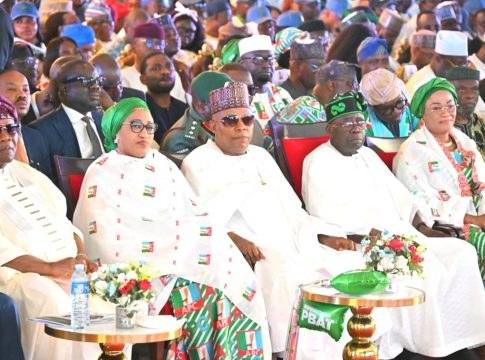
Tinubu’s re-election machinery faces a test beyond endorsements, political defections and crowd mobilisation as poverty, insecurity and declining purchasing power reshape Nigerians’ expectations of leadership
The inauguration of the All Progressives Congress (APC) Presidential Campaign Council for President Bola Tinubu’s re-election on Wednesday was designed to demonstrate political strength, organisational capacity and the breadth of support behind the President’s second-term ambition. The gathering of governors, ministers, legislators, party chieftains and influential politicians from outside the APC provided an imposing picture of a ruling party preparing early for a fiercely contested election.
Yet beneath the spectacle lies a more consequential question: does the assembly of political heavyweights necessarily translate into the confidence of ordinary Nigerians, many of whom are struggling to feed their families, pay rent, transport their children to school and meet increasingly expensive healthcare needs?
This is where the political implications of the inauguration become more profound than the ceremony itself. Nigeria’s electoral politics is approaching a point at which the traditional mobilisation of influential politicians, the distribution of campaign materials, the organisation of rallies and the transportation of supporters to polling units may no longer be sufficient to establish a convincing claim to popular consent.
The APC may possess an extensive political network, but the strength of that network must ultimately be tested against the lived experiences of voters. The central question is no longer simply how many governors, ministers or former opposition figures stand behind Tinubu. It is whether the government’s record gives ordinary citizens sufficient reason to renew its mandate.
The Politicians Are United, But What About the People?
The appearance of Anambra State Governor Chukwuma Charles Soludo of the All Progressives Grand Alliance, Osun State Governor Ademola Adeleke of the Accord Party and Federal Capital Territory Minister Nyesom Wike, a prominent Peoples Democratic Party figure, added political significance to the inauguration.
Their declarations of support suggest that Tinubu’s campaign is seeking to extend its reach beyond the APC’s formal membership. Such alliances can provide access to political networks, experienced campaigners and influential local structures. They can also help a presidential candidate communicate with constituencies that might otherwise be difficult to reach.
But political endorsements are not the same as popular endorsements.
A governor’s declaration does not automatically become the declaration of every citizen in his state. A party leader’s political calculation does not necessarily reflect the preference of every party member. Nor does the participation of an influential politician guarantee that voters who supported a different candidate in 2023 will abandon their earlier preferences.
The assumption that political leaders can transfer their supporters to a presidential candidate without resistance underestimates the growing independence of the Nigerian electorate. Voters may respect their governors while disagreeing with their presidential preferences. They may also appreciate particular government projects without believing that the President deserves another term.
This distinction is particularly important in a political environment where economic hardship has made the consequences of government decisions increasingly personal.
A trader whose working capital has been eroded by rising operating costs, a civil servant whose salary no longer covers essential expenses, an unemployed graduate and a farmer struggling with transportation and input costs may assess political leadership differently from the calculations of party elites.
For such citizens, the most important campaign message may not be the number of influential people endorsing a candidate, but what that candidate can demonstrate about the condition of their lives.
Poverty Is Becoming an Electoral Question
The economic circumstances surrounding the campaign cannot be treated as a secondary consideration.
The World Bank’s October 2026 Nigeria Development Update acknowledges improvements in economic growth and public finances but stresses that the next priority is translating macroeconomic stability into inclusive growth, job creation, poverty reduction and better livng standards. The bank reported that economic growth reached 4.2 per cent in the first half of 2026, while warning that inflation remained elevated and continued to weigh on household purchasing power.
These findings capture the fundamental tension confronting the Tinubu administration. Economic indicators may show improvement, and reforms may strengthen government revenue or investor confidence, but the political value of those achievements depends substantially on whether ordinary Nigerians experience their benefits.
For a family that spends most of its income on food, transportation and accommodation, the distinction between economic recovery and personal recovery is crucial. A stronger external reserve position cannot, by itself, pay school fees. Higher government revenue does not automatically guarantee affordable food. Increased investment does not necessarily translate into jobs for unemployed young people unless it expands productive economic activity.
The World Bank has emphasised that improved public finances must be accompanied by more effective spending and better delivery of health, education and other essential services. Its October assessment also highlights the importance of how state governments use increased revenues to improve development outcomes.
This is where the APC’s campaign faces a demanding test. It must explain not only what the administration has done to stabilise the economy but also why many citizens continue to experience economic insecurity and what concrete measures will improve their circumstances.
The removal of the petrol subsidy and the foreign exchange reforms were presented as necessary steps towards correcting structural distortions. The government and its supporters argue that abandoning reform could recreate old economic problems. Critics counter that the burden has fallen disproportionately on citizens who have limited savings, low incomes and inadequate social protection.
A serious campaign must confront both sides of this argument. It cannot dismiss economic hardship merely by pointing to growth figures, just as the opposition cannot establish the superiority of an alternative simply by condemning existing policies.
The electorate deserves evidence, credible proposals and a clear explanation of how economic recovery will reach households.
The Voter Is Not Merely A Crowd To Be Mobilised
Perhaps the most significant implication of the APC inauguration is what it reveals about the changing relationship between political organisations and citizens.
For decades, Nigerian election campaigns have frequently depended on political patrons, established party structures, influential community figures and the ability to assemble large crowds. These remain important features of electoral competition, but their effectiveness should not be confused with proof of genuine voter commitment.
A crowd at a campaign rally may contain enthusiastic supporters, curious onlookers, people attracted by the event and individuals motivated by material incentives. Its size cannot establish how people will vote in secret at the polling booth.
The same applies to political defections and endorsements. They demonstrate the choices of political actors, not necessarily the convictions of the electorate.
The real democratic test is whether voters can make independent choices without intimidation, inducement or pressure from those who control access to public resources and political opportunities.
This is why the notion of herding voters into polling booths, where they participate without exercising a genuinely independent choice, deserves serious scrutiny. An election should not become a ritual in which citizens are mobilised to validate decisions already shaped by political elites.
The purpose of voting is not simply to produce turnout figures. It is to allow citizens to choose their leaders, assess competing programmes and hold officeholders accountable.
Yiaga Africa’s National Voting Intentions Survey, conducted in September 2026 across the 36 states and the Federal Capital Territory, illustrates the importance of these issues. Its published findings indicate that economic concerns, demand for political change, insecurity and questions about electoral integrity feature prominently in respondents’ attitudes towards the 2027 election. The survey also identifies concerns about vote-buying and institutional trust. <Cite refs={["turn519882search2"]}/>
These findings do not establish how every Nigerian will vote, nor do they determine the election’s outcome. They do, however, reinforce the need to distinguish between a campaign’s organisational strength and the public’s willingness to support its candidate.
The implication for the APC is clear: a formidable campaign structure may facilitate mobilisation, but it cannot substitute for public confidence.
Money Politics May Not Be Enough
Economic hardship creates conditions in which vote-buying and transactional politics can become particularly troubling.
When citizens struggle to meet basic needs, immediate financial inducements may become attractive, especially where political promises have repeatedly failed to improve their circumstances. A voter facing hunger or urgent medical expenses may find it difficult to reject money offered during an election campaign.
Yet the acceptance of an inducement does not necessarily mean the voter has surrendered all political preferences. Citizens may collect campaign gifts and still make a different choice in the privacy of the voting booth. Conversely, financial pressure can undermine free choice when inducements, threats or dependency become instruments of political control.
This is why political parties should not assume that financial resources, campaign logistics or patronage networks guarantee electoral loyalty.
The APC’s extensive council may provide it with considerable organisational reach. But if citizens increasingly judge political parties by the cost of living, employment opportunities and personal security, a campaign built predominantly around elite endorsements could struggle to address the questions that matter most to voters.
The same warning applies to opposition parties. Criticising the ruling party will not automatically secure public support. Opposition candidates must demonstrate that their proposed policies are realistic, affordable and capable of producing better outcomes.
The electorate’s challenge is to resist being reduced to a collection of votes to be purchased, transported or counted. Its democratic strength lies in the ability to reward performance, reject failure and insist that political promises be subjected to scrutiny.
The Danger of Mistaking Political Alliances for Popular Consent
The presence of Soludo, Adeleke and Wike at the inauguration illustrates another feature of Nigerian politics: the distinction between party affiliation and individual political alignment.
Such arrangements are not inherently undemocratic. Politicians can legitimately support candidates outside their parties, and electoral alliances can create opportunities for cooperation across political boundaries.
The difficulty arises when elite agreements are presented as conclusive evidence of a broader popular mandate.
A governor may support Tinubu for reasons connected with policy, federal-state relations or personal political calculations. Voters in that governor’s state may assess the same President according to fuel prices, employment, infrastructure, security and the performance of the federal government.
These are different judgments, and a democratic system must allow both to coexist.
The APC should therefore resist the temptation to interpret the expanding list of political endorsements as proof that the electorate has already accepted its case for a second term. Such an assumption could encourage complacency and reduce the campaign’s incentive to address uncomfortable questions.
The opposition, meanwhile, should not assume that elite defections or criticism of the ruling party automatically represent a groundswell of public support for its own candidates.
Only a credible electoral process can determine the preferences voters ultimately express.
From Campaign Promises to Accountability
Tinubu’s instruction that campaign leaders must deliver votes at the ward level reveals the importance attached to grassroots organisation. But there is a difference between delivering votes as a political target and earning votes through public confidence.
The former can become an exercise in managing political structures. The latter requires sustained engagement with citizens, credible policies and demonstrable results.
If the administration believes its reforms are working, the campaign should explain the evidence, acknowledge the costs and show how further progress will improve living conditions. It should provide clear answers on employment, food affordability, insecurity, public healthcare, education and the effectiveness of social protection.
It should also explain how increased public revenue is being translated into better services and what mechanisms will ensure that funds allocated to development reach their intended beneficiaries.
These questions are especially relevant because the World Bank’s October assessment places greater emphasis on inclusive growth and effective public spending as the next phase of Nigeria’s economic recovery.
The opposition must meet a similar standard. It should explain how its economic proposals would work, what they would cost and how it would protect vulnerable citizens while maintaining fiscal sustainability.
A mature election should offer voters a meaningful choice between competing ideas and records, rather than a contest dominated by personality, patronage and accusations.
2027 Must Be About The Voter’s Choice
The inauguration of the APC Presidential Campaign Council is an important organisational milestone, but its political significance will ultimately depend on how the party responds to the electorate’s concerns.
The council may assemble influential politicians, coordinate campaign activities and expand the President’s political network. None of these achievements, however, can guarantee that Nigerians will renew his mandate.
Widespread poverty, persistent economic insecurity and public dissatisfaction make it essential for the ruling party to demonstrate that the benefits of reform are becoming tangible. They also make it necessary for opposition parties to offer credible alternatives rather than assume that frustration with the government will automatically deliver victory.
Above all, the 2027 election must be more than a demonstration of which party can assemble the largest political machinery.
Nigerians must be able to participate freely, evaluate competing candidates, reject inducements and intimidation, and vote according to their convictions. Electoral authorities must protect the integrity of the process, while political parties must respect the independence of voters and accept legitimate outcomes.
The real measure of a campaign is not how many powerful people stand beside its candidate, how many supporters attend its rallies or how many vehicles transport voters to polling units.
It is whether citizens freely choose that candidate because they believe the record justifies another mandate.
The era in which political mobilisation could be mistaken for popular consent must give way to an election culture in which the voter, not the political godfather, is sovereign. For Tinubu and the APC, the challenge is not merely to assemble a winning campaign structure but to persuade Nigerians that another four years would serve their interests. That argument must be made through policies, evidence and accountability—not the assumption that political alliances can substitute for the people’s verdict.