 PublicSphere Live
Capital Market
NGX: Equities Market Ends Week Lower as ASI Sheds 0.33%, Investors Take Cautious Position
Although the number of advancing equities exceeded decliners on Friday, the marginal decline in the ASI suggested that gains in the broader market were not sufficiently concentrated in stocks with enough index weight to push the benchmark higher.
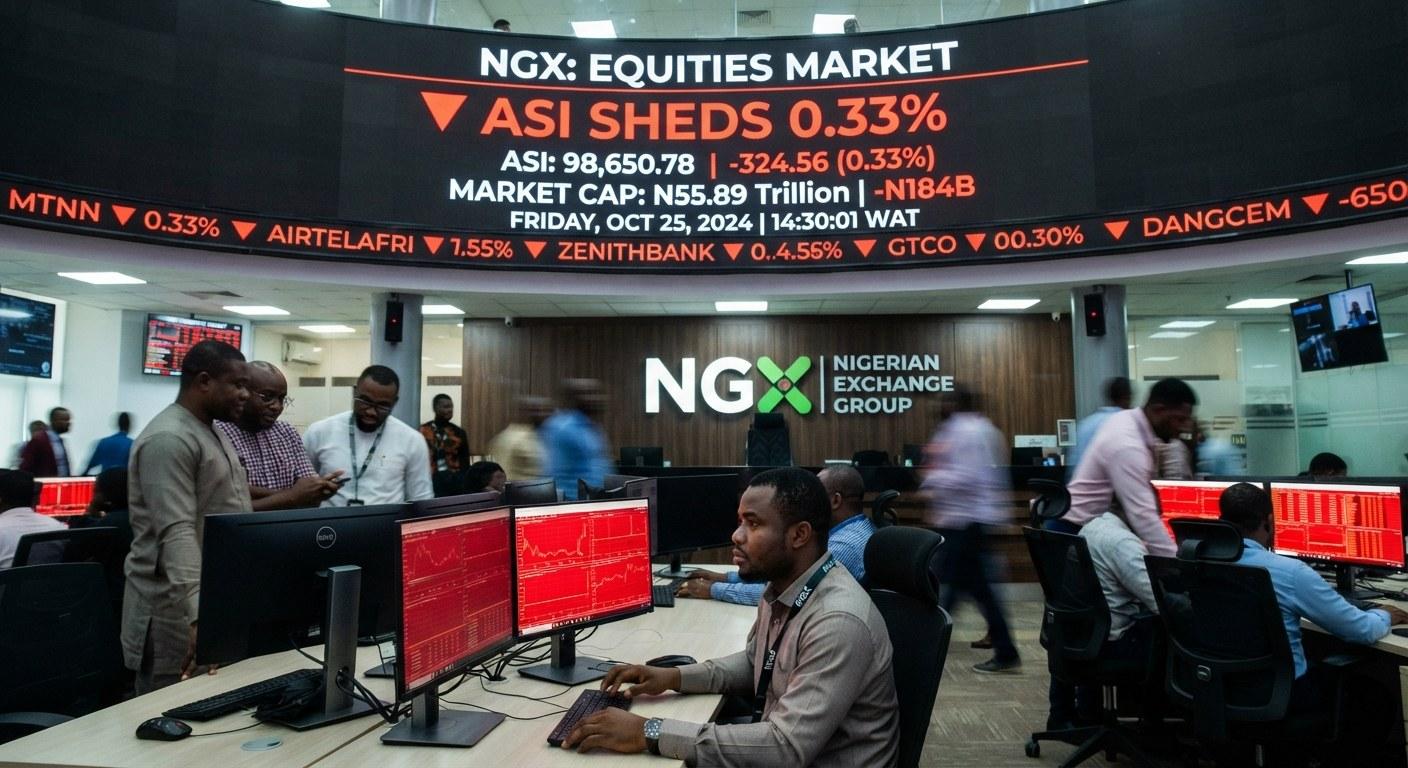
Nigeria’s equities market ended the trading week on Friday, October 16, 2026, on a mildly bearish note, as the benchmark All-Share Index (ASI) recorded a marginal daily decline and finished the week in negative territory, despite maintaining a substantial year-to-date gain of 59.07 per cent.
The performance reflected a market in which buying interest remained selective, with gains in some consumer goods and premium-listed stocks failing to offset weakness in several other market segments. Although the number of advancing equities exceeded decliners on Friday, the marginal decline in the ASI suggested that gains in the broader market were not sufficiently concentrated in stocks with enough index weight to push the benchmark higher.
Trading activity also weakened compared with Thursday, with both the volume and monetary value of transactions declining, even as the number of deals increased. This combination suggests that investors executed more transactions involving a lower aggregate volume and value of shares, although the figures alone do not establish whether the change resulted from smaller orders, shifts in the stocks traded or a broader reduction in institutional participation.
The market's performance therefore presents a mixed picture: short-term weakness, a still-positive four-week trajectory and a strong cumulative advance since the beginning of the year. With market capitalisation standing at approximately ₦160.7 trillion, equivalent to $121 billion, investors have substantial gains to protect while assessing the sustainability of the rally.
ASI's Daily Decline Contrasts With Strong Year-To-Date Return
The NGX All-Share Index closed at 247,539.73 points, shedding 167.40 points, or 0.07 per cent, from the previous session. While the daily decline was modest, the benchmark's 0.33 per cent loss for the week indicates that the market struggled to sustain upward momentum over the five trading sessions.
The ASI remains, however, one of the clearest indicators of the remarkable gains accumulated by Nigerian equities in 2026. Its year-to-date appreciation of 59.07 per cent shows that investors who entered the market earlier in the year have enjoyed significant capital appreciation, notwithstanding recent fluctuations.
The four-week performance was also positive, with the index advancing 0.5 per cent over the period. This suggests that the weekly decline has not yet overturned the broader short-term advance.
Nevertheless, the gap between the strong year-to-date return and the weaker weekly performance deserves attention. Markets that have recorded substantial gains can become vulnerable to profit-taking as investors seek to secure returns, particularly when share prices have risen faster than underlying corporate earnings or when valuations begin to look demanding.
The latest figures do not establish that profit-taking was the principal cause of Friday's decline, but they are consistent with a market experiencing some hesitation after a substantial rally.
For investors, the immediate question is whether the ASI can regain upward momentum or whether the market will spend more time consolidating its gains. A sustained recovery would require stronger buying interest across heavyweight equities, while continued weakness in leading stocks could keep the benchmark under pressure even when a reasonable number of smaller companies advance.
Trading Activity Declines As Investors Exchange Fewer Shares
The NGX recorded 257,669,053 shares traded in 31,972 deals, with a total transaction value of approximately ₦13.04 billion on Friday.
Compared with Thursday, October 15, trading volume declined by 10 per cent, turnover fell by 14 per cent, while the number of deals increased by 6 per cent.
The reduction in turnover was greater than the decline in volume, indicating that the aggregate value of shares traded fell more sharply than the number of shares exchanged. This could reflect changes in the mix of stocks traded or the prices at which transactions occurred.
The increase in deals, meanwhile, suggests that trading activity remained reasonably broad in terms of transaction count. However, a higher number of deals does not necessarily mean that more investors participated, because a single investor can execute multiple transactions and individual deals can vary substantially in size.
The figures point to a market with continued transactional activity but lower overall trading value. Whether this reflects temporary caution or a more sustained reduction in demand will become clearer from subsequent sessions.
The market also recorded 134 equities participating in trading, with 26 gainers and 23 losers. This means that advancing stocks outnumbered declining stocks by three, while the remaining 85 equities did not fall into either category of gainers or losers based on the supplied summary.
That distribution offers an important counterpoint to the ASI's decline. The broader count of advancing stocks was positive, but it did not translate into an increase in the benchmark index. This can happen when stocks with relatively small index weight appreciate while larger or more influential equities weaken.
The lesson is that market breadth and index performance must be examined together. A positive balance of gainers does not automatically mean that the market's total capitalisation or benchmark index will rise.
Market Capitalisation Holds At ₦160.7 Trillion
The NGX's market capitalisation stood at approximately ₦160.7 trillion, or $121 billion, at the close of Friday's trading.
This valuation reflects the considerable expansion in the Nigerian equities market over the course of the year. It also highlights the growing importance of equities as a component of the country's investment landscape.
However, market capitalisation should not be confused with the amount of cash invested in the market or the money available to investors for withdrawal. It represents the market value of listed shares, calculated using their prevailing prices and applicable share counts.
The relatively stable headline valuation alongside the marginal ASI decline suggests that the market's overall position remained broadly intact at the end of the week. Yet, the significance of the ₦160.7 trillion figure lies less in its size alone than in whether listed companies can sustain the earnings growth, dividend payments and corporate governance standards needed to support valuations over time.
The market's substantial year-to-date advance provides a strong foundation for optimism, but maintaining investor confidence will require continued improvements in corporate performance, transparency and the broader economic environment.
Gainers And Losers: Selective Buying Continues
Friday's individual stock performance revealed significant price movements among some of the market's smaller or less heavily weighted equities.
Thomas Wyatt Nigeria led the gainers, appreciating by 10 per cent to close at ₦2.42 per share. E-Tranzact International followed with a gain of 9.84 per cent, while Austin Laz & Company rose by 9.77 per cent. Omatek Ventures advanced by 9.59 per cent.
These gains demonstrate that investors continued to identify opportunities in individual stocks despite the marginal decline in the benchmark index.
However, a sharp one-day increase should not, on its own, be interpreted as evidence of a lasting change in a company's fundamentals. Investors need to examine trading liquidity, corporate announcements, financial results, valuation and the sustainability of demand before deciding whether such movements represent durable investment opportunities.
On the losing side, UPDC Real Estate Investment Trust recorded the steepest decline, shedding 10 per cent to close at ₦21.15 per share. Trans-Nationwide Express lost 9.09 per cent, Critical Minerals Financing Corporation declined by 8.06 per cent, and Royal Exchange fell by 6.48 per cent.
The divergence between the strongest gainers and losers illustrates the selective nature of trading. Even in a market that has delivered impressive aggregate returns, individual securities can experience sharp reversals.
Investors should therefore distinguish between the direction of the overall market and the prospects of individual companies. The ASI provides a useful benchmark, but it cannot substitute for company-specific analysis.
UBA, Zenith Bank And GTCO Lead Volume Activity
United Bank for Africa recorded the highest trading volume on Friday, with approximately 28.3 million shares exchanged. Zenith Bank followed with 16.5 million shares, Livestock Feeds recorded 16.4 million shares, and Guaranty Trust Holding Company traded 14.5 million shares.
The prominence of UBA, Zenith Bank and GTCO is noteworthy because banking stocks are important components of the Nigerian equities market. Their trading activity can provide useful indications of investor interest in the financial services sector.
However, volume alone does not establish whether a stock attracted net buying or selling pressure. A share can record high trading volume even when its price declines, because every completed transaction involves both a buyer and a seller.
To determine whether activity in these stocks supported the market, investors would need to consider their respective closing prices, percentage changes, transaction values and contributions to the benchmark index.
The presence of Livestock Feeds among the most actively traded equities also suggests that investor activity was not confined to banking stocks. Nevertheless, without the company's closing performance and corresponding sector data, it would be premature to draw broader conclusions about the direction of demand in the agricultural or consumer-related segments.
Sectoral Performance: Consumer Goods And Premium Stocks Provide Support
The sectoral and specialised index figures supplied for Friday show a mixed performance across the market. Consumer goods and premium-listed equities recorded gains, while the Top 30 and insurance indices declined. Oil and gas was broadly flat on the day, while the industrial index was reported as approximately unchanged.
The NGX Consumer Goods Index gained 0.08 per cent on Friday, added 0.09 per cent over the week and stood 1.55 per cent higher year to date.
Selected NGX Indices: Year-to-Date Performance
Year-to-date percentage changes reported for Friday, October 16, 2026.
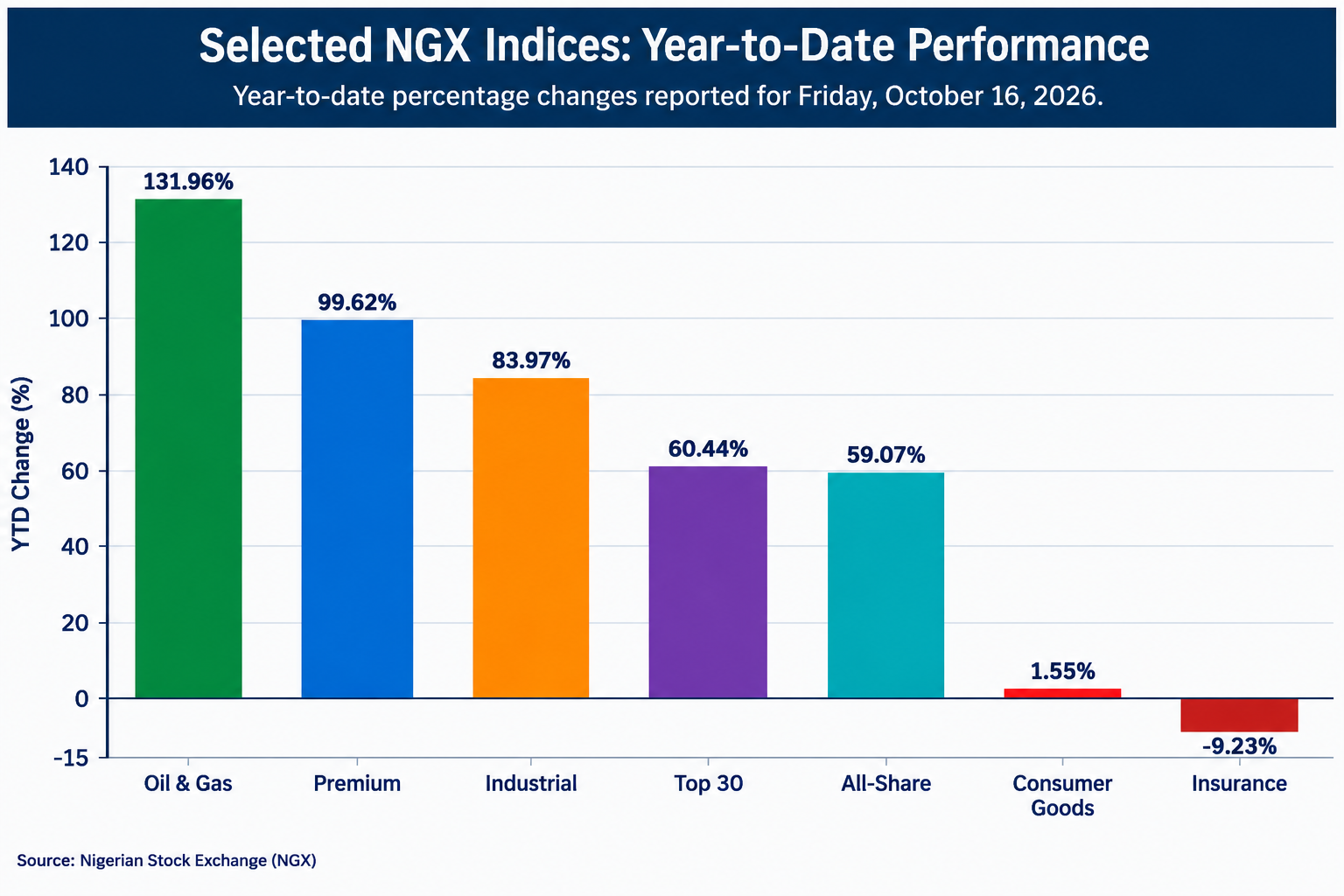
The consumer goods index's positive weekly performance indicates that the segment maintained a modest upward bias. Yet, its 1.55 per cent year-to-date return is considerably below the broader market's 59.07 per cent advance.
This divergence raises questions about the distribution of market gains. Consumer-facing companies operate in an environment where household purchasing power, production costs, foreign-exchange exposure and the price of essential inputs can influence margins and demand. For investors, the key consideration is whether improving operating conditions can translate into stronger earnings and valuations.
The NGX Premium Index gained 0.06 per cent on Friday but lost 1.5 per cent over the week. Its year-to-date return of 99.62 per cent nevertheless places it among the strongest-performing indices in the supplied figures.
This combination of a small daily gain and a negative weekly return suggests that the latest session's improvement was not sufficient to reverse the week's losses. Its substantial year-to-date appreciation also makes it important for investors to assess valuation risks and the sustainability of the gains.
The NGX Top 30 Index declined by 0.09 per cent on Friday and lost 0.41 per cent during the week. Its year-to-date gain remained strong at 60.44 per cent.
The Top 30's daily decline, which was slightly greater than that of the ASI, suggests that the larger constituents represented by this index did not provide sufficient support to lift the broader benchmark. Nevertheless, the index's year-to-date advance remains broadly comparable to the ASI's performance.
The NGX Oil & Gas Index was reported as approximately unchanged on Friday. It recorded a 3.13 per cent weekly gain and a remarkable 131.96 per cent appreciation year to date, the strongest performance among the indices listed in the supplied data.
The sector's exceptional cumulative return points to the importance of oil and gas equities in the market's 2026 rally. However, investors should not assume that all companies in the sector have performed equally well or that further gains are assured. Company earnings, production levels, energy prices, operating costs, regulatory developments and capital expenditure requirements remain relevant to valuations.
The NGX Industrial Index was also reported as approximately flat on Friday, with a year-to-date gain of 83.97 per cent. That cumulative performance indicates that industrial equities have been an important contributor to the year's broader market advance.
Industrial companies can benefit from infrastructure investment, construction demand and improvements in domestic production, but their performance depends on factors including energy costs, access to foreign exchange, financing expenses and the ability to pass higher costs on to customers.
The NGX Insurance Index declined by 0.05 per cent on Friday and lost 0.14 per cent for the week. Its year-to-date performance remained negative at -9.23 per cent.
Insurance was therefore the weakest-performing sectoral index among those for which year-to-date figures were supplied. Its performance contrasts sharply with the oil and gas, industrial and premium indices.
The sector's weakness warrants attention, although the figures alone cannot explain its causes. Investors should examine underwriting performance, investment income, capital adequacy, claims experience, regulatory requirements and the implications of industry recapitalisation for individual companies.
An important qualification: the supplied market summary does not include the Friday figures for every NGX sectoral index. Consequently, the analysis above covers all sectoral indices and specialised indices for which figures were provided, rather than claiming to represent a complete ranking of every sector on the exchange.
Weekly Scorecard Shows A Market of Contrasts
The week's performance can be summarised by three competing forces: a marginal decline in the benchmark, substantial cumulative gains in several indices and uneven returns across sectors.
The ASI's 0.33 per cent weekly loss suggests that investors were unwilling or unable to sustain the market's upward momentum through the final session of the week. The positive four-week return of 0.5 per cent, however, indicates that the latest setback has not erased the preceding month's gains.
The year-to-date picture is more striking. Oil and gas gained 131.96 per cent, the Premium Index advanced 99.62 per cent and the Industrial Index appreciated by 83.97 per cent. The Top 30 Index and the ASI also delivered strong gains of 60.44 per cent and 59.07 per cent respectively.
The insurance index, by contrast, remained down 9.23 per cent for the year, while consumer goods recorded a much more modest gain of 1.55 per cent.
These differences demonstrate why investors should look beyond the headline ASI when evaluating portfolio performance. A portfolio concentrated in the year's strongest-performing sectors may have delivered returns substantially different from one invested in weaker segments. Actual outcomes would also depend on individual stock selection, purchase prices, dividends, transaction costs and portfolio weights.
Outlook: Can The Market Regain Its Momentum?
The outlook for the coming week will depend on whether investors return to heavyweight equities, whether trading activity strengthens and whether the market's recent weakness spreads beyond the stocks that have experienced losses.
A recovery in the ASI would be more convincing if accompanied by stronger turnover, sustained demand for fundamentally sound companies and broader participation across sectors. A rebound driven by a few stocks with limited participation elsewhere would be less persuasive as evidence of a market-wide recovery.
Investors should also monitor corporate earnings, dividend announcements, interest-rate expectations, inflation developments, foreign-exchange conditions and policy decisions that could influence the attractiveness of equities relative to fixed-income investments.
Following a year-to-date ASI gain of 59.07 per cent, valuation discipline is particularly important. Strong historical returns can encourage excessive optimism, but they do not guarantee that share prices will continue rising at the same pace. Investors should assess earnings growth, cash flow, debt levels, dividend sustainability and management quality rather than buying stocks simply because their prices have increased.
For long-term investors, temporary market weakness may create opportunities to acquire fundamentally sound equities at more attractive prices. Such opportunities, however, should be established through company-level analysis rather than assumed from a falling index alone.
Short-term traders, meanwhile, should remain alert to volatility and avoid interpreting isolated price increases as confirmation of a sustained rally.
Conclusion
The Nigerian equities market ended Friday, October 16, 2026, with a modest decline in the All-Share Index and a 0.33 per cent loss for the week. Lower trading volume and turnover pointed to reduced aggregate market activity, even as the number of deals increased.
Yet, the broader picture remains positive. The ASI is up 59.07 per cent year to date, while oil and gas, premium-listed equities and industrial stocks have recorded particularly strong gains. Consumer goods maintained a modest positive trajectory, whereas insurance continued to lag.
The central issue for the coming weeks is whether the market can translate its impressive cumulative returns into a more sustainable advance supported by corporate earnings, stronger participation and disciplined valuations.
For now, Friday's session points to a market taking a breather rather than one whose longer-term direction has been conclusively reversed. The next trading sessions will help determine whether the weekly decline represents temporary consolidation or the beginning of a more extended correction.