 PublicSphere Live
Editorial
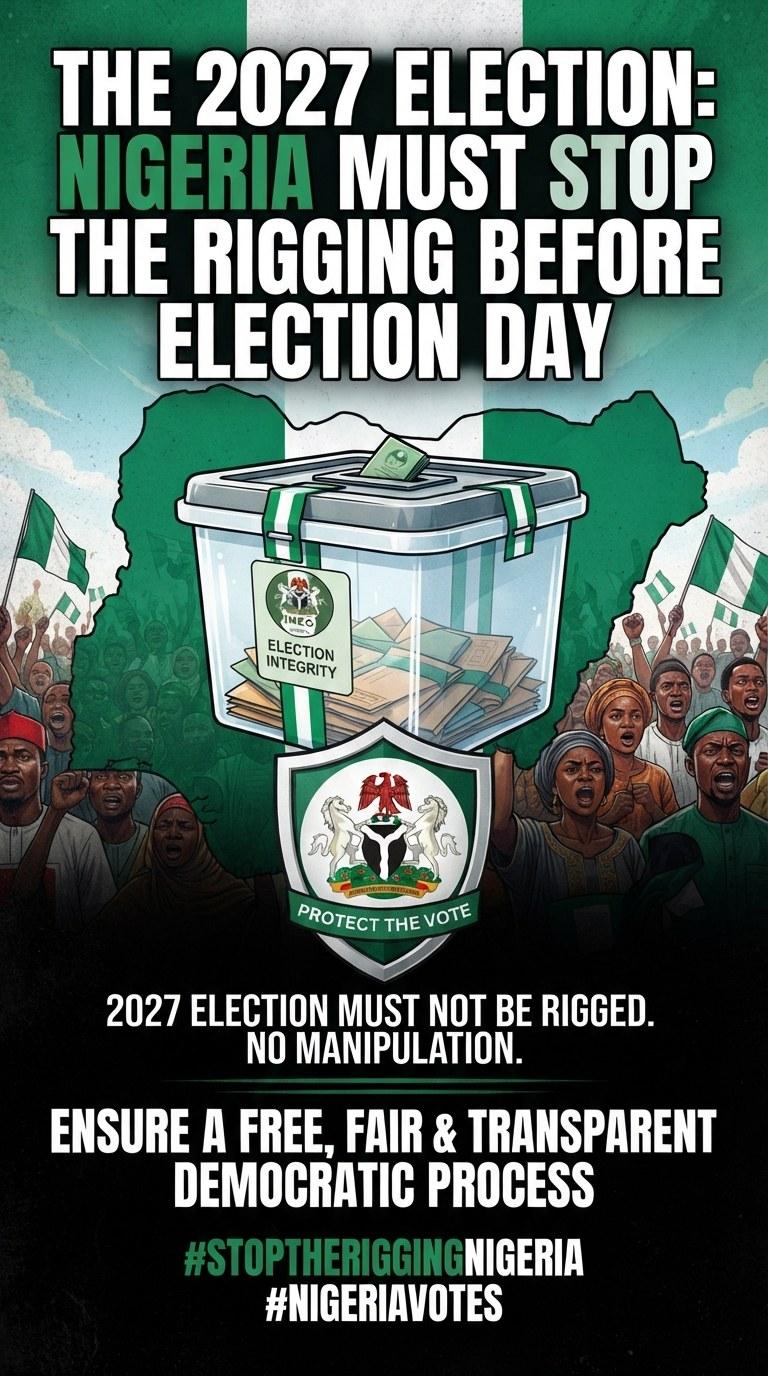
EDITORIAL: The 2027 Election: Nigeria Must Stop the Rigging Before Election Day
Rather, it must be treated as a serious call for investigation, transparency and preventive action. In matters concerning the integrity of elections, waiting until the damage becomes irreversible is an unforgivable gamble with democracy.

Nigeria cannot afford another electoral season in which the credibility of the ballot is sacrificed on the altar of political desperation. The warning alleged to havebeen raised by Channels Television journalist, Seun Okinbaloye, that the 2027 general election may already be compromised through alleged manipulation of the voters' register deserves the urgent attention of the Independent National Electoral Commission (INEC), political parties, civil society organisations and, above all, Nigerians.
It is a warning that should neither be dismissed as journalistic alarmism nor accepted as conclusive proof of an established conspiracy. Rather, it must be treated as a serious call for investigation, transparency and preventive action. In matters concerning the integrity of elections, waiting until the damage becomes irreversible is an unforgivable gamble with democracy.
Okinbaloye raised the alarm on Friday night during Channels Television's Politics Today, alleging that politicians had begun laying the groundwork for electoral manipulation through underage registration, multiple registrations and the inclusion of fictitious or otherwise ineligible voters in the national register.
His central argument was both disturbing and deserving of reflection: the 2027 election may not necessarily be compromised on the day Nigerians troop out to vote. The manipulation, if the allegations are substantiated, could begin much earlier, through the systematic distortion of the instrument upon which the entire electoral process rests.
That instrument is the voters' register.
The significance of this warning cannot be overstated. An election is only as credible as the processes through which eligible citizens are identified, accredited and permitted to exercise their constitutional right to vote. Where the register is defective, the consequences may extend beyond administrative irregularities. It could create opportunities for impersonation, multiple voting, ballot stuffing and the artificial inflation of electoral figures.
In other words, the sanctity of the ballot cannot be guaranteed where the foundation upon which voting rests has been compromised.
The Warning Is No Longer Theoretical
What makes Okinbaloye's intervention particularly significant is that concerns about the voters' register are no longer confined to political speculation or social media conjecture. INEC itself has acknowledged the discovery of questionable entries, including photographs suspected to have been generated through artificial intelligence.
In a report published on October 30, 2026, The Guardian reported that INEC's Director of Information and Communication Technology, Dr Lawrence Bayode, disclosed that some registration officers allegedly used their official login credentials to introduce AI-generated photographs and other questionable records into the preliminary register. The commission said its Automated Biometric Identification System helped uncover the irregularities.
This revelation is profoundly troubling. It raises questions not merely about the existence of suspicious records, but also about the conduct of personnel entrusted with protecting the integrity of the electoral database. If those responsible for administering the registration process are themselves implicated in introducing questionable entries, the problem becomes considerably more serious.
The commission must therefore go beyond identifying suspicious photographs. It must establish how the records were created, who authorised them, whether the identities correspond to actual Nigerian citizens, whether the entries were intended to facilitate electoral fraud and whether any political actors or external networks were involved.
There must be no institutional concealment, selective investigation or administrative sleight of hand.
Equally important is the latest disclosure by INEC Chairman, Professor Joash Amupitan, that the commission had received more than 4,800 claims and approximately 600 objections concerning the preliminary voters' register. These submissions emerged from the inspection exercise conducted across the country and through electoral officials. INEC has indicated that discrepancies will be addressed before certification of the final register on December 15, 2026.
These figures demand careful examination. Not every claim represents evidence of fraud; some may concern legitimate corrections, omissions or errors in personal particulars. Nevertheless, the volume of complaints reinforces the necessity for a rigorous verification exercise.
INEC must not mistake the submission of complaints for their resolution. The real test is whether every substantiated objection is investigated and every fraudulent entry removed before the register becomes the definitive instrument for the 2027 elections.
The commission has already made the preliminary register available online in addition to its physical display, an important opportunity for greater public scrutiny. That opportunity must be accompanied by an effective mechanism for receiving complaints, tracking their resolution and communicating the outcome to affected citizens.
The Political Class Must Not Be Allowed To Subvert The Ballot
There is a particularly dangerous dimension to the allegations raised by Okinbaloye: the possibility that political actors may be attempting to manipulate the electoral process long before the official commencement of campaigns.
Nigeria's political history offers sufficient reasons for vigilance. The struggle for political power has, on several occasions, been accompanied by allegations of electoral malpractice, manipulation of voting figures, intimidation, vote buying and the abuse of state institutions. These experiences have progressively weakened public confidence in the electoral system.
Yet democracy cannot survive on the strength of political slogans, elaborate campaign rallies or the theatrical display of popular support. Its legitimacy derives from the freely expressed choices of citizens and the assurance that every eligible vote counts equally.
A politician who cannot persuade voters through ideas, competence, character and a demonstrable commitment to public welfare has no legitimate business seeking advantage through manipulation of the electoral machinery.
The voters' register must never become a clandestine instrument of political warfare.
Under the provisions of the Electoral Act 2022, a person must be a Nigerian citizen who has attained the age of 18 to qualify for registration. The law also prohibits registration more than once. These are not optional administrative guidelines; they are fundamental safeguards against the distortion of the electorate.
Underage registration is particularly objectionable because it undermines the constitutional principle that electoral participation belongs to citizens who have attained the legally prescribed age. Multiple registration is equally unacceptable because it creates opportunities for the multiplication of voting identities and compromises the principle of one eligible voter, one vote.
The appearance of fictitious identities, if established, would represent an even more sinister threat. It could provide the raw material for electoral impersonation and other forms of fraud.
However, Nigerians must distinguish between suspicious entries, administrative mistakes and proven attempts at electoral manipulation. Every allegation must be investigated, documented and established through credible evidence. Accusations against individuals or political parties should not substitute for forensic examination.
The objective is not to manufacture political enemies. It is to protect the Nigerian electorate from anyone who seeks to deprive it of its constitutional choice.
INEC Must Demonstrate That It Is In Control
The responsibility resting on INEC at this moment is enormous. It is not enough for the commission to issue reassuring statements about its preparedness for the elections. Nigerians require demonstrable evidence that the institution possesses the independence, technological capacity, administrative discipline and institutional courage to confront electoral malpractice, irrespective of where it originates.
The commission must understand that credibility is not acquired through declarations of neutrality. It is earned through transparent decisions, impartial enforcement of electoral laws and the willingness to expose wrongdoing, even when doing so may offend powerful political interests.
The discovery of questionable photographs and registration records should trigger an independent forensic audit of the preliminary register. Such an exercise should examine biometric duplicates, suspicious registration patterns, questionable dates of birth, multiple identities and unusual concentrations of registrations in particular locations.
INEC should also publish periodic reports explaining the nature of discrepancies discovered, the number of entries investigated, the number removed and the corrective measures taken. Where registration officials are found culpable, disciplinary action and prosecution should follow in accordance with the law.
The commission should not be permitted to investigate itself without adequate external scrutiny. Independent electoral experts, accredited civil society organisations, political parties and credible technology professionals should be given appropriate opportunities to observe the verification process.
Furthermore, political parties must be granted access to the register in accordance with the law, enabling them to identify discrepancies and submit properly documented objections. Such access must, however, be governed by safeguards against the misuse of voters' personal information.
INEC must also protect its digital infrastructure against unauthorised access, manipulation and the possible abuse of official registration credentials.
The commission's own admission that questionable records were introduced by registration officers makes it imperative that accountability extends beyond the database to the human beings who operate it.
There must be consequences for electoral officials who compromise their responsibilities. Without accountability, technological sophistication becomes little more than an expensive ornament.
Nigerians Must Become Guardians Of Their Own Democracy
The responsibility for credible elections cannot be outsourced entirely to INEC. Nigerians must recognise that democracy is not a spectator sport in which citizens merely appear on election day, cast their ballots and disappear until the next electoral cycle.
The ongoing scrutiny of the voters' register presents an opportunity for citizens to become active participants in protecting their democratic rights.
Every registered voter should verify his or her particulars. Citizens should report suspicious entries, deceased persons whose names remain on the register, duplicate identities and other irregularities through the appropriate INEC channels.
Community organisations, professional associations, traditional institutions, religious bodies and civil society groups should encourage responsible participation in the verification process.
The media, too, must rise to the occasion. Okinbaloye's intervention illustrates the importance of investigative journalism and the responsibility of journalists to draw public attention to developments that may threaten democratic institutions.
But journalism must go beyond raising alarms. It must investigate, establish facts, demand explanations and follow up on the promises made by public institutions.
INEC should welcome legitimate scrutiny rather than regard it as hostility. An electoral commission that is confident in its processes should have nothing to fear from informed public examination.
Similarly, political parties must abandon the temptation to regard every electoral safeguard as an obstacle to their ambitions. Their representatives should participate in the verification process and cooperate with legitimate investigations.
The integrity of the register is not an APC issue, an opposition issue or a presidential campaign issue. It is a Nigerian issue.
No political party should be allowed to claim ownership of the electoral process, just as no individual seeking public office should enjoy immunity from scrutiny.
The 2023 Experience Must Not Be Repeated
The 2027 general election carries enormous significance for Nigeria's democratic future. The country is approaching another defining moment in its political evolution, with citizens expected to decide whether to renew the mandate of the incumbent administration or entrust national leadership to another political direction.
That decision must belong exclusively to the electorate.
The controversies surrounding the 2023 general election, particularly public dissatisfaction with aspects of the result-transmission process, demonstrated how quickly confidence in electoral institutions can deteriorate when citizens believe that the process has fallen short of expectations.
Nigeria cannot afford another election in which the credibility of the outcome becomes a subject of prolonged national dispute.
The consequences of a compromised electoral process extend far beyond the immediate political fortunes of candidates. They affect the legitimacy of government, public confidence in institutions, national cohesion, investor sentiment and the willingness of citizens to participate in democratic governance.
A government whose electoral mandate is persistently questioned may find it more difficult to command public confidence, regardless of the policies it subsequently introduces.
This is why the protection of the 2027 election must begin with the protection of the voters' register.
There is also a responsibility on political leaders to restrain their supporters from spreading unverified allegations, threatening electoral officials or inciting violence. The defence of democracy must not itself become an excuse for lawlessness.
The Time For Action Is Now
Okinbaloye's warning should serve as a national wake-up call. But the country must go beyond the rhetoric of electoral danger and insist on concrete institutional remedies.
INEC has a narrow but critical window before the certification of the final voters' register. Its December 15 deadline must not become an administrative formality through which unresolved discrepancies are hurriedly swept aside.
The commission must demonstrate that it has examined the complaints received, investigated suspicious entries, identified those responsible for deliberate wrongdoing and taken appropriate corrective action.
The National Assembly should exercise its oversight responsibilities, while security and law enforcement agencies must investigate credible evidence of organised attempts to compromise the electoral database.
Political parties must equally demonstrate that their commitment to democracy extends beyond the prospect of winning elections.
Above all, Nigerians must understand that electoral rigging is not restricted to the dramatic scenes of ballot snatching, violence and result alteration witnessed at polling stations. It can take more sophisticated forms, beginning with the manipulation of the information upon which the entire voting process depends.
A fraudulent name on a register, an underage identity, a duplicated biometric record or a fictitious voter may appear insignificant in isolation. Collectively, however, such irregularities could create opportunities for the distortion of electoral outcomes.
The country must not wait until January 2027, when voters are already at polling stations, before discovering that the foundations of the election have been compromised.
The ultimate responsibility of INEC is to guarantee that every eligible Nigerian has an equal opportunity to vote and that no ineligible person is permitted to distort that privilege.
The ultimate responsibility of politicians is to seek power through persuasion, not subterfuge.
And the ultimate responsibility of Nigerians is to refuse to surrender their democratic inheritance to those who may regard political office as a prize to be captured rather than a public trust to be earned.
Nigeria's democracy must not become a casualty of political desperation. The 2027 election belongs to Nigerians, not to the political class, not to INEC and certainly not to those who may contemplate manipulating the electoral machinery for personal advantage.
The ballot must remain the sovereign voice of the people. INEC must protect it, politicians must respect it, and Nigerians must defend it. The time to prevent electoral fraud is now, not after the damage has been done.
.