 PublicSphere Live
Business
ANALYSIS: The ₦1.35 Trillion Power Bill: Nigeria’s Manufacturing Sector at A Crossroads
The disclosure by the Manufacturers Association of Nigeria (MAN) that manufacturers spent an estimated ₦1.35 trillion on alternative power in 2025, up from ₦1.1 trillion in 2024, is more than another disturbing statistic about the operating environment
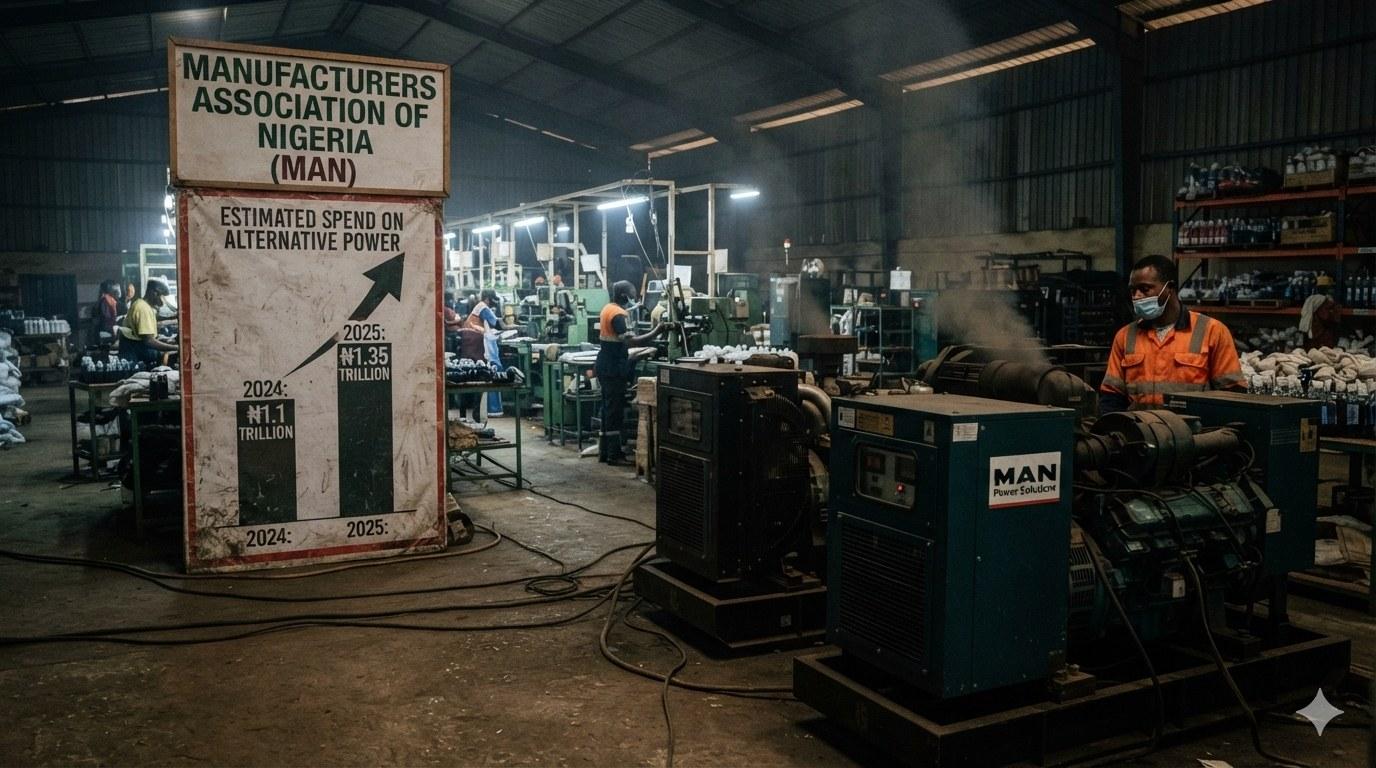
The disclosure by the Manufacturers Association of Nigeria (MAN) that manufacturers spent an estimated ₦1.35 trillion on alternative power in 2025, up from ₦1.1 trillion in 2024, is more than another disturbing statistic about the operating environment. It is a measure of the structural crisis confronting Nigerian industry and, perhaps more importantly, a warning that the country’s aspiration to become a serious manufacturing economy cannot be achieved while factories are compelled to spend an increasing proportion of their scarce capital merely to keep their machines running.
The 23 per cent increase in alternative-power expenditure is particularly troubling because it occurred in a year when manufacturers were already contending with higher financing costs, foreign-exchange pressures, logistics bottlenecks, regulatory charges and declining consumer purchasing power. In other words, the additional ₦250 billion spent on alternative energy was not an isolated increase in the cost of doing business. It was added to a formidable pile of expenses that manufacturers must absorb before they can even begin to think about expanding production, employing more workers, acquiring modern technology or entering new markets.
This is the fundamental contradiction in Nigeria's industrial story. The country wants manufacturing to become a larger contributor to economic growth, employment, exports and government revenue, yet the manufacturers who are expected to drive that transformation are being forced to provide privately what should ordinarily be supplied through an efficient national electricity system.
The Hidden Tax On Production
Electricity is not merely another input into manufacturing. It is the bloodstream of modern industry. A factory without dependable electricity cannot maintain predictable production schedules, operate sophisticated machinery efficiently or guarantee consistent quality. When electricity becomes unreliable, manufacturers have little choice but to invest in generators, diesel, gas-fired systems, solar installations, batteries and other alternative sources.
That expenditure represents a form of hidden tax on production.
A manufacturer who spends ₦1 billion on alternative power is not necessarily becoming more productive because of that expenditure. In many cases, the money is being spent simply to compensate for an inadequacy in the operating environment. Capital that could have gone into a new production line, research and development, worker training, warehouse expansion or export development is diverted into energy infrastructure.
The consequence is profound. When thousands of manufacturers make similar decisions, the economy effectively loses billions of naira in productive investment. What appears on the balance sheet of individual companies as energy expenditure becomes, at the macroeconomic level, a constraint on industrial expansion.
The concern expressed by MAN President Francis Meshioye that self-generation is becoming unsustainable should therefore not be dismissed as another complaint from the organised private sector. It goes to the heart of Nigeria's industrial competitiveness.
The Factory Cannot Carry Every Burden
Manufacturers are simultaneously confronting several pressures. Energy costs have risen, access to foreign exchange remains an important consideration for companies dependent on imported machinery and raw materials, financing remains expensive, logistics costs remain significant, while consumers themselves are struggling with reduced purchasing power.
This creates a dangerous chain reaction.
When production costs rise, manufacturers have three broad choices: absorb the increase, reduce production or pass some of the cost to consumers. Absorbing the entire increase reduces profitability and weakens the ability of companies to reinvest. Cutting production can lead to lower capacity utilisation and employment. Passing the cost to consumers contributes to higher prices at a time when household incomes are already under pressure.
There is therefore no painless option.
The significance of the ₦1.35 trillion figure lies partly in what it says about the cumulative effect of these pressures. A manufacturer may survive a single increase in energy costs, another increase in transportation, another increase in financing costs and another increase in raw-material prices. But when all of them occur simultaneously, the combined pressure can push even established companies towards retrenchment, downsizing or closure.
That is why the report of increased alternative-power spending alongside factory closures and production cuts deserves serious policy attention.
The Raw-Material Paradox
The second major warning in the MAN report concerns Nigeria's dependence on imported raw materials. Manufacturers reportedly imported approximately ₦3.53 trillion worth of raw materials in the first half of 2025, with about ₦1.72 trillion coming from Asia.
These numbers expose another structural weakness in the Nigerian industrial economy.
A country cannot easily become an industrial powerhouse when the factories within its borders remain heavily dependent on inputs produced elsewhere. Importing raw materials is not inherently negative. Every industrial economy imports some materials, machinery and intermediate goods. The problem arises when imports become indispensable because domestic supply chains are weak, underdeveloped or unable to meet the quantity, quality and consistency required by industry.
Nigeria possesses enormous agricultural, mineral and natural resources, yet a substantial portion of the value chain associated with those resources remains outside the country.
The implication is that Nigeria often occupies the least profitable position in its own resource economy: exporting raw or minimally processed commodities, importing processed products or industrial inputs, and then asking domestic manufacturers to compete against producers operating in countries with stronger infrastructure and cheaper production systems.
The challenge, therefore, is not simply to tell manufacturers to "buy Nigerian." The country must first create the conditions under which Nigerian inputs can compete with imported alternatives on price, quality, reliability and volume.
Industrial Policy Must Move Beyond Paper
This is where the newly approved national industrial policy becomes crucial.
Nigeria has never suffered from a shortage of policy documents. The country has produced numerous plans, strategies, frameworks and initiatives designed to stimulate industrialisation. The recurring problem has been implementation.
Meshioye's warning that policy adoption alone will not translate into industrial growth is therefore well founded.
Industrial policy must ultimately be measured by what happens inside the factory. Are electricity costs falling? Are production volumes increasing? Are local raw materials becoming more available? Are manufacturers obtaining affordable long-term financing? Are roads, ports and railways reducing logistics costs? Are regulatory agencies making business easier rather than more complicated? Are Nigerian products becoming competitive in regional and international markets?
These are the real tests.
A successful industrial policy cannot be judged by the elegance of its language or the number of committees established to implement it. Its success must be visible in factory floors, production lines, employment figures, export receipts and the ability of Nigerian manufacturers to compete against imported products.
Government As A Customer
The call for enforcement of Executive Orders 003 and 005 is another important aspect of the MAN position.
Government is one of the largest purchasers of goods and services in any economy. If government procurement consistently favours imported products when comparable Nigerian-made alternatives exist, the state is effectively using public money to strengthen foreign production at the expense of domestic industry.
The principle behind local procurement is therefore straightforward. Government spending should, where quality and value requirements are satisfied, help create demand for domestic production.
But enforcement must be credible.
If ministries, departments and agencies are required to prioritise locally manufactured goods, compliance cannot depend merely on goodwill. There must be transparent procurement standards, monitoring mechanisms and consequences for persistent violations. Otherwise, local-content policies will remain aspirational statements rather than instruments of industrial transformation.
The forthcoming electoral period provides another opportunity. Political parties and government institutions will inevitably spend substantial sums on campaign materials, clothing, printing, furniture, vehicles, technology and other supplies. A meaningful commitment to Nigerian manufacturing would require political actors to examine how much of that expenditure can be directed towards domestic producers.
The irony would be difficult to ignore if political parties campaigned on the promise of creating jobs for Nigerians while importing the very materials that could have been manufactured by Nigerian companies.
Capacity Utilisation Tells Only Part of The Story
The reported rise in manufacturing capacity utilisation from 51.33 per cent in the first quarter of 2025 to 57.50 per cent in the second quarter is encouraging, but it needs to be interpreted carefully.
On the surface, the improvement suggests that manufacturers were able to utilise a greater proportion of their installed capacity. That could indicate strengthening demand, improved operating conditions or better access to some critical inputs.
But capacity utilisation cannot be examined in isolation.
A factory can increase its utilisation rate while simultaneously facing rising costs and declining margins. It can produce more units but earn less per unit. It can operate its machines for longer periods while spending considerably more on electricity, fuel, transportation and financing.
The quality of industrial growth therefore matters as much as its quantity.
Nigeria needs manufacturers that are not merely producing more but producing competitively. The objective should be an industrial sector capable of generating sustainable profits, paying competitive wages, investing in technology, increasing exports and surviving without permanent dependence on government intervention.
The AFCFTA Test
The African Continental Free Trade Area presents perhaps the most important opportunity for Nigerian manufacturers, but it also exposes the weaknesses in the country's industrial structure.
Nigeria has one of Africa's largest consumer markets, a significant entrepreneurial population and a strategic geographical position. These advantages could allow Nigerian companies to become major suppliers to African markets.
But market size alone does not guarantee competitiveness.
As Meshioye correctly observed, Nigerian manufacturers must compete on cost, quality, standards, reliability and delivery. An African customer will not necessarily buy a Nigerian product simply because it is Nigerian. The product must offer value.
This is where the energy crisis becomes especially important. A manufacturer burdened by expensive self-generated electricity is already starting the race at a disadvantage. If that manufacturer also imports raw materials at elevated costs, pays expensive logistics charges and borrows money at high interest rates, competing with companies operating in countries with cheaper infrastructure becomes increasingly difficult.
AfCFTA could therefore become either a tremendous industrial opportunity or a painful reminder of Nigeria's lack of competitiveness.
The Way Forward
Nigeria's industrial challenge cannot be solved by one intervention. Electricity reform must proceed alongside improvements in gas supply, transmission and distribution. Domestic raw-material production must be strengthened through deliberate value-chain development. Financing for manufacturers must become more accessible and better suited to the long investment cycles associated with industry. Ports, roads and other logistics infrastructure must reduce rather than add to production costs.
Equally important, regulation must become predictable. Manufacturers need to know what rules apply to them and how those rules will be administered. Sudden changes in tariffs, taxes, levies or administrative requirements can make long-term investment decisions extremely difficult.
The government must also recognise that industrialisation requires patience. Factories cannot be built overnight, supply chains cannot be developed in a few months and technological capabilities cannot be created by decree.
The objective should be to create an environment in which the private sector has a rational incentive to invest for the long term.
The ₦1.35 trillion spent on alternative power in 2025 should consequently be viewed not simply as a statistic about manufacturers' expenses but as an economic signal. It represents resources that could have been deployed elsewhere in the industrial economy. It is evidence of the price companies are paying to remain operational in an environment where basic infrastructure remains unreliable.
Nigeria's ambition to become Africa's industrial hub will ultimately be determined not by declarations but by whether it can reduce the cost of production.
The country already has the entrepreneurs, the market, the natural resources and the geographical advantages. What it lacks is an operating environment that allows these advantages to translate consistently into competitive production.
The challenge before the Federal Government is therefore clear. The national industrial policy must move rapidly from policy document to measurable action. The power sector must deliver more reliable and affordable electricity. Local supply chains must be deepened. Government procurement must support domestic manufacturers. Finance must become more accessible, while logistics and regulation must stop eroding competitiveness.
Above all, Nigeria must abandon the assumption that manufacturers can indefinitely absorb the cost of fixing the country's structural deficiencies themselves.
A manufacturing economy cannot be built on generators alone. It cannot be built on imported raw materials alone. It cannot be built on government pronouncements alone.
It will be built when Nigerian factories can produce efficiently, competitively and consistently enough to satisfy Nigerian consumers and then compete successfully for customers across Africa and the wider world. The ₦1.35 trillion alternative-power bill is a reminder of how far the country still has to travel—and how urgently the journey must begin.