PublicSphere Live
Capital Market
Dangote Refinery IPO Breaks Nigerian, African Records, Extends Offer by Two Weeks
Dangote says subscriptions have exceeded three to four times the targeted amount as company seeks to expand participation across African markets
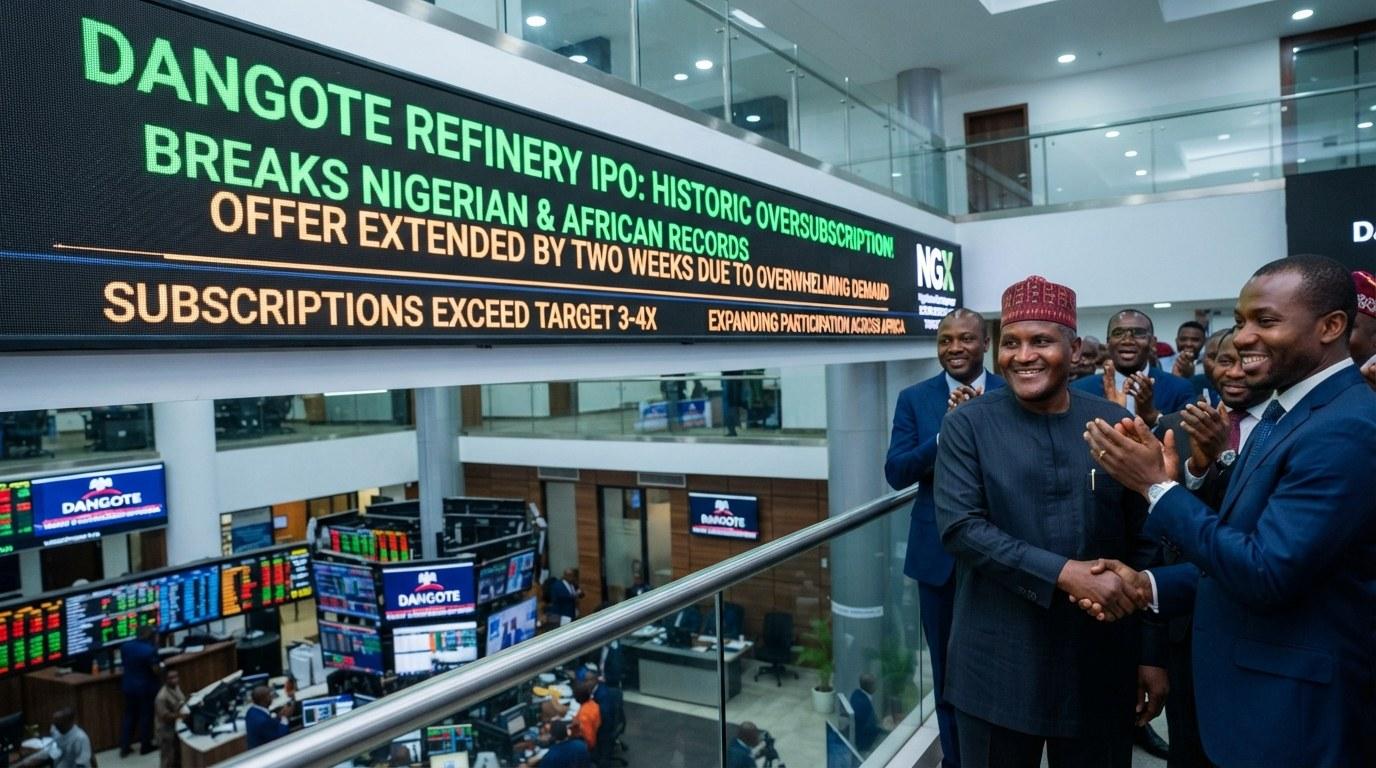
Dangote Petroleum Refinery and Petrochemicals FZE has extended the application period for its Initial Public Offering (IPO) by two weeks to October 27, 2026, following approval by the Securities and Exchange Commission (SEC), as the company seeks to accommodate growing investor interest across Africa and other international markets.
The offer, which opened on September 14, was originally scheduled to close on Tuesday, October 13. The extension will now provide prospective investors until Tuesday, October 27, to complete their applications and participate in what the company describes as one of the most significant capital market offerings in Nigerian and African history.
The decision comes amid exceptionally strong investor demand, with Aliko Dangote, President of Dangote Group, disclosing that subscriptions have already exceeded three to four times the amount the company originally intended to raise.
Dangote, who spoke with journalists at the refinery on Monday, said the extension was not primarily driven by the need to raise additional funds but by the company's determination to give more Africans the opportunity to become shareholders in the industrial project.
“The IPO is going very well. We will extend the closing date because we want more of our African brothers and sisters to participate,” he said.
According to him, the company has been working with stock market operators across the continent to develop arrangements that would make it easier for investors outside Nigeria to participate in the offer without facing unnecessary administrative and regulatory difficulties.
He disclosed that discussions with the Nairobi Securities Exchange had helped identify an approach that could facilitate participation by investors in Kenya, adding that the company was working to replicate similar arrangements with other African exchanges.
“But when it comes to the amount of money we originally intended to raise, we have already received subscriptions amounting to more than three or four times that figure,” Dangote said.
“So, it is not about the amount of money. It is about the number of people who will have the opportunity to participate in this offer. That means quite a lot to us.”
The statement highlights the company's ambition to transform the public offering from a conventional capital-raising exercise into a broader opportunity for African investors to participate in the ownership and future growth of a major industrial enterprise.
Four Billion Shares on Offer
The IPO comprises 4.1 billion ordinary shares with a nominal value of US$0.000013 each, offered at N525 per share.
At the offer price, the total value of the shares being offered amounts to approximately N2.1525 trillion, making the transaction a major event for Nigeria's capital market and potentially one of the country's most consequential equity offerings.
The scale of the offer places considerable attention on the refinery's business prospects, the depth of investor demand and the ability of the capital market to accommodate a transaction of such magnitude.
For investors, participation provides an opportunity to acquire an equity interest in an enterprise whose activities are central to petroleum refining, fuel supply, petrochemicals and the wider industrial development of Nigeria and Africa.
The refinery has attracted attention because of its potential to reduce the continent's dependence on imported refined petroleum products, strengthen domestic processing capacity and create new opportunities for trade within African markets.
Its expansion ambitions and the strategic importance of energy security have also placed the company at the centre of discussions about Africa's industrial future.
However, the scale of the offer and the reported oversubscription do not, on their own, establish the future market value of the shares or guarantee investment returns. Prospective investors will still need to examine the offer documents, the company's financial position, its growth plans and the risks associated with the petroleum and petrochemical industries.
African Investors at The Centre of The Extension
The additional two weeks are intended to widen access to the offer, particularly for investors who may have encountered practical difficulties in participating from outside Nigeria.
Dangote Refinery said it was expanding distribution channels across African jurisdictions and introducing unsponsored depository receipt programmes to facilitate cross-border investment.
Such arrangements can help investors gain exposure to securities in another market through mechanisms supported by financial intermediaries, potentially reducing some of the practical obstacles associated with direct participation in a foreign securities offering.
The company said the extension would also give prospective investors more time to complete account-opening procedures, identity verification and other regulatory requirements necessary to submit valid applications.
These administrative requirements can be particularly challenging for retail investors seeking to participate in a foreign market, where differences in documentation, settlement arrangements and financial regulations may complicate the application process.
By extending the offer period and developing access channels in other African countries, the company hopes to broaden the pool of participating investors beyond Nigeria's established investment community.
The initiative also reflects a wider ambition to strengthen connections between African capital markets, enabling investors in one country to participate more readily in businesses operating elsewhere on the continent.
For Dangote, the potential significance of the exercise goes beyond the immediate proceeds of the IPO. A more geographically diverse shareholder base could strengthen the refinery's connection with African consumers, businesses and institutions that stand to benefit from an expanding regional energy market.
The company has, however, not disclosed in the supplied announcement the precise breakdown of subscriptions by country, investor category or geographical market.
CEO Welcomes SEC Approval
David Bird, Managing Director and Chief Executive Officer of Dangote Petroleum Refinery and Petrochemicals FZE, welcomed the SEC's approval for the extension, describing the additional period as an opportunity to make the offer accessible to a wider range of investors.
“We welcome the SEC's approval of the extension, which will give more investors across Africa the opportunity to participate in the Offer,” Bird said.
He explained that the company's objective from the outset had been to enable as many people as possible to participate in the IPO and share in the refinery's future growth.
“From the outset, our ambition has been to enable as many people as possible to participate in the IPO and share in DPRP's future growth. The additional time will help us extend that opportunity to more investors across Africa,” he added.
The company's position suggests that it regards the number and diversity of shareholders as important considerations alongside the amount of capital subscribed.
The SEC's approval is also significant because an extension of a public offer must operate within the applicable regulatory framework, ensuring that prospective investors receive the additional time through an authorised process.
The extension does not, however, mean that the offer is guaranteed to produce a particular level of investor returns, nor does oversubscription eliminate the risks associated with equity investment.
Refinery's Strategic Importance Drives Interest
Investor interest in the offer comes against the background of the refinery's strategic position in Nigeria's petroleum industry and the longstanding challenges associated with the country's dependence on imported refined products.
For decades, Nigeria exported substantial volumes of crude oil while importing significant quantities of petrol, diesel and other refined petroleum products, exposing the economy to international supply disruptions, foreign-exchange pressures and the cost of transporting finished products over long distances.
The establishment of a large-scale domestic refinery offers the prospect of changing important aspects of that arrangement by increasing local processing capacity and creating opportunities to supply neighbouring countries and other international markets.
The refinery's integrated operations also connect crude processing with the production of petrochemicals and other industrial feedstocks, potentially supporting downstream manufacturing and associated businesses.
If its production capacity, operational reliability and distribution networks continue to develop, the facility could contribute to a more diversified petroleum supply system, although the extent of the benefits will depend on commercial performance, crude availability, logistics, pricing and market conditions.
For investors considering the IPO, these opportunities must be weighed against the substantial capital requirements of operating a large industrial complex, fluctuations in crude oil and refined-product prices, foreign-exchange exposure, financing costs and competition from established international suppliers.
The company's reported subscription levels nevertheless indicate that the offer has attracted considerable attention, with investors seeking exposure to an enterprise positioned at the intersection of energy security, industrial development and regional trade.
A Test for Africa's Capital Markets
The extension could also become an important test of the capacity of African financial markets to support large cross-border investment transactions.
Although the continent has a substantial pool of private wealth, pension assets and institutional capital, investment activity is often concentrated within national markets, while regulatory differences, settlement systems, currency arrangements and limited distribution channels can make cross-border participation difficult.
The proposed cooperation with the Nairobi Securities Exchange and efforts to establish similar arrangements with other exchanges could help address some of these challenges.
If implemented effectively, the approach could offer a model for connecting investors across different African markets with major industrial enterprises seeking broad-based ownership.
The initiative could also encourage closer collaboration among stock exchanges, brokers, custodians and other financial institutions, potentially strengthening the infrastructure required for more integrated continental investment.
Nevertheless, the effectiveness of these arrangements will depend on their practical implementation, the regulatory requirements in participating jurisdictions and the extent to which investors can understand the costs, rights and risks attached to the securities they acquire.
For retail investors, accessibility must be matched by clear disclosure and adequate understanding of the investment, particularly where depository receipts or other cross-border instruments are involved.
The extension therefore presents both an opportunity and a responsibility: the company can widen participation, while financial intermediaries and regulators must ensure that the process remains transparent and compliant with applicable rules.
Investors Get Two More Weeks
With the new closing date fixed for Tuesday, October 27, the company said it remained encouraged by engagement from retail, institutional and cross-border investors across its target markets.
The additional period is expected to provide time for ongoing market-access initiatives and enable more prospective shareholders to complete the requirements for participation.
For Dangote Group, the immediate objective is to translate the reported demand into broader ownership of the refinery, extending the opportunity to investors who might otherwise have been unable to participate before the original deadline.
For Nigeria's capital market, the offering represents a major test of its ability to accommodate a large equity transaction while attracting interest beyond the domestic market.
For Africa, the broader question is whether a major industrial enterprise can use a public offering to encourage investment across national borders and deepen the relationship between the continent's capital markets and its industrial ambitions.
Dangote's declaration that subscriptions have already exceeded three to four times the intended fundraising target places the emphasis firmly on participation rather than the need for additional capital.
The next two weeks will therefore be crucial in determining how effectively the company can convert the strong interest it has reported into a wider and more geographically diverse shareholder base.
With the offer now scheduled to close on October 27, the refinery is seeking to make its IPO not merely a landmark transaction in the Nigerian financial market, but also a demonstration of how African investors can participate in financing and owning the continent's major industrial assets.