PublicSphere Live
Capital Market
NGX ASI Rises 0.26% as Industrial Stocks Rally, Market Capitalisation Holds at ₦159.7trn
However, the recovery was not sufficiently strong to erase the market’s losses over the preceding week and four-week period, suggesting that investors remain selective rather than uniformly optimistic.
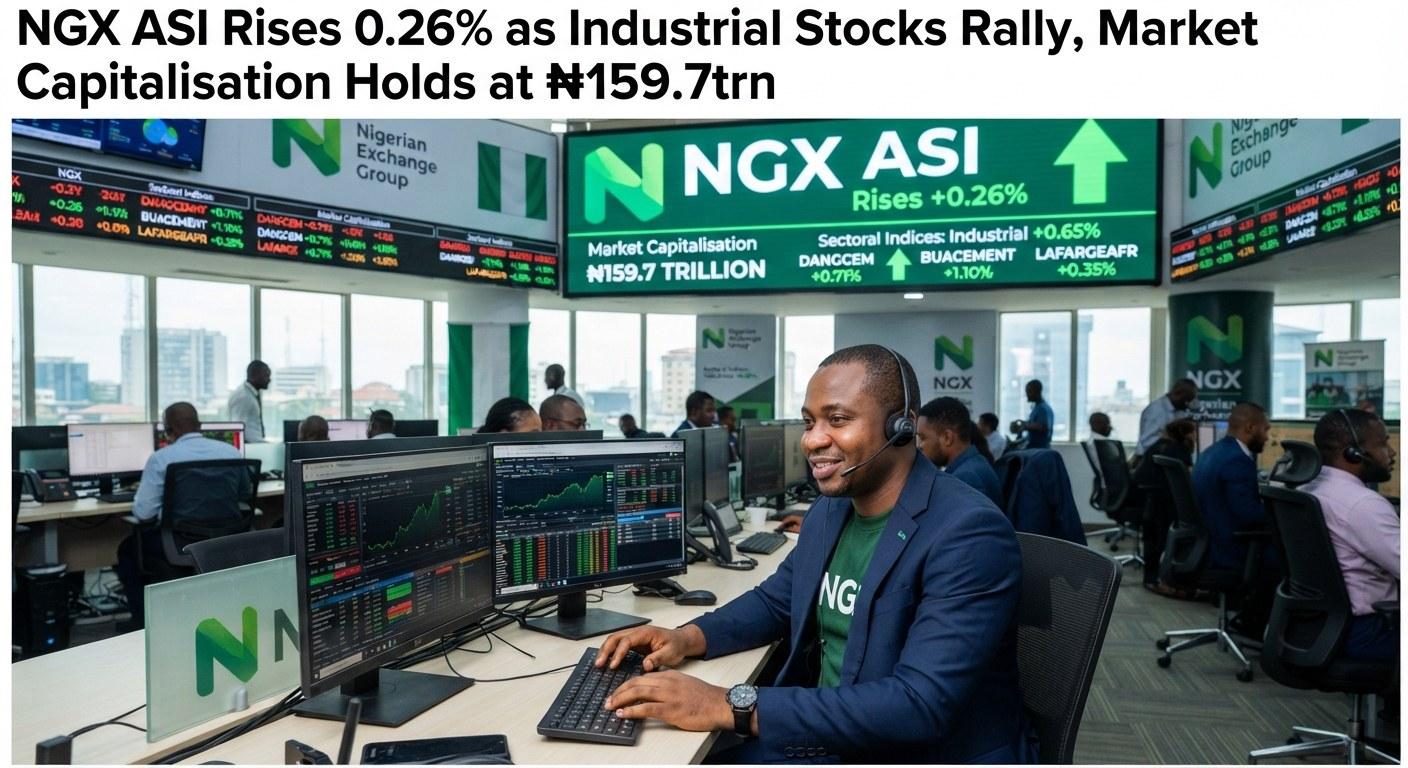
Nigeria’s equities market returned to positive territory on Tuesday as renewed buying interest in industrial stocks, consumer goods and selected heavyweight equities lifted the benchmark NGX All-Share Index (ASI) by 0.26 per cent, even as the market continued to contend with short-term losses and a decline in trading participation.
The benchmark index advanced by 632.79 points to close at 245,911.13, extending the market’s year-to-date gain to 58.03 per cent and reinforcing the resilience of Nigerian equities despite recent profit-taking and uneven sectoral performance. However, the recovery was not sufficiently strong to erase the market’s losses over the preceding week and four-week period, suggesting that investors remain selective rather than uniformly optimistic.
Market capitalisation closed at approximately ₦159.7 trillion, equivalent to about $120 billion, while the value of shares traded rose substantially compared with the previous session. Yet the simultaneous decline in the number of deals indicated that the increase in turnover did not translate into broader trading activity. This distinction is important because a market can record higher transaction values without experiencing a corresponding expansion in the number of active trades or the breadth of investor participation.
Tuesday’s session therefore presented a mixed picture: the headline indices were predominantly positive, industrial equities delivered the strongest performance among the reported benchmarks, and gainers outnumbered losers, but recent losses and uneven trading activity continued to temper the significance of the recovery.
Market Indices: Industrial Index Leads The Recovery
The performance of the major market indices provided a clearer picture of where investors concentrated their buying interest during Tuesday’s session. The NGX Industrial Index led the reported benchmarks, advancing by 1.17 per cent, substantially outperforming the broader market.
The NGX Premium Index gained 0.56 per cent, while the NGX Consumer Goods Index appreciated by 0.29 per cent. The NGX Top 30 Index rose by 0.27 per cent, matching the direction of the All-Share Index, while the NGX Pension Index advanced by 0.11 per cent. The NGX Main Board Index recorded the smallest gain, rising by 0.05 per cent
he following table summarises the reported performance of the principal indices.
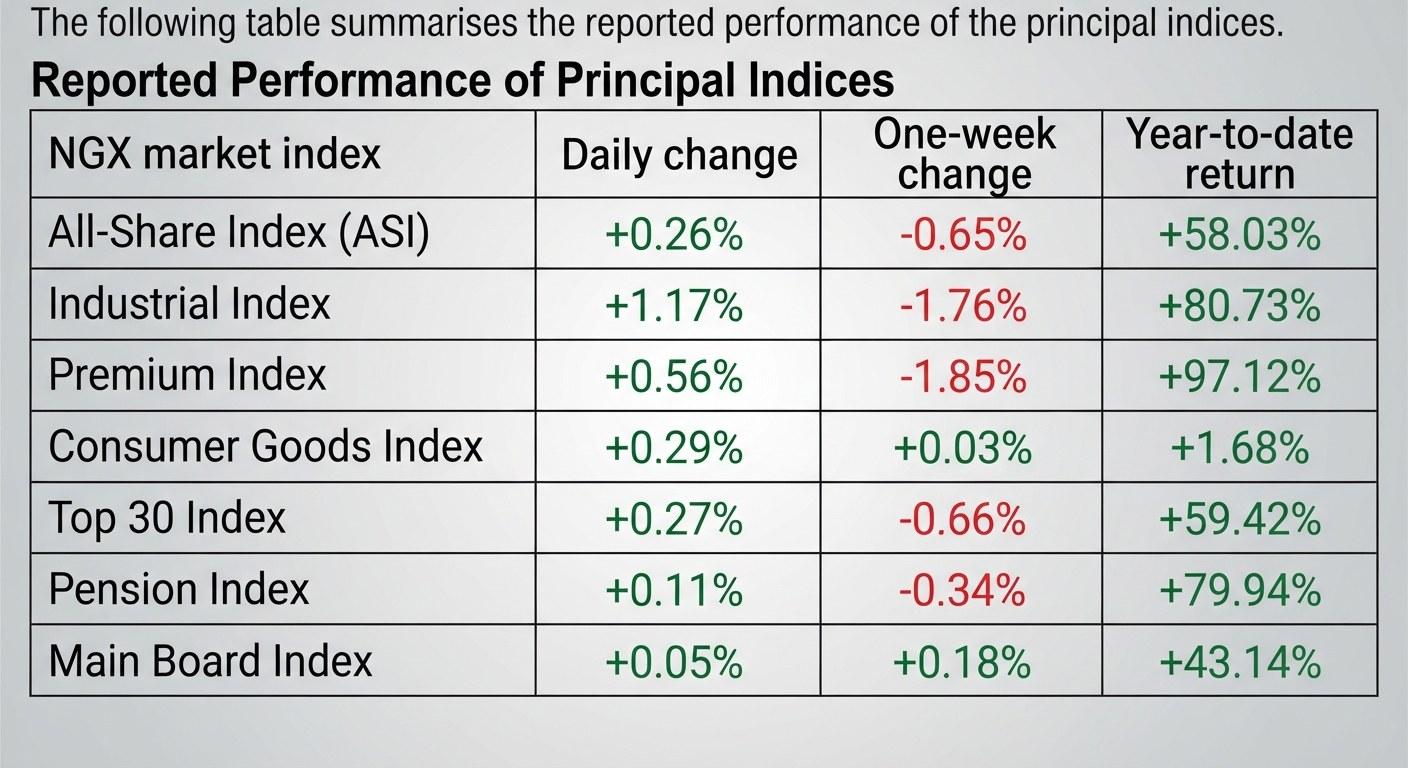
Source: NGX trading summary for October 20, 2026. Returns are as reported in the supplied market data.
The industrial sector’s 1.17 per cent advance stands out because it was more than four times the ASI’s daily percentage gain. This suggests that buying interest in industrial constituents was an important component of Tuesday’s recovery. However, without the full daily constituent-level report, it would be premature to attribute the index’s advance to a particular company.
The industrial index’s year-to-date return of 80.73 per cent also highlights the sector’s strong performance in 2026. Nevertheless, its one-week loss of 1.76 per cent shows that short-term selling pressure has not disappeared.
The Premium Index presents a similar contrast. Despite gaining 0.56 per cent on Tuesday, it remained down 1.85 per cent over one week, even as its year-to-date return stood at 97.12 per cent. This combination suggests that the index has retained substantial accumulated gains while experiencing recent corrections.
The Pension Index, which gained 0.11 per cent during the session, has also maintained a substantial year-to-date return of 79.94 per cent. Its daily performance was more modest than that of the industrial and premium benchmarks, but the positive movement contributed to the broad improvement across the reported indices.
The Consumer Goods Index rose by 0.29 per cent, with a year-to-date return of 1.68 per cent. Compared with the other major benchmarks, this is a relatively weak cumulative performance. It indicates that the sector has not shared equally in the broader market’s substantial gains, although individual consumer goods companies may have performed differently.
The Main Board Index’s 0.05 per cent increase was the weakest daily result among the indices reported. Its year-to-date return of 43.14 per cent, however, remains significant. The figures illustrate that even the least buoyant of the listed benchmarks has delivered a considerable positive return since the beginning of the year.
Sectoral Performance: Industrials Show Strength, But The Picture Remains Incomplete
Tuesday’s data point to industrial equities as the strongest performers among the reported indices. Consumer goods also advanced, while the Top 30 and Premium indices recorded positive movements.
However, the supplied trading summary does not include the daily percentage changes for the NGX Banking Index, NGX Insurance Index or NGX Oil and Gas Index. Their performance cannot therefore be established reliably from the available figures, and it would be misleading to assign them gains or losses without the corresponding market data.
This limitation is important because the banking, insurance, industrial, consumer goods and oil and gas sectors have different earnings drivers, risk exposures and investment characteristics.
Banking shares, for example, may respond to expectations about interest rates, recapitalisation, asset quality, earnings and dividend prospects. Industrial companies can be affected by production costs, energy supply, foreign exchange exposure, infrastructure constraints and demand for their products. Consumer goods businesses face their own challenges, including household purchasing power, input costs and the ability to pass higher expenses on to customers.
Oil and gas equities are exposed to developments in crude oil prices, domestic energy production, operating costs and investment plans, while insurance companies may be influenced by premium growth, investment income, claims experience and capital requirements.
These differences explain why an advance in the All-Share Index does not necessarily mean that every sector has recovered. Investors seeking to understand the complete direction of the market need both the headline indices and the underlying sectoral figures.
The available data nevertheless establish that industrial equities were a significant bright spot in Tuesday’s session. Their strong daily performance, combined with an 80.73 per cent year-to-date return, makes the sector an important part of the market’s broader 2026 story.
Historical market reporting also illustrates the importance of examining sector movements separately. On October 19, banking and industrial equities came under pressure, with Dangote Cement and several major banks contributing to the market’s decline.
Tuesday’s industrial rebound is therefore notable, although one positive session is not enough to establish a sustained change in sectoral direction.
Market Breadth Favours Buyers
Market breadth was positive on Tuesday, with 28 equities advancing against 21 that declined. This left seven more gainers than losers and suggested that upward price movements extended beyond a handful of stocks.
Of the 133 equities that participated in trading, the 28 gainers represented approximately 21.1 per cent, while the 21 losers accounted for 15.8 per cent. The remaining 84 equities, or about 63.2 per cent, did not finish in either of the two reported categories of gainers or losers.
This distribution matters because it helps distinguish a broad-based recovery from one driven almost entirely by a few large companies. Although the number of advancing stocks exceeded decliners, the majority of participating equities did not register a gain or loss in the reported classification.
The four leading gainers recorded particularly strong advances.
Austin Laz & Company led the market, appreciating by 9.97 per cent to close at ₦3.53 per share. Associated Bus Company followed with a 9.92 per cent increase, while Cutix gained 9.91 per cent and Thomas Wyatt Nigeria advanced by 9.77 per cent.
These movements show that some smaller and mid-priced equities attracted considerable buying interest. However, percentage gains alone do not reveal the amount of money invested in each stock or whether the increases were supported by a substantial volume of transactions.
The market’s leading decliners also recorded significant losses. Livestock Feeds fell by 9.76 per cent to ₦17.10 per share, making it the session’s worst performer. Guinea Insurance declined by 7.78 per cent, NPF Microfinance Bank lost 5.75 per cent, and Mutual Benefits Assurance dropped by 4.69 per cent.
The presence of an insurance company among the major losers, alongside a microfinance bank and an agricultural business, illustrates the varied nature of the selling pressure. Nevertheless, the available data do not establish a common reason for these declines.
The contrast between Austin Laz & Company’s 9.97 per cent gain and Livestock Feeds’ 9.76 per cent decline also demonstrates the degree of dispersion in individual share performance. Investors could not assume that the market’s positive headline direction translated into gains across their entire portfolios.
Turnover Rises 44% As Deals Decline
Trading activity was one of the most revealing aspects of Tuesday’s session.
Investors exchanged 348,689,253 shares in 32,588 deals, with a total transaction value of approximately ₦25.84 billion. Compared with Monday, turnover improved by 44 per cent, while the number of deals fell by 24 per cent.
The increase in turnover suggests that the value of transactions rose significantly, even as the market recorded fewer individual deals. One possible explanation is that some transactions involved larger quantities of shares or higher-value equities. However, the aggregate figures alone cannot establish the precise cause.
The distinction between transaction value and transaction frequency is important for interpreting investor sentiment. A market experiencing higher turnover and more deals may be demonstrating both increased financial commitment and wider participation. Tuesday’s combination of higher turnover and fewer deals presents a more nuanced picture.
Trading volume also remained broadly stable. Monday’s reported volume was 349.34 million shares, compared with 348.69 million shares on Tuesday, a decline of approximately 0.19 per cent.
Consequently, the higher turnover was not accompanied by a substantial increase in the number of shares exchanged. Rather, the market recorded almost the same share volume but generated a significantly higher monetary value from transactions.
United Bank for Africa led trading by volume, recording 48.1 million shares. FCMB Group followed with 30.1 million shares, while Zenith Bank recorded 21 million shares and Guaranty Trust Holding Company traded 16.1 million shares.
The prominence of these banking stocks indicates that financial-sector equities continued to feature prominently in market activity. However, their trading volumes do not by themselves establish whether investors were accumulating shares or reducing their holdings, since every completed transaction involves both a buyer and a seller.
For investors, the key question is whether the improvement in turnover will be sustained over subsequent sessions and accompanied by stronger market breadth. A persistent rise in transaction value alongside positive index performance would provide more convincing evidence of renewed buying conviction.
Market Capitalisation And The Bigger Picture
The NGX closed Tuesday with a market capitalisation of approximately ₦159.7 trillion, equivalent to about $120 billion according to the supplied report.
The market’s capitalisation recovered from Monday’s reported ₦159.26 trillion, although the figures are rounded and should be treated as approximate. Monday’s sharp decline had reduced market value by about ₦1.47 trillion, making Tuesday’s advance a welcome, if incomplete, recovery.
The broader performance figures remain encouraging when viewed over the full year. The ASI’s 58.03 per cent year-to-date gain indicates that Nigerian equities have delivered substantial cumulative appreciation despite the latest bout of volatility.
Yet the index’s one-week decline of 0.65 per cent and four-week decline of 1.7 per cent reveal that the market has been struggling to maintain uninterrupted upward momentum.
Investors must therefore distinguish between the market’s long-term cumulative performance and its shorter-term direction. A substantial year-to-date gain does not eliminate the possibility of further corrections, particularly where share prices have risen significantly and investors are inclined to secure profits.
The industrial sector’s strong daily advance and year-to-date gain of 80.73 per cent may continue to attract attention, but valuation, earnings quality, cash flow and dividend sustainability remain important considerations. The same caution applies to the Premium Index, whose 97.12 per cent year-to-date gain reflects a strong cumulative performance but does not guarantee future appreciation.
The market’s next direction will depend partly on whether buyers return consistently to major equities and whether the recovery broadens beyond selected stocks. Corporate earnings, dividend expectations, macroeconomic conditions and prevailing interest rates will remain relevant to investors’ decisions.
Outlook: A Positive Session, But Confirmation Is Still Needed
Tuesday’s session offered some relief after Monday’s sell-off. The ASI gained 0.26 per cent, the reported indices closed higher, industrial equities led the advance, and gainers outnumbered losers. Turnover also improved substantially, while market capitalisation recovered modestly.
However, the decline in the number of deals, the near-flat share volume and the ASI’s negative one-week and four-week returns caution against interpreting the session as a decisive market turnaround.
The immediate test is whether the benchmark can build on its close of 245,911.13 points in subsequent sessions. Sustained gains accompanied by stronger participation and improving breadth would lend credibility to the recovery. A return to selling pressure, particularly among heavyweight equities, could instead leave the market vulnerable to further fluctuations.
Investors should also monitor the performance of the banking, insurance and oil and gas indices when the complete sectoral data become available. Their movements would help determine whether Tuesday’s recovery extended across the principal industries or was concentrated in the industrial and other reported benchmarks.
Ultimately, the Nigerian equities market remains strongly positive on a year-to-date basis but uneven in the short term. Tuesday’s advance demonstrates that buyers are still willing to support selected shares, even after a difficult session. Whether that willingness develops into a broader recovery will depend on the consistency of subsequent trading, the quality of corporate fundamentals and investors’ assessment of the risks and opportunities ahead.
For now, the most defensible conclusion is that the NGX recorded a modest but meaningful rebound, led by industrial equities, without yet providing sufficient evidence that its recent correction has definitively ended.