 PublicSphere Live
Capital Market
NGX ASI Rebounds 0.92% as Dangote Cement, Banks Lift Market Capitalisation to ₦160.5trn
Market Analysis | Friday, October 23, 2026
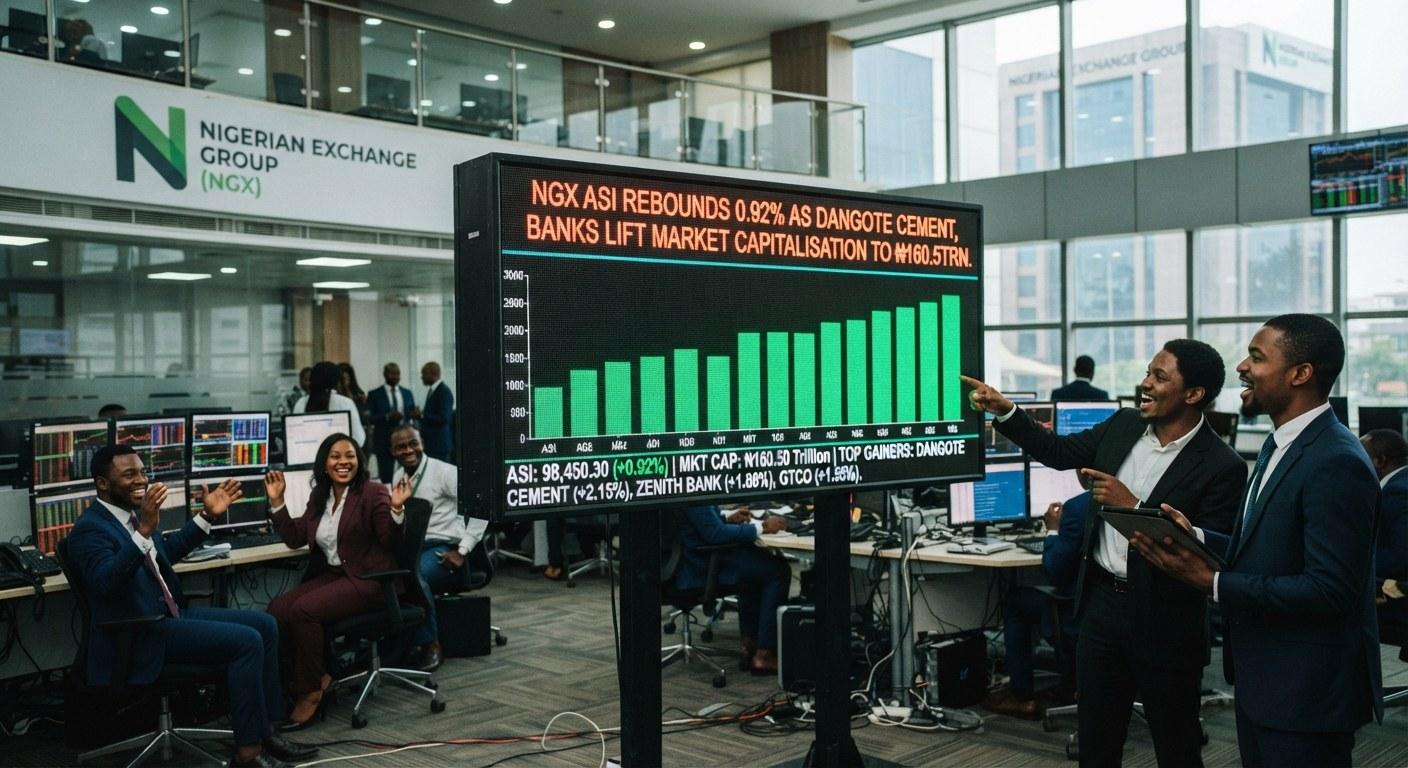
Nigeria’s equities market ended the final trading session of the week on a positive note on Friday, as renewed buying interest in heavyweight industrial stocks, banking shares and premium-listed companies propelled the benchmark Nigerian Exchange All-Share Index (NGX ASI) higher by 0.92 per cent, even as the market’s broader weekly performance remained marginally negative.
The benchmark index advanced by 2,265.33 points to close at 247,222.27, recovering some of the ground lost during the week and pushing total market capitalisation to ₦160.5 trillion, equivalent to approximately $120 billion. The rebound offered investors a measure of relief after a difficult period of intermittent selling pressure, but it did not entirely erase the caution reflected in the market’s four-week performance.
The day’s rally was particularly significant because Dangote Cement, one of the Exchange’s major industrial counters, gained the maximum 10 per cent permitted under the market’s daily price movement limit, while First HoldCo, Guinea Insurance and Fidelity Bank also recorded substantial advances. These gains helped establish a more constructive tone at the close of trading, notwithstanding losses in several other listed companies.
Trading statistics showed that investors exchanged 353,878,103 shares in 33,539 deals, with a combined transaction value of ₦22.296 billion. Compared with Thursday’s session, share volume declined by approximately two per cent, while turnover improved by 10 per cent and the number of deals increased by seven per cent.
The combination of lower volume and higher turnover suggests that more money changed hands despite a slight reduction in the number of shares traded. It may indicate increased activity in higher-priced securities or larger-value transactions, although the aggregate figures alone cannot establish which factor was responsible.
More importantly, the rise in transaction value and deal count, alongside the appreciation in the ASI, indicates that Friday’s advance was accompanied by meaningful trading activity rather than a purely passive movement in quoted prices.
Nevertheless, the market closed with 23 gainers against 25 losers among the 132 equities that participated in trading. The narrow difference between advancing and declining stocks underscores an important distinction: while the benchmark index enjoyed a strong recovery, the improvement was not sufficiently broad to establish an unambiguous market-wide bullish trend.
ASI’s 0.92% Recovery: Relief Rally Or A Change In Market Direction?
Friday’s performance must be examined against the market’s recent trajectory rather than interpreted as an isolated demonstration of renewed investor confidence. The Exchange had experienced persistent weakness earlier in the week, with the ASI declining by 0.91 per cent on Monday and slipping further on Thursday as investors reduced exposure to selected banking, insurance, consumer goods and oil and gas stocks. Thursday’s benchmark close was 244,956.94 points, according to market reports.
The rise to 247,222.27 points on Friday therefore represents a meaningful recovery from Thursday’s closing level. However, the market’s reported weekly loss of 0.13 per cent indicates that the latest advance was not enough to produce a positive return for the week.
This distinction matters to investors because a single session of strong appreciation does not necessarily signal that the market has entered a sustained upward phase. Rather, Friday’s movement may reflect a combination of bargain hunting, selective repositioning and renewed demand for companies whose share prices had come under pressure.
The All-Share Index has now delivered a year-to-date gain of 58.87 per cent, an impressive return that demonstrates the substantial appreciation equities have recorded since the beginning of 2026. Yet the four-week decline of 1.95 per cent suggests that the market has encountered resistance after its earlier advances.
Investors are consequently facing two competing realities: a strong cumulative annual performance and evidence of shorter-term volatility. How the market reconciles these forces will be important in determining whether the latest rally can be sustained.
Dangote Cement Leads The Industrial Recovery
The standout performance of Dangote Cement provided one of the most important signals from Friday’s session. The company’s shares appreciated by 10 per cent to close at ₦1,111, placing it among the day’s strongest performers and providing substantial support for the industrial segment.
The significance of the advance extends beyond the performance of an individual company. Dangote Cement is a major constituent of the Nigerian equities market, and a sharp movement in its share price can influence benchmark performance, investor sentiment and perceptions of the industrial sector.
The NGX Industrial Index surged by 3.68 per cent on Friday, the strongest advance among the six indices highlighted in the trading summary. Its weekly gain stood at 1.95 per cent, while its year-to-date appreciation reached 87.56 per cent.
These figures indicate that industrial stocks have maintained considerable strength over the year, even as the broader market has experienced intermittent corrections. Investors may be responding to expectations surrounding infrastructure spending, construction demand, manufacturing activity and the prospects of companies capable of maintaining profitability in a challenging operating environment.
However, the daily advance should not be interpreted as evidence that all industrial companies are experiencing improved earnings or that the sector faces no risks. Higher operating costs, energy expenses, financing conditions and demand constraints remain important considerations when assessing corporate valuations.
For Dangote Cement, sustained investor interest will ultimately depend on the relationship between its share price, earnings prospects, cash generation and future growth opportunities. Friday’s 10 per cent increase is a strong market signal, but subsequent sessions will determine whether the momentum attracts additional buyers or encourages profit-taking.
Banking Stocks Regain Momentum
The banking sector also contributed significantly to Friday’s positive performance. The NGX Banking Index gained 2.57 per cent, while Fidelity Bank advanced by 9.09 per cent. First HoldCo also recorded a 10 per cent appreciation, placing it among the leading gainers of the session.
The banking index’s year-to-date return stood at 65.94 per cent, although its weekly performance remained negative at 0.67 per cent. The figures point to a sector that has delivered substantial gains over the year but continues to experience short-term fluctuations.
The renewed buying interest may indicate that investors are reassessing opportunities in financial services stocks following recent price weakness. Banking shares are particularly sensitive to expectations about interest rates, asset quality, loan growth, capital adequacy, foreign-exchange exposure and the ability of lenders to translate balance-sheet expansion into sustainable earnings.
The sector’s longer-term performance will also depend on how effectively banks deploy their capital to support businesses and households without exposing themselves to excessive credit risks.
For First HoldCo and Fidelity Bank, Friday’s price movements may strengthen sentiment, but investors will need to examine their financial results, capital positions and valuations before deciding whether the rally presents an attractive entry point.
The 2.57 per cent advance in the banking index is encouraging, particularly after recent weakness in several financial stocks. Nevertheless, the negative weekly return demonstrates that the sector has yet to establish a decisive short-term recovery.
Premium And Top-Tier Stocks Strengthen
The NGX Premium Index rose by 2.71 per cent on Friday, bringing its year-to-date gain to 101.22 per cent. Its weekly return was positive at 0.80 per cent, making it the strongest performer over the week among the indices supplied, on a relative basis.
The performance suggests that selected premium-listed companies continued to attract demand despite the market’s broader volatility. These companies often draw attention because of their market size, visibility, liquidity or perceived capacity to withstand economic pressures.
The NGX Top 30 Index gained one per cent during the session but remained marginally negative over the week, at 0.01 per cent. Its year-to-date appreciation stood at 60.42 per cent.
Together, these indices reinforce the impression that Friday’s recovery was supported by relatively large and influential companies. Yet the differences between their daily and weekly performances also show why investors should distinguish between a strong closing session and a consistent upward trend.
The Premium Index’s three-digit year-to-date return is particularly striking, but such appreciation also makes valuation discipline important. Investors entering after substantial price increases must consider whether expected earnings growth can justify prevailing share prices.
Insurance Stocks Remain Under Pressure
The insurance sector presented a more subdued picture. The NGX Insurance Index gained just 0.17 per cent on Friday, despite the wider market’s stronger performance. Its weekly decline was 2.79 per cent, while its year-to-date return remained negative at 11.76 per cent.
The figures indicate that insurance stocks have struggled to participate meaningfully in the market’s broader annual advance. Although Guinea Insurance gained 9.41 per cent during Friday’s session, the index’s modest appreciation suggests that strength in individual counters did not translate into a comparable sector-wide recovery.
The sector’s performance deserves attention because insurance companies are important to the development of Nigeria’s financial system, providing risk protection for businesses, households and investors. Their long-term prospects depend on effective underwriting, claims management, investment income, regulatory compliance and public confidence in insurance services.
Investors should therefore avoid assuming that a sharp one-day increase in an individual insurance stock necessarily signals an improvement in the entire sector.
The NGX Pension Index rose by 0.57 per cent on Friday, but its weekly return was negative at 0.71 per cent. Its year-to-date appreciation of 79.88 per cent nevertheless points to a strong cumulative performance.
Market Breadth And Trading Activity
Friday’s market breadth remained mixed, with 23 gainers against 25 losers. Although the number of advancing stocks was close to the number of declining stocks, the negative balance suggests that the rally did not extend across the entire market.
Dangote Cement led the gainers, followed by First HoldCo, Guinea Insurance and Fidelity Bank. On the losing side, Livestock Feeds declined by 9.79 per cent to ₦17.05, while Tripple Gee & Co. lost 8.74 per cent, UPDC Real Estate Investment Trust fell 8.14 per cent and HBM Nigeria declined by 7.65 per cent.
Livestock Feeds nevertheless recorded the highest trading volume, with 46.8 million shares exchanged. Lasaco Assurance followed with 23.8 million shares, Sovereign Trust Insurance recorded 21.5 million and Stanbic IBTC Holdings traded 19.8 million shares.
The combination of heavy trading and a sharp price decline in Livestock Feeds illustrates why high activity should not automatically be interpreted as positive sentiment. Trading volume reveals the extent of transactions, but the direction of price movements and the reasons behind them remain essential to understanding investor behaviour.
Overall, the market recorded 353.88 million shares traded in 33,539 deals, valued at ₦22.30 billion. Although volume fell by approximately two per cent compared with Thursday, turnover increased by 10 per cent and deals rose by seven per cent.
Market capitalisation climbed to ₦160.5 trillion, equivalent to approximately $120 billion, according to the supplied figures.
Outlook: Can The Recovery Survive Next Week?
The immediate outlook for the Nigerian equities market will depend on whether Friday’s buying interest continues into the next trading week. The industrial and banking sectors have provided encouraging support, while the strong performance of the Premium Index suggests that investors remain interested in selected large and established companies.
However, the negative weekly return of the ASI, its 1.95 per cent four-week decline and the continued weakness of the insurance index argue against declaring a comprehensive market recovery.
Investors will need to monitor corporate earnings, dividend expectations, interest-rate conditions, inflation, exchange-rate developments and government economic policies. These factors influence the relative attractiveness of equities compared with fixed-income investments and determine how much risk investors are willing to assume.
The market’s year-to-date return of 58.87 per cent remains substantial, but past gains cannot guarantee future performance. After a strong annual advance, some investors may continue to realise profits, especially in stocks whose valuations have risen significantly.
Friday’s session therefore offers grounds for cautious optimism rather than unqualified celebration. The rise in the ASI and market capitalisation demonstrates that buyers returned to selected heavyweight stocks, but the balance between gainers and losers shows that confidence remains uneven.
The decisive test will be whether the next sessions produce broader participation, sustained turnover and further gains across industrial, banking and other major sectors.
For now, the Nigerian Exchange has ended the week with a welcome rebound, led by Dangote Cement and supported by renewed demand for selected financial stocks. Whether that rebound becomes the foundation of a more durable rally will depend on the strength of underlying corporate fundamentals and the willingness of investors to maintain their positions beyond a single encouraging session.