 PublicSphere Live
Capital Market
NGX ASI Sheds 159.55 Points as Banking Stocks Drag Market Lower Despite 57.41% YTD Gain
Rising share volume fails to lift turnover as investors remain cautious; banking index loses 4.07% in one week while industrial and premium stocks retain strong year-to-date gains
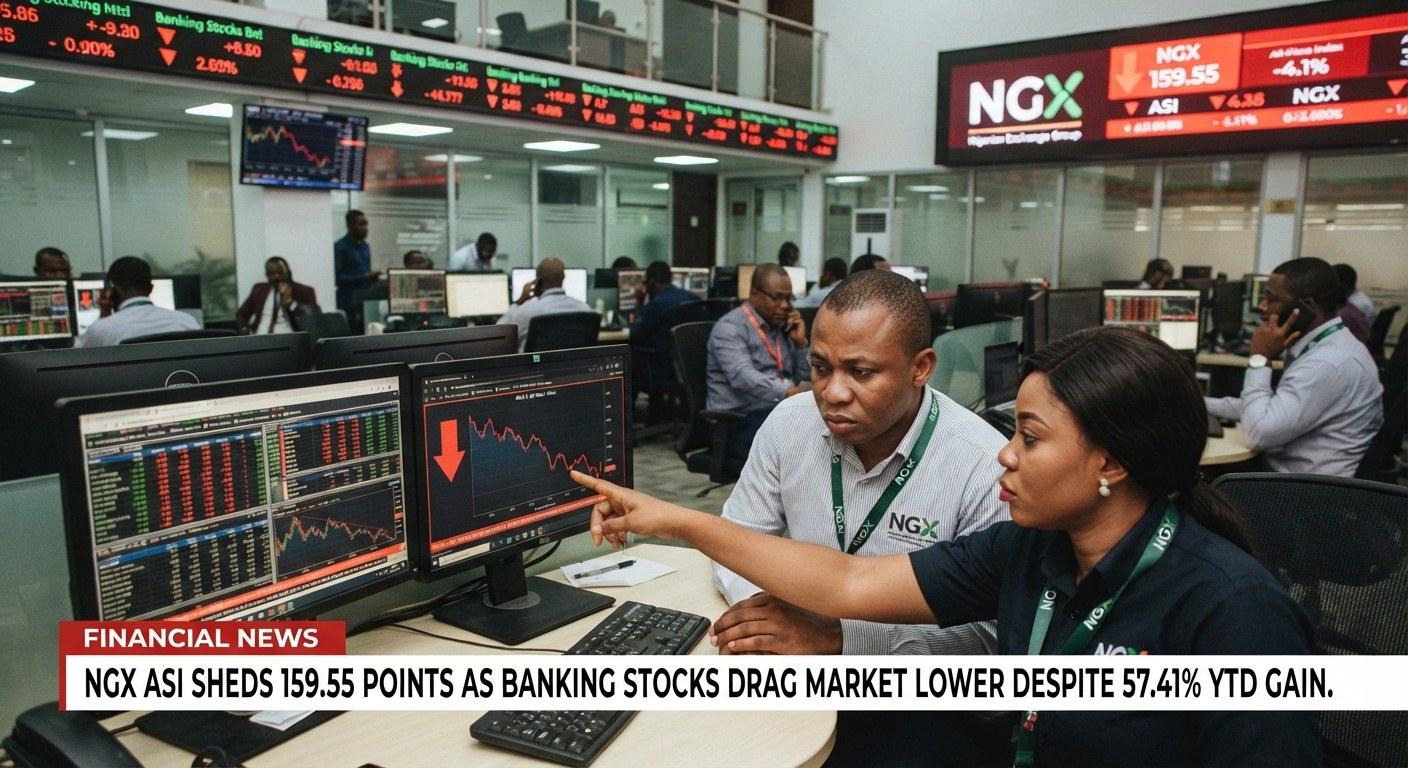
The Nigerian Exchange Limited (NGX) extended its recent period of weakness on Thursday, October 22, as the benchmark All-Share Index (ASI) declined by 159.55 points, reflecting continued pressure on equities despite the market's impressive year-to-date appreciation of 57.41 per cent.
The decline, although marginal at 0.07 per cent, provides another indication that investors are becoming more selective in their dealings after the substantial gains recorded by the Nigerian equities market earlier in the year. The market's recent performance suggests that the broad rally that propelled share prices higher is encountering resistance, with profit-taking, sector-specific weakness and changing investor expectations potentially influencing trading decisions.
The ASI closed at 244,956.94 points, down from its previous close, while market capitalisation stood at approximately N159 trillion, equivalent to $119 billion. The market's performance was particularly noteworthy because trading volume improved slightly even as the total value of transactions and the number of deals declined.
According to the trading summary, investors exchanged 360,706,232 shares in 31,355 deals, valued at N20.288 billion. Compared with Wednesday's session, volume increased by two per cent, but turnover declined by 14 per cent, while the number of deals fell by four per cent.
These figures present a market in which more shares changed hands without a corresponding increase in the monetary value of transactions. The divergence suggests that trading activity was concentrated partly in lower-priced securities or that the composition of transactions shifted towards shares with relatively modest values. However, without a detailed breakdown of individual transactions and average execution prices, it would be premature to attribute the movement to any single cause.
What is clearer is that the increase in volume did not translate into stronger market momentum. With 16 equities advancing against 22 decliners among the 132 listed securities that participated in trading, the balance of activity favoured sellers.
The ASI's Decline Raises Questions About Market Momentum
The immediate concern for investors is not necessarily Thursday's 0.07 per cent decline but the market's performance over a longer period.
The ASI recorded a one-week loss of 1.11 per cent and a four-week decline of 2.48 per cent. These consecutive periods of weakness indicate that the latest retreat forms part of a broader softening in market performance rather than an isolated daily fluctuation.
Nevertheless, the market retains a substantial year-to-date gain of 57.41 per cent. This remains a significant return on paper for investors who entered the market early enough to benefit from the rally, although individual returns would depend on the securities held, purchase prices, transaction costs and any dividends received.
The contrast between strong annual gains and recent declines illustrates a familiar feature of equity markets: substantial appreciation can coexist with short-term uncertainty.
After a sustained rally, investors may begin to reassess valuations, lock in profits or redirect funds towards securities they consider to have better prospects. Such decisions can produce a period of consolidation in which the market struggles to establish a clear direction.
The current pattern therefore calls for careful interpretation. A one-week or four-week decline does not, by itself, establish that the market has entered a prolonged bear phase. Equally, the strong year-to-date performance should not be treated as a guarantee that prices will continue rising.
The crucial issue is whether buying interest will return strongly enough to absorb selling pressure and stabilise the benchmark index.
Banking Stocks Emerge As A Major Source Of Weakness
The banking sector deserves particular attention because of its importance to the Nigerian equities market and its exposure to the country's wider economic and financial conditions.
The NGX Banking Index declined by 0.16 per cent on Thursday, extending its one-week loss to 4.07 per cent. Despite the recent weakness, the index remains up by 61.78 per cent year to date.
The weekly decline was the steepest among the major indices highlighted in the trading report, suggesting that banking equities have faced comparatively significant pressure in recent sessions.
Several considerations may influence investors' assessment of banking shares, including earnings expectations, recapitalisation requirements, the cost of funds, asset quality, loan-loss provisions and the sustainability of dividend payments. However, the trading figures alone do not establish which of these factors drove Thursday's performance.
The recapitalisation of Nigerian banks remains an important structural development for the industry. Investors will be watching how individual institutions strengthen their capital positions, manage balance-sheet risks and deploy additional capital to support lending and business expansion.
The challenge is to distinguish between temporary share-price weakness and a deterioration in the underlying fundamentals of particular institutions. A falling sector index does not mean that every bank is experiencing the same pressures, just as strong annual returns do not mean that every banking stock offers equal value.
Zenith Bank and Guaranty Trust Holding Company were among the most actively traded securities by volume, recording approximately 33.8 million and 21 million shares respectively. Their presence among the leading volume contributors demonstrates the continuing importance of major financial stocks to market liquidity, even as the banking index weakened.
For investors, the sector's next direction will depend partly on corporate results, capital strength, earnings quality and confidence in banks' ability to sustain returns.
Industrial And Premium Indices Retain Strong Annual Gains
The relative resilience of the industrial and premium indices provides a contrasting picture of the market.
The NGX Industrial Index advanced by 0.10 per cent on Thursday, while the NGX Premium Index gained 0.07 per cent. These were modest improvements, but they offered a measure of support in a session when the broader market declined.
The industrial index has gained 80.91 per cent year to date, while the premium index has appreciated by 95.90 per cent. These figures place both indices among the strongest performers in the market's annual comparison.
However, their shorter-term performances reveal a more complicated picture. The industrial index lost 1.66 per cent over one week, while the premium index declined by 1.80 per cent. Thursday's advances therefore represent limited positive movements within periods that remain negative overall.
The premium index's substantial annual gain also raises an important question about valuations. Securities that have appreciated considerably may continue to attract investors if their earnings prospects justify higher prices, but they may also become vulnerable to profit-taking when expectations become difficult to exceed.
The industrial sector's performance similarly highlights the importance of examining company-specific fundamentals rather than relying exclusively on index movements. Manufacturing costs, foreign-exchange exposure, access to credit, energy expenses and consumer demand can influence individual industrial companies in different ways.
The fact that both indices rose on Thursday suggests that demand remained available for selected equities. It does not, however, establish that a broad-based recovery has begun.
Oil And Gas Remains The Year's Outstanding Sector
The NGX Oil and Gas Index continues to distinguish itself through its exceptional year-to-date performance, despite another daily decline.
The index shed 0.11 per cent on Thursday and recorded a one-week loss of 0.05 per cent. Yet its year-to-date gain stood at 131.86 per cent, the strongest among the major indices listed in the report.
This extraordinary appreciation reflects the importance investors attach to developments within the energy sector, although the index's performance cannot be attributed to any single company or event without a more detailed analysis of its constituents.
Nigeria's energy industry continues to attract attention because of the country's petroleum production ambitions, refining capacity, domestic fuel supply and efforts to expand investment across the oil and gas value chain.
The emergence of additional domestic refining capacity has also changed the context in which investors assess parts of the downstream petroleum industry. However, the commercial benefits of these developments will depend on factors such as operating efficiency, feedstock availability, product pricing, distribution infrastructure and foreign-exchange conditions.
The index's substantial gain also creates a potential vulnerability: the more prices rise, the greater the importance of earnings and cash flows keeping pace with market expectations.
Investors should therefore avoid assuming that a sector with the strongest year-to-date performance must necessarily deliver the best returns from current price levels. Past appreciation and future investment prospects are not the same thing.
Mixed Performance Across Other Indices
Other market indices also reflected the uneven nature of Thursday's session.
The NGX Top 30 Index declined by 0.06 per cent, bringing its one-week loss to 1.08 per cent, although it remains up 58.84 per cent year to date.
The NGX Pension Index shed 0.02 per cent on the day and lost 1.42 per cent over one week. Its annual appreciation, however, stood at 78.86 per cent.
These figures reinforce the observation that the recent weakness extends beyond a narrow selection of stocks. At the same time, the different annual performances suggest that the market's gains have not been distributed evenly across sectors and categories of securities.
Such disparities matter because the headline ASI can conceal substantial differences in the experiences of individual investors. A portfolio concentrated in banking shares may behave differently from one weighted towards industrial, energy or premium equities.
Investors therefore need to look beyond the headline index and consider the performance, valuation and earnings prospects of the specific companies they own.
AVA Capital Leads Gainers As Thomas Wyatt Suffers Sharp Decline
Individual share-price movements offered further evidence of the market's divergent fortunes.
AVA Capital led the gainers, appreciating by 9.85 per cent to close at N7.25 per share. PZ Cussons Nigeria followed with an increase of 8.58 per cent, while Tantalizers gained 5.85 per cent and International Energy Insurance advanced by 5.42 per cent.
On the losing side, Thomas Wyatt Nigeria recorded the steepest decline, falling by 10 per cent to N2.52 per share. Austin Laz & Company lost 8.81 per cent, Secure Electronic Technology declined by 6.85 per cent, and UPDC shed 6.49 per cent.
These movements demonstrate why market-wide performance should not be confused with the prospects of individual securities. While the overall market weakened, some companies attracted sufficient demand to record substantial gains. Others experienced significant selling pressure.
The reasons behind these movements cannot be established from daily price changes alone. Investors would need to examine company announcements, earnings, liquidity, corporate developments and other relevant disclosures before deciding whether a sharp movement represents a buying opportunity or a warning sign.
Livestock Feeds led trading by volume, with approximately 41 million shares exchanged. Zenith Bank followed with 33.8 million shares, while Guaranty Trust Holding Company and Jaiz Bank recorded approximately 21 million and 19.2 million shares respectively.
High trading volume can indicate active investor interest, but it does not automatically demonstrate that a security is undervalued or that its price will rise. The direction of transactions, the reasons for trading and the company's financial condition remain essential considerations.
Market Outlook: Caution Without Panic
Thursday's trading session presents a market that remains substantially ahead on an annual basis but is struggling to sustain its recent momentum.
The 57.41 per cent year-to-date appreciation of the ASI provides evidence of the scale of the market's earlier advance. However, the 1.11 per cent weekly loss and 2.48 per cent four-week decline indicate that investors should pay close attention to the possibility of continued consolidation.
The fall in turnover, despite a slight increase in volume, also suggests that the composition and value of transactions deserve closer examination. Whether this pattern reflects a temporary shift in trading activity or a more persistent change in investor appetite will become clearer through subsequent sessions.
The immediate priorities for investors should be disciplined stock selection, close monitoring of corporate disclosures and realistic expectations about returns. Companies with credible earnings, sustainable cash flows, sound balance sheets and reasonable valuations may offer stronger foundations than securities purchased solely because they have recently recorded dramatic price increases.
Regulators and market operators also have an interest in sustaining confidence through transparent disclosures, effective market oversight and an investment environment in which prices can respond to reliable information.
Ultimately, the Nigerian equities market does not need to rise every day to remain attractive. Periods of consolidation can help investors reassess valuations and separate fundamentally strong companies from those whose share prices have moved ahead of their underlying performance.
The more important test is whether listed companies can translate capital-market gains into stronger earnings, productive investment and sustainable shareholder returns.
For now, the NGX remains in positive territory for the year, but Thursday's figures deliver a clear message: the market's impressive annual rally should not obscure the growing importance of selectivity, valuation discipline and caution in the weeks ahead.