 PublicSphere Live
Capital Market
NGX Banking Index Gains 0.01% As GTCO, Zenith, UBA Drive Heavy Trading
Banking stocks attract substantial investor interest as NGX turnover rises to ₦28.22 billion, but marginal sector-index growth points to selective buying and uneven price performance.
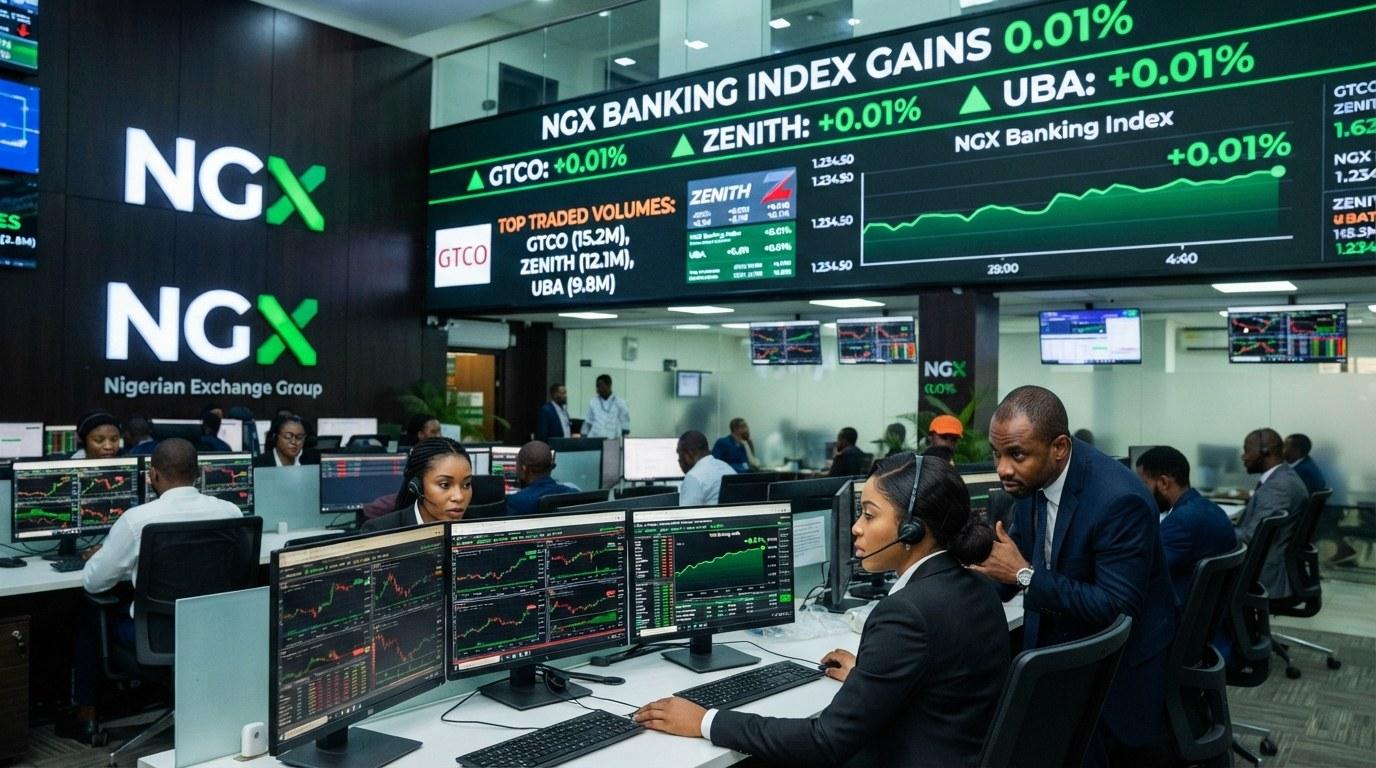
LAGOS, October 27, 2026 — Trading in banking stocks on the Nigerian Exchange Limited (NGX) on Tuesday reflected a market characterised by strong investor participation in selected financial services companies, even as the sector's benchmark index recorded only marginal growth amid a broader equities rally.
The NGX Banking Index advanced by 0.01 per cent to close the session, according to the trading summary, while the benchmark NGX All-Share Index (ASI) rose by 1.07 per cent to 253,990.06 points. The contrast between the performance of the broader market and that of banking equities suggests that Tuesday's rally was driven more decisively by other sectors, particularly industrial stocks, than by a broad-based appreciation in bank share prices.
Nevertheless, the volume of transactions recorded in some of the country's leading banks demonstrated that financial stocks remained central to market activity. Guaranty Trust Holding Company Plc (GTCO), Zenith Bank Plc and United Bank for Africa Plc (UBA) ranked among the four most actively traded equities by volume, alongside Honeywell Flour Mills Plc.
The session therefore presented a mixed picture for banking investors: high trading activity, a positive weekly performance for the sector index and a substantial year-to-date gain, but limited additional price appreciation on the day.
Banking Index Lags The Broader Market
The NGX Banking Index's 0.01 per cent increase was modest compared with the ASI's 1.07 per cent advance. While the general market gained 2,699.52 points, the banking benchmark remained virtually flat, indicating that the sector did not participate proportionately in the day's overall market advance.
This divergence is important because the performance of the banking sector often serves as an indicator of investor confidence in the financial system, corporate earnings prospects, credit conditions and the wider Nigerian economy.
However, an index's daily movement must be distinguished from the volume of shares traded. High turnover in a particular banking stock does not automatically translate into a price increase. Transactions represent both purchases and sales, and a share can attract considerable activity without recording a substantial change in its closing price.
The marginal movement in the banking index could therefore reflect a balance between buying interest and profit-taking across constituent stocks. It could also reflect differences in the performance of individual banks, with gains in some counters offset by weakness or limited movement in others.
The available trading summary does not provide the individual closing-price changes of all banking stocks for Tuesday. It would consequently be premature to conclude that the entire banking sector experienced either widespread buying or broad selling pressure.
What the figures establish is that banking equities remained actively traded, but their collective performance was considerably weaker than the broader market's advance.
GTCO, Zenith Bank And UBA Dominate Trading Volume
The most significant indication of the banking sector's relevance to Tuesday's market was the substantial volume of transactions involving its leading listed institutions.
GTCO recorded 30.7 million shares traded, making it the second most actively traded equity on the exchange. Zenith Bank followed with 27.6 million shares, while UBA recorded 21.7 million shares. Only Honeywell Flour Mills, with 32.6 million shares, surpassed GTCO in the overall volume ranking
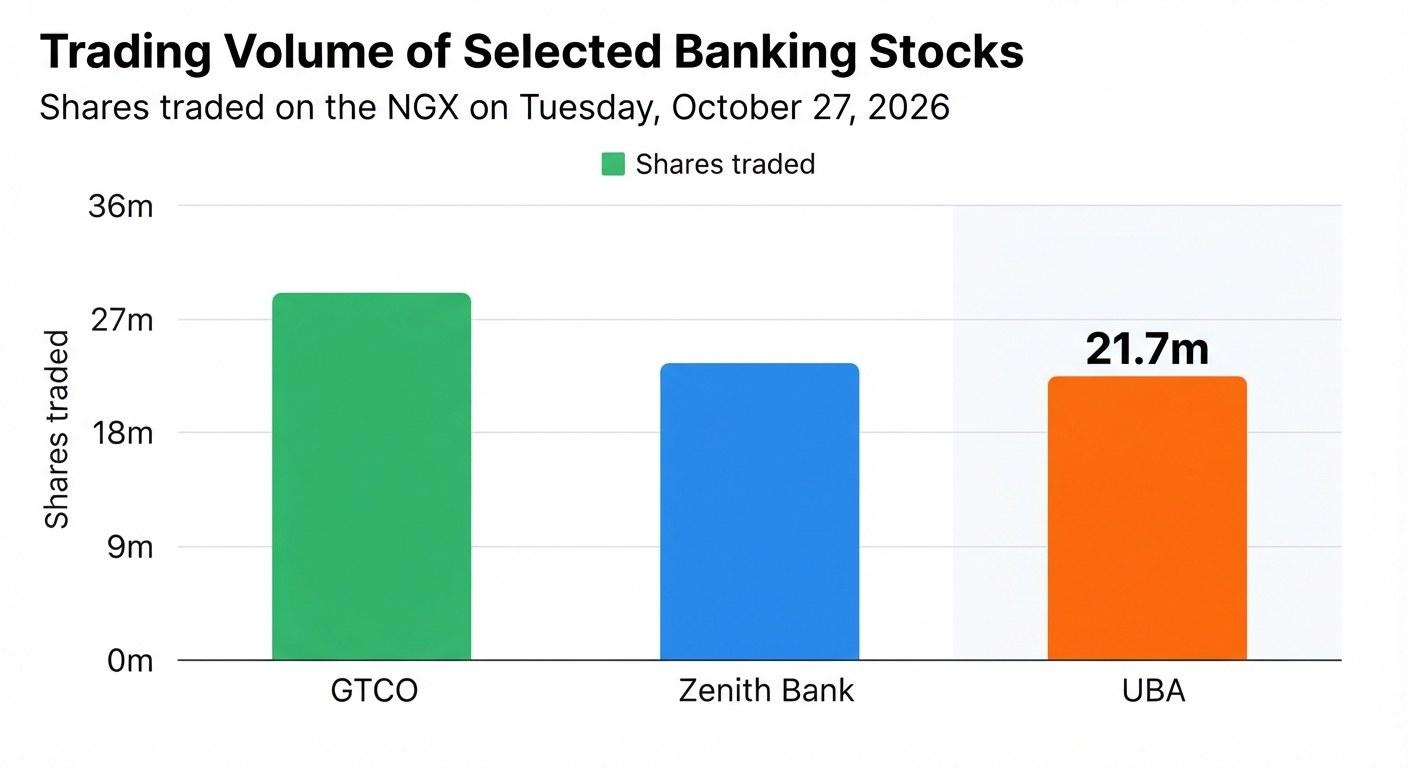
Together, the three banking stocks accounted for approximately 80 million shares, representing a substantial concentration of trading activity in major financial institutions. GTCO's 30.7 million shares represented the highest trading volume among the banking stocks identified in the report. Its position suggests that the holding company attracted considerable attention from market participants, including investors adjusting their portfolios, short-term traders seeking price opportunities and shareholders repositioning their holdings.
Zenith Bank's 27.6 million shares also underscored the importance of the institution in the market's daily liquidity. As one of Nigeria's major banking groups, its shares are closely followed by investors interested in the earnings capacity, capital strength and dividend prospects of the financial services industry.
UBA's 21.7 million shares completed the strong showing by the three institutions. Its presence among the most actively traded equities reinforced the continued relevance of large-cap banking stocks to investors seeking exposure to Nigeria's financial sector.
However, trading volume alone cannot establish whether investors were accumulating or disposing of these shares. Without the stocks' daily price movements, value traded and buy-sell order data, the direction of investor sentiment in each bank cannot be conclusively determined.
The more defensible conclusion is that these institutions remained important channels for equity-market liquidity on a day when total market turnover expanded.
Market Turnover Rises As Transaction Numbers Decline
The overall trading figures provided another perspective on investor behaviour.
The NGX recorded 376,924,245 shares in 35,822 deals, valued at ₦28.22 billion. Compared with Monday's session, trading volume increased by 14 per cent and turnover rose by 11 per cent, while the number of deals declined by 18 per cent.
This combination of higher volume and value alongside fewer transactions suggests that the average transaction was larger than on the preceding trading day.
Using the reported percentage changes, Monday's estimated turnover was approximately ₦25.43 billion, while Tuesday's turnover increased by about ₦2.79 billion. The figures point to an expansion in the amount of capital changing hands despite a reduction in the number of recorded deals.
The average value per deal also increased substantially. Based on the reported figures, Tuesday's average was approximately ₦787,600 per transaction, compared with roughly ₦492,000 on Monday. These estimates are indicative because they depend on the rounded percentage changes supplied in the trading summary.
For banking stocks, this environment may offer opportunities for investors to enter or exit positions in relatively liquid counters. High liquidity can improve the ability to execute sizeable trades, although the actual trading conditions vary by stock and market depth.
The rise in turnover should not, however, be interpreted as proof that fresh institutional money entered the banking sector. The overall market figures cover all participating equities, while the report does not disclose the banking sector's aggregate monetary turnover or the proportion attributable to institutional investors.
Consequently, the banking sector's contribution to the increase in market value traded cannot be quantified from the available data.
Banking Sector's Weekly Momentum Remains Strong
Although the daily performance was almost flat, the banking index's weekly gain offered a more encouraging picture.
The NGX Banking Index advanced by 3.26 per cent over one week, outperforming its marginal daily movement. This indicates that banking shares had experienced positive momentum over the preceding trading sessions, even though the sector's advance slowed considerably on Tuesday.
The weekly performance is particularly significant when considered alongside the index's year-to-date appreciation of 69.85 per cent.
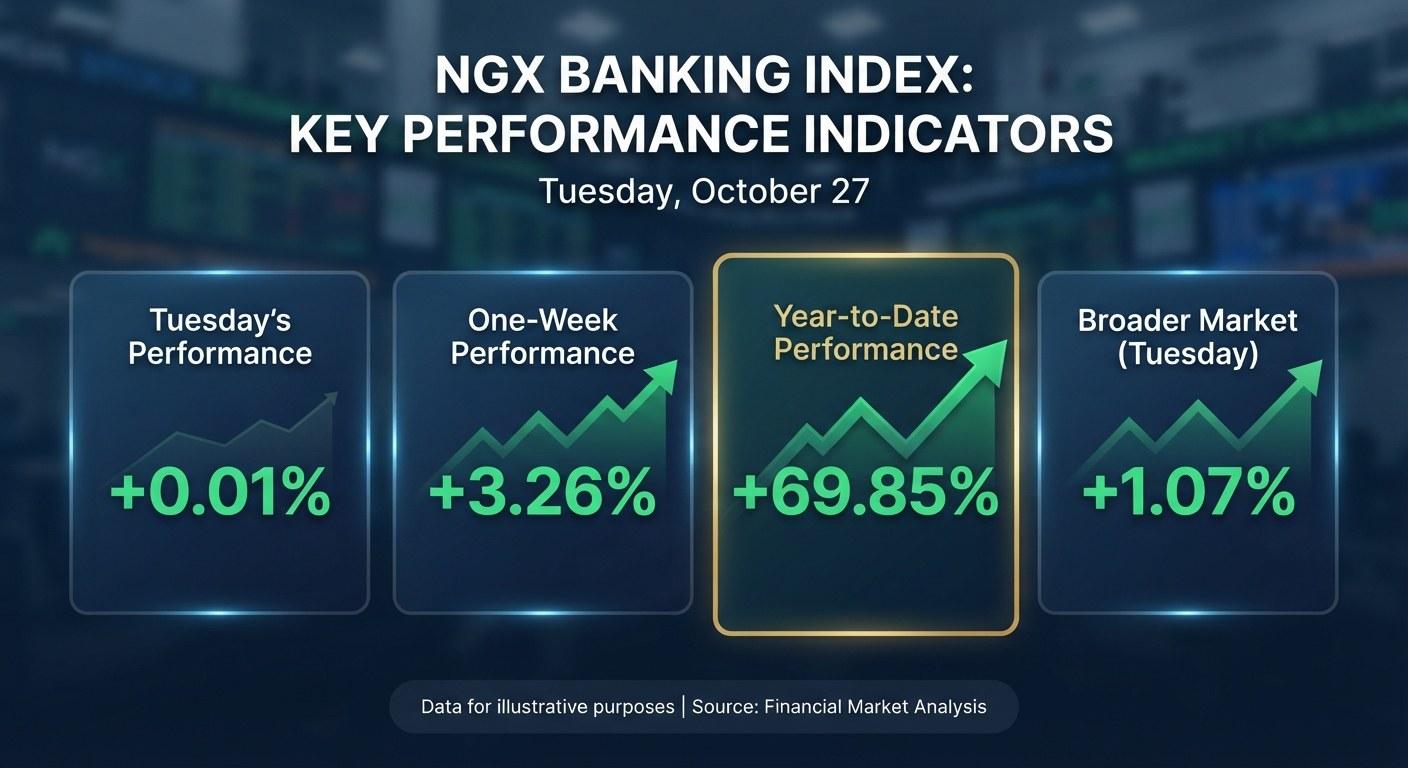
A year-to-date gain of nearly 70 per cent demonstrates the substantial appreciation recorded by the banking index since the beginning of 2026. Such a performance can reflect a combination of earnings expectations, dividend considerations, repricing of bank shares and changing investor assessments of the sector's resilience.
Nevertheless, the year-to-date return should be assessed alongside the banking industry's evolving operating environment, including recapitalisation requirements, funding costs, asset quality, regulatory compliance and the capacity of banks to sustain profitability.
The performance also raises an important investment consideration. After substantial appreciation, some investors may choose to realise gains, while others may continue buying on expectations of stronger earnings and improved capital positions. Such opposing strategies can produce heavy trading without a corresponding increase in the index.
Tuesday's modest index movement is consistent with the possibility of this kind of selective positioning, although the available figures cannot establish profit-taking as the definitive explanation.
Broader Market Rally Favours Industrial Stocks
The sector comparison provides further insight into why banking equities failed to match the broader market's performance.
The NGX Industrial Index surged by 5.5 per cent on Tuesday, while the NGX Premium Index gained 2.96 per cent and the NGX Top 30 Index advanced by 1.16 per cent. The ASI rose by 1.07 per cent.
By contrast, the NGX Consumer Goods Index increased by only 0.05 per cent, while the NGX Banking Index gained 0.01 per cent.
The industrial sector was therefore the standout performer among the indices listed in the trading report. Dangote Cement's 9.8 per cent appreciation and Honeywell Flour Mills' 9.67 per cent gain also illustrated the strength of selected industrial and consumer-related counters.
These gains helped demonstrate that Tuesday's market rally was uneven across sectors. The increase in the ASI did not mean that every major segment of the market advanced at a similar pace.
For investors, this distinction matters because sector rotation can influence the distribution of returns across portfolios. When industrial stocks outperform banks, investors may reassess relative valuations, earnings growth prospects and the attractiveness of different sectors.
However, a single session is insufficient to establish a sustained rotation away from banking shares. The banking index's weekly gain of 3.26 per cent and year-to-date increase of 69.85 per cent show that its longer-term performance remained positive despite Tuesday's subdued result.
The more balanced interpretation is that the banking sector consolidated its position while selected industrial stocks drove a larger share of the day's upward market movement.
Recapitalisation And Earnings Will Shape Investor Expectations
One of the important structural considerations for banking investors in Nigeria remains the sector's recapitalisation programme and the implications of stronger capital requirements for individual institutions.
The capacity of banks to meet regulatory capital thresholds, maintain adequate buffers and fund business expansion is central to their long-term competitiveness.
Well-capitalised institutions may be better positioned to finance larger corporate transactions, support infrastructure development, expand digital banking services and manage unexpected credit losses. Strong capital positions can also improve confidence in a bank's ability to withstand economic volatility.
Nevertheless, recapitalisation is not an automatic guarantee of higher share prices or improved shareholder returns. Investors must also consider how additional capital is raised, the possible dilution of existing shareholders, the cost of funding and the returns generated from deploying the additional resources.
Earnings quality remains equally important. Banks' financial performance depends on interest income, fee-based revenue, operating expenses, impairment charges, deposit costs and the quality of their loan portfolios.
Higher interest income can support profitability, but elevated funding costs or an increase in non-performing loans can offset some of the benefits. Likewise, expansion in lending can strengthen revenue, but only where credit is properly assessed and repayment risks are effectively managed.
For the NGX Banking Index to sustain its strong year-to-date performance, investors will need evidence that the sector can translate capital strength and business expansion into durable earnings and shareholder value.
Investor Outlook: Liquidity Is Encouraging, But Selectivity Is Necessary
The immediate outlook for banking equities will depend on whether the sector can convert its strong weekly momentum and high trading activity into broader price appreciation.
The increase in overall market turnover to ₦28.22 billion provides evidence of active participation in the equities market. The substantial trading volumes in GTCO, Zenith Bank and UBA also confirm that major financial stocks remained prominent in market activity.
However, the 0.01 per cent increase in the banking index cautions against interpreting high volume as evidence of a sector-wide rally. Investors will need to examine individual bank prices, published financial results, dividend prospects, capital adequacy, asset quality and valuations before drawing conclusions about the attractiveness of particular stocks.
The broader market's 1.07 per cent gain and the industrial index's 5.5 per cent advance also suggest that Tuesday's strongest price momentum was concentrated outside the banking benchmark.
In the coming sessions, a sustained improvement in the banking index would provide stronger evidence that positive sentiment is broadening across financial stocks. Conversely, continued high trading volumes accompanied by limited price gains would suggest that active trading is not yet translating into substantial sector-wide appreciation.
Conclusion
The performance of banking equities on Tuesday, October 27, 2026, was characterised by strong trading activity but limited daily price growth.
GTCO, Zenith Bank and UBA featured prominently in the market's volume rankings, while the NGX Banking Index maintained positive weekly and year-to-date returns. Yet its 0.01 per cent daily appreciation lagged significantly behind the ASI's 1.07 per cent advance and the industrial index's 5.5 per cent surge.
The figures suggest that banking stocks retained their importance in market liquidity but did not lead the day's rally.
For investors, the central question is whether the sector's impressive year-to-date performance can be supported by sustainable earnings growth, successful recapitalisation, disciplined credit management and attractive shareholder returns.
Until individual stock movements and sector-specific turnover are examined alongside those fundamentals, Tuesday's trading session is best viewed as one of active participation and uneven performance rather than evidence of either a broad banking rally or a sector-wide retreat.