PublicSphere Live
Capital Market
NGX ASI Sheds 0.44% as Profit-Taking Hits Equities, Year-to-Date Return Holds Above 62%
UBA, Access Holdings, Zenith Bank and GTCO lead trading activity as 133 equities participate; industrial stocks retain strong annual gains despite broad-based market weakness.
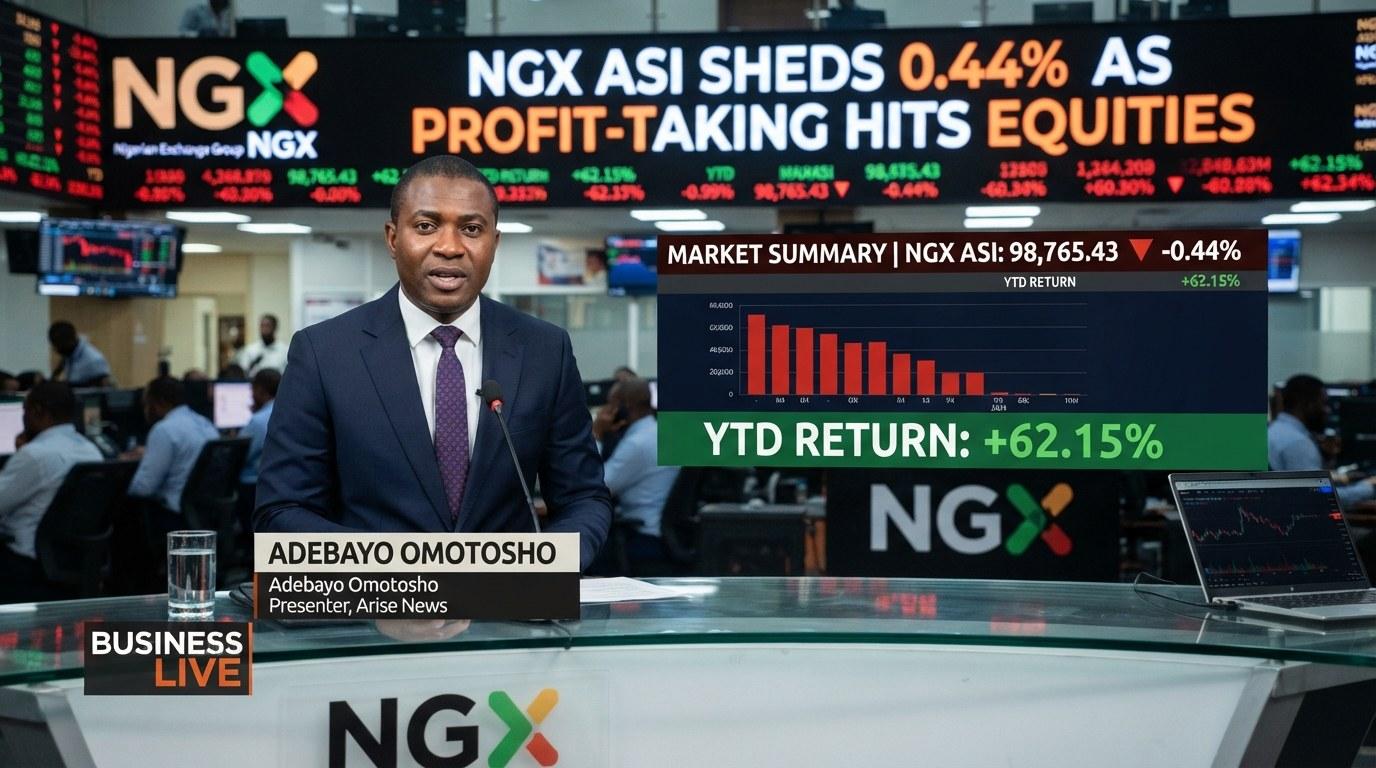
Nigeria’s equities market closed Wednesday’s trading session, October 28, 2026, on a negative note, as profit-taking in selected stocks pulled down the benchmark Nigerian Exchange Limited (NGX) All-Share Index (ASI), even as the market maintained a strong year-to-date return of 62.51 per cent.
The ASI declined by 1,107.28 points, representing a 0.44 per cent loss, to close at 252,882.78 points. The decline reflected a session in which more equities recorded losses than gains, although the market’s longer-term performance continued to indicate substantial appreciation in share prices since the beginning of the year.
Trading activity covered 133 listed equities, with 26 gainers and 30 losers. The distribution indicated a moderately negative market breadth, as declining stocks outnumbered advancing stocks by four. The remaining 77 equities did not fall into either the advancing or declining categories for the session, based on the supplied figures.
The performance suggests that investors were becoming more selective in their positioning, with gains in a number of stocks unable to offset losses in other counters. However, the relatively limited difference between gainers and losers, alongside the market’s substantial annual return, indicates that the session’s weakness should be considered within the broader context of the market’s performance rather than interpreted as evidence of a sustained downturn.
The market’s one-week gain of 3.17 per cent and year-to-date appreciation of 62.51 per cent remained important indicators of its underlying strength. Nevertheless, the modest four-week gain of 0.38 per cent suggested that the market had experienced some consolidation over the past month.
Key Market Indices: Industrials And Consumer Goods Show Relative Resilience
The performance of the major indices presented a mixed picture, with most benchmarks closing lower during the session. However, the figures also revealed significant differences in sectoral performance over the one-week, four-week and year-to-date periods.
NGX IndexDaily change1-week returnYTD return
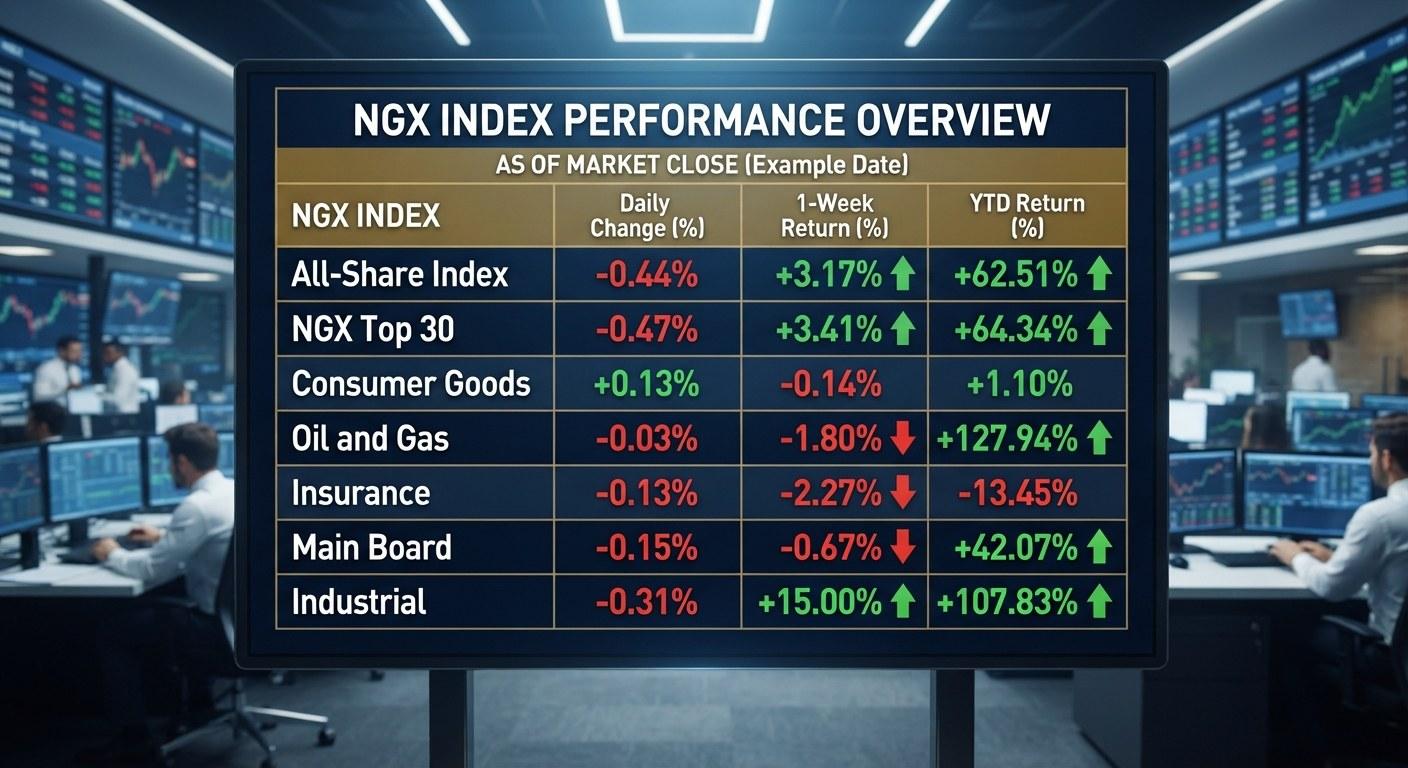
The figures supplied for the session show that the Consumer Goods Index was the only one among these sectoral and broad-market benchmarks to record a daily advance, rising by 0.13 per cent. The Oil and Gas Index lost just 0.03 per cent, while the Insurance Index declined by 0.13 per cent.
The NGX Main Board Index shed 0.15 per cent, while the Industrial Index fell by 0.31 per cent. The NGX Top 30, which tracks a selection of leading companies, declined by 0.47 per cent, slightly underperforming the All-Share Index.
These movements suggest that the market's weakness was relatively broad, although the magnitude of losses varied across the indices. The Consumer Goods sector's positive close offered a measure of support, demonstrating that buying interest remained in selected segments despite the prevailing selling pressure.
Industrial Index Retains Strong Year-To-Date Performance
One of the most notable features of the market was the Industrial Index's 107.83 per cent year-to-date appreciation, despite its 0.31 per cent decline during Wednesday's session.
The index also recorded a reported one-week gain of 15 per cent, making it the strongest performer over that period among the indices listed in the supplied data.
This performance points to the substantial gains industrial stocks have accumulated during the year. It also illustrates why investors should distinguish between daily price movements and the longer-term performance of their portfolios.
An index can decline in one session while remaining significantly higher than its level at the beginning of the year. Such a situation may reflect profit-taking after strong advances, changes in investor expectations or the reallocation of funds among sectors.
Nevertheless, the available figures do not establish the precise cause of the Industrial Index's daily decline. Investors would need to examine the individual constituents, their trading volumes, company announcements and valuation levels to determine whether the weakness represented temporary profit-taking or a more fundamental reassessment.
The industrial sector's strong annual return also raises questions about sustainability. After substantial appreciation, investors may become more sensitive to earnings disappointments, operating costs, financing expenses and the ability of companies to translate higher revenues into improved profitability.
For industrial companies, continued investor confidence will depend on their capacity to sustain earnings growth, manage production costs and benefit from investment in Nigeria's productive economy.
Oil And Gas Remains The Year's Strongest Performer
The Oil and Gas Index delivered the strongest year-to-date return among the selected indices, gaining 127.94 per cent despite recording a marginal daily decline of 0.03 per cent.
However, the index's one-week performance was negative at 1.80 per cent, suggesting that recent trading has been less favourable than its longer-term trajectory.
The divergence between its annual and weekly returns is significant. It shows that the sector has accumulated substantial gains during 2026 but has also experienced near-term pressure.
The performance of oil and gas equities can be influenced by several factors, including international crude oil prices, domestic refining developments, production volumes, foreign-exchange movements, operating costs and expectations about energy demand.
In Nigeria, the development of domestic refining capacity and the wider oil and gas value chain have important implications for investors assessing the prospects of listed energy companies. However, the performance of the sectoral index should not be interpreted as evidence that every oil and gas company has enjoyed similar gains.
The 127.94 per cent annual appreciation indicates that the sector has been a major contributor to the market's investment opportunities. At the same time, the recent weekly decline suggests that investors may need to evaluate individual companies carefully rather than assume that past returns will continue.
Consumer Goods Provides A Positive Note
The Consumer Goods Index advanced by 0.13 per cent, making it the strongest daily performer among the selected indices.
Its year-to-date return, however, stood at just 1.10 per cent, while its one-week performance was negative by 0.14 per cent.
This combination suggests that the sector's daily advance has yet to translate into a stronger performance over the longer measurement periods provided.
Consumer goods companies occupy an important position in Nigeria's economy because their products serve households across different income groups. Their earnings prospects are influenced by purchasing power, food and other input costs, distribution expenses, energy prices and companies' ability to adjust selling prices without losing customers.
The sector's positive daily performance could reflect selective demand for particular stocks, but the available figures do not identify the individual companies responsible for the advance.
For investors, the central consideration remains whether companies can achieve sustainable volume growth and improve operating efficiency while managing the pressures affecting consumers.
A positive daily return is encouraging, but it should be assessed alongside corporate earnings, dividend prospects, valuations and the industry's broader operating environment.
Insurance And Main Board Show Different Challenges
The Insurance Index declined by 0.13 per cent during the session and lost 2.27 per cent over one week. Its year-to-date performance was also negative, at 13.45 per cent.
This contrasted with the NGX Main Board Index, which recorded a smaller daily decline of 0.15 per cent but retained a positive year-to-date return of 42.07 per cent.
The insurance sector's negative annual return indicates that, based on the supplied figures, its constituents have generally faced a more difficult market environment than the broader equities market over the same period.
However, sector-level performance does not establish that every insurer has underperformed. Investors must distinguish between companies with strong underwriting performance, improving investment income and adequate capital positions and those experiencing weaker operating results.
The sector's performance should also be considered alongside regulatory developments, capital requirements, claims management and the industry's ability to expand insurance penetration in Nigeria.
The Main Board's 42.07 per cent year-to-date gain, meanwhile, demonstrates that significant investment returns remain possible outside the strongest-performing sectors. Its modest weekly decline suggests some short-term weakness, but its annual performance remains positive.
Sovereign Trust Insurance Leads Gainers As First Holdco Falls
At the individual-stock level, Sovereign Trust Insurance led the gainers, appreciating by 10 per cent to close at ₦1.98 per share.
UPDC Real Estate Investment Trust followed with a 9.61 per cent advance, while Austin Laz & Company gained 9.21 per cent. United Bank for Africa rose by 6.83 per cent.
The strong performances of these stocks showed that buying interest remained concentrated in selected counters even as the benchmark index declined.
First HoldCo was the session's worst performer among the stocks identified, losing 10 per cent to close at ₦139.50 per share. Tripple Gee & Co. declined by 5.51 per cent, while E-Tranzact International and Fortis Global Insurance each shed 4.76 per cent.
The difference between the strongest and weakest performers reinforces the importance of stock selection in a market where individual equities can move sharply in opposite directions.
Such movements may reflect company-specific developments, valuation considerations, liquidity conditions or changes in investor sentiment. Without additional company announcements and order-book information, however, it would be inappropriate to attribute the price changes to a particular event.
Banking Stocks Dominate Trading Volume
Banking equities featured prominently among the session's most actively traded stocks, highlighting the continued importance of financial services companies to activity on the exchange.
United Bank for Africa recorded the highest volume, with 38.5 million shares traded. Access Holdings followed with 30.7 million shares, while Zenith Bank recorded 30.6 million shares. Guaranty Trust Holding Company completed the leading group with 26.3 million shares.
Together, the four banks accounted for 126.1 million shares traded.
This concentration of activity illustrates the liquidity available in some of the market's major banking stocks. High trading volumes can facilitate entry and exit for investors, although volume alone does not establish whether a stock is undervalued or likely to appreciate.
UBA's combination of the highest trading volume and a 6.83 per cent price gain was particularly noteworthy. It indicated that the stock attracted substantial trading interest alongside a positive price movement.
Nevertheless, investors should examine the value traded, the balance between buying and selling orders, company fundamentals and prevailing valuations before drawing conclusions about the sustainability of the advance.
Outlook: Market Strength Faces A Test Of Sustainability
The NGX's Wednesday performance presents a market that remains substantially ahead for the year but is experiencing selective selling pressure and uneven sectoral returns.
The All-Share Index's 62.51 per cent year-to-date gain provides a strong backdrop, while the Industrial and Oil and Gas indices have delivered particularly significant annual advances. The Consumer Goods Index's modest daily gain also shows that opportunities remain unevenly distributed across the market.
Going forward, the direction of the market will depend on investor confidence, corporate earnings, dividend expectations, interest-rate conditions, inflation trends and the attractiveness of equities relative to alternative investments.
Investors should also watch market breadth, turnover and the behaviour of major stocks. A sustained recovery supported by broader participation would offer stronger evidence of market resilience than an advance driven by only a handful of large-capitalisation companies.
Conversely, persistent declines across more sectors, accompanied by weakening trading activity, could indicate that investors are becoming more cautious.
The central message from Wednesday's session is that a negative daily close does not erase the substantial gains accumulated by the Nigerian equities market in 2026. However, the strong year-to-date return also makes disciplined stock selection, valuation analysis and risk management increasingly important.
.