 PublicSphere Live
Business
EDITORIAL: Nigeria’s Borrowing Addiction: The Imperative of Transparency, Productivity and Fiscal Responsibility
Professor Akpan Ekpo’s warning against indiscriminate external borrowing should compel the Federal Government and the National Assembly to confront the uncomfortable truth that Nigeria’s mounting debt obligations are increasingly disconnected from the productive capacity of its economy.
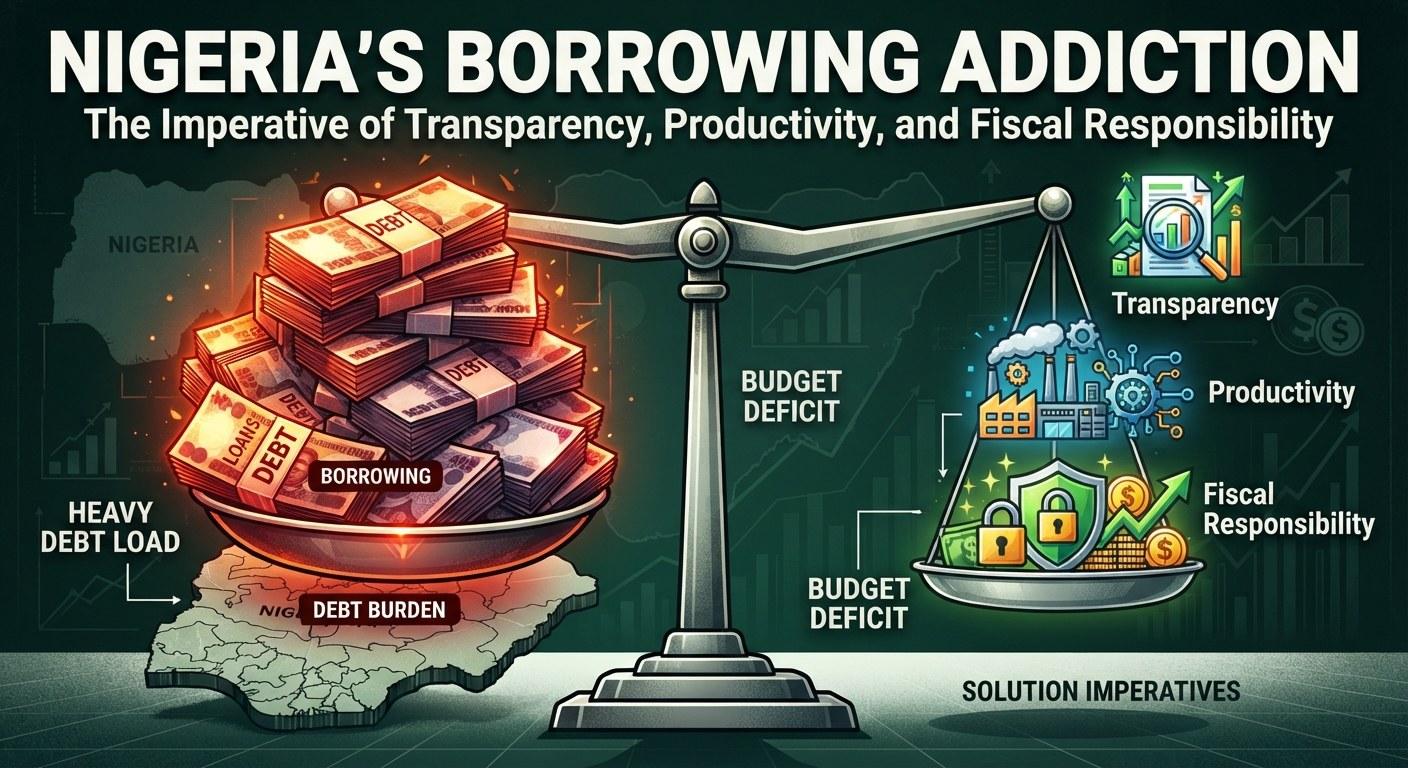
Nigeria stands at a perilous economic crossroads where the temptation to borrow has become almost irresistible to successive governments, while the obligation to account for borrowed funds appears to have receded into the background of public finance administration. It is against this troubling backdrop that the intervention of renowned economist, Professor Akpan Ekpo, urging the Federal Government to suspend its proposed external borrowing, deserves serious national consideration.
Ekpo’s position is neither an ideological rejection of borrowing nor an attempt to obstruct government’s developmental ambitions. Rather, it is a compelling call for prudence, accountability, economic rationality and a fundamental reassessment of the nation’s fiscal priorities. His argument strikes at the very heart of Nigeria’s development dilemma: a country perpetually in search of financial resources, yet struggling to demonstrate that the resources already acquired have translated into commensurate improvements in the lives of its citizens.
The proposed borrowing of approximately $20 billion and €1.73 billion, coming barely months before the 2027 general elections, should therefore not be treated as another routine financial transaction. It warrants the most rigorous scrutiny by the National Assembly, the economic community and the Nigerian public.
Borrowing Is Not The Problem; The Absence Of Accountability Is
There is nothing inherently objectionable about borrowing. Nations borrow to finance infrastructure, expand productive capacity, modernise industries and accelerate development. Indeed, responsible borrowing can be an indispensable instrument of economic transformation, particularly for developing countries confronted with enormous infrastructure deficits.
The distinction, however, lies between borrowing to create wealth and borrowing merely to sustain expenditure.
A country that borrows to construct productive infrastructure, expand electricity generation, improve transportation networks, modernise agricultural systems and establish industrial capacity may reasonably expect the investment to generate economic returns sufficient to service its obligations.
But a country that borrows without clearly defined objectives, verifiable implementation plans and measurable outcomes risks converting temporary financial relief into permanent economic bondage.
Ekpo’s insistence on feasibility studies, cost-benefit analyses and transparency should therefore become the governing principle of Nigeria’s borrowing policy. Before contracting additional loans, the government must demonstrate precisely what the money will accomplish, how much the projects will cost, who will execute them, when they will be completed and what measurable benefits Nigerians should expect.
The familiar invocation of roads, bridges, electricity and other infrastructure is insufficient. Such broad descriptions, without project-specific information, expenditure breakdowns and independent monitoring, create an atmosphere of opacity that undermines public confidence.
The Nigerian people are not asking for miracles. They are demanding accountability for their collective patrimony.
The National Assembly Must Rise Above Routine Approvals
Perhaps the most disturbing dimension of the borrowing controversy is the apparent inadequacy of legislative oversight.
The National Assembly occupies a constitutionally significant position in the management of public finance. Its responsibility extends beyond approving government requests and endorsing executive proposals. It must interrogate the assumptions underpinning borrowing plans, examine their implications for debt sustainability and insist on evidence that the proposed expenditure will advance national development.
A legislature that merely rubber-stamps borrowing requests abdicates its constitutional responsibility and weakens the foundations of democratic accountability.
The Senate and House of Representatives must demand comprehensive documentation covering the intended projects, procurement arrangements, implementation timelines, repayment schedules, interest obligations and anticipated economic returns.
They must also establish mechanisms for monitoring the utilisation of borrowed funds and periodically reporting progress to Nigerians.
The country cannot afford a situation in which loan agreements receive enthusiastic legislative approval while their implementation becomes shrouded in administrative secrecy.
Legislators must understand that the burden of debt is not confined to the executive branch that contracts it. It ultimately falls on the Nigerian people, including generations yet unborn.
The Intergenerational Injustice Of Unproductive Debt
Ekpo’s warning about the intergenerational consequences of borrowing deserves particular attention.
Debt is not merely an accounting entry. It is a claim on future national income. Every loan contracted today creates an obligation that must eventually be discharged through taxation, revenue mobilisation, refinancing or some combination of these measures.
When borrowed resources finance productive investments, future generations inherit both the obligation and the economic assets capable of generating returns.
When borrowed resources disappear into inefficient expenditure, abandoned projects, inflated contracts or poorly conceived programmes, future generations inherit the liabilities without receiving the corresponding benefits.
This is the fundamental injustice of irresponsible borrowing.
Nigeria’s younger population already confronts unemployment, deteriorating infrastructure, inadequate educational opportunities, rising living costs and limited access to economic advancement. To saddle this generation with enormous debt obligations without simultaneously expanding its productive opportunities would constitute a profound failure of intergenerational responsibility.
The government must therefore answer a question that transcends partisan politics: what tangible economic inheritance will today’s borrowing leave for tomorrow’s Nigerians?
Debt-To-Revenue Ratio: The Real Fiscal Warning
Ekpo’s emphasis on the debt-to-revenue ratio, rather than an exclusive reliance on debt-to-GDP calculations, highlights an important weakness in Nigeria’s public finance debate.
GDP measures the overall size of an economy, but government revenue determines its immediate capacity to meet debt obligations.
A country may possess a substantial economic base yet generate insufficient public revenue to service its debts comfortably. This is particularly consequential for Nigeria, where the government’s revenue-generating capacity has historically been constrained by dependence on oil exports, weak tax administration and a large informal economy.
Oil prices fluctuate according to international market conditions beyond Nigeria’s control. Production levels are vulnerable to insecurity, operational disruptions, infrastructure constraints and other domestic challenges.
Consequently, a fiscal system heavily dependent on petroleum receipts remains exposed to external shocks.
The government must urgently broaden its revenue base through productive economic activity, improved tax administration, export diversification and stronger domestic industries.
However, expanding taxation without expanding production and household incomes would merely transfer the burden of fiscal irresponsibility to already struggling citizens and businesses.
The solution is not simply to extract more revenue from Nigerians. It is to create an economy capable of generating more wealth.
Manufacturing Must Become The Centrepiece Of Economic Transformation
One of Ekpo’s most compelling arguments concerns manufacturing.
Nigeria’s ambition to become a $1 trillion economy by 2030 cannot be realised through consumption, importation and financial transactions alone. It requires a fundamental expansion of productive capacity.
The figures cited by the economist are particularly sobering. Manufacturing has contributed less than 12 per cent to GDP over approximately six decades, while manufactured goods account for only about two per cent of exports. Meanwhile, manufacturing imports reportedly represented 48 per cent of total imports in 2025.
These figures expose the structural contradictions of an economy that aspires to industrial greatness while importing an enormous proportion of the goods consumed by its population.
A nation that imports finished products extensively while exporting comparatively little manufactured merchandise will struggle to generate sustainable foreign exchange, create sufficient industrial employment or establish resilient economic foundations.
Manufacturing must therefore become a central pillar of national economic policy.
This requires more than speeches about industrialisation. It demands reliable electricity, accessible credit, efficient transportation, functional ports, competitive taxation, stable exchange-rate conditions and predictable government policies.
The cost of generating electricity independently, transporting raw materials, importing machinery and accessing financing continues to undermine the competitiveness of Nigerian manufacturers.
Government must confront these structural obstacles with urgency.
Small and medium-sized enterprises, which constitute a vital component of the productive economy, deserve particular attention. They need affordable financing, simplified regulatory procedures, dependable infrastructure and a business environment in which policy announcements translate into practical assistance.
The repeated failure of well-intentioned government programmes to achieve their objectives suggests that implementation, rather than policy formulation alone, remains a major weakness.
Capital Expenditure Must Produce Visible Results
Ekpo’s concern about inadequate releases for capital expenditure raises another fundamental question: what purpose does borrowing serve if the resources are not deployed efficiently and promptly?
Capital expenditure is supposed to create the infrastructure and productive assets upon which economic growth depends. When appropriated funds are not released, projects are delayed, construction costs escalate and anticipated economic benefits are postponed.
The government must therefore undertake a comprehensive review of the budgetary process, including the relationship between borrowing, appropriation, cash releases and project implementation.
There must be greater discipline in selecting projects, prioritising those with demonstrable economic and social returns.
The emphasis should be on completing viable projects rather than distributing limited resources across numerous initiatives that remain unfinished for years.
A completed electricity project that improves industrial productivity is more valuable than several abandoned power initiatives. A functional road connecting agricultural communities to markets is more beneficial than an expensive project that exists primarily in budget documents.
The test of public expenditure must be its impact on national productivity and citizens’ welfare.
Borrowing Before An Election: A Question Of Timing And Trust
The timing of the proposed external borrowing, only months before the 2027 elections, introduces an additional dimension of concern.
This does not automatically establish that the borrowing is politically motivated or improper. Nevertheless, the proximity to an election makes transparency and public scrutiny particularly indispensable.
Government must demonstrate that the borrowing is driven exclusively by legitimate developmental requirements and not by electoral considerations.
The possibility that additional borrowing could inject substantial liquidity into the economy and intensify inflationary pressures must also be carefully assessed.
Nigeria’s economy remains vulnerable to rising prices, exchange-rate pressures and the erosion of household purchasing power. Any fiscal expansion must therefore be evaluated against its potential consequences for inflation, monetary stability and the cost of living.
Economic policy cannot be divorced from the realities confronting ordinary Nigerians.
Nigeria Must Redefine Its Development Philosophy
Ultimately, the borrowing controversy is symptomatic of a deeper national problem: Nigeria has yet to establish a sufficiently durable relationship between public expenditure and productive economic transformation.
The country cannot borrow its way into prosperity indefinitely.
External loans may provide temporary financial relief, but they cannot substitute for industrialisation, institutional discipline, effective governance and economic diversification.
The Federal Government should suspend the proposed borrowing until comprehensive project assessments, transparent financing arrangements and credible implementation frameworks are publicly established.
The National Assembly must conduct a thorough, independent examination of the proposals. Nigerians must be informed about the intended projects, the financial obligations involved and the expected developmental outcomes.
More importantly, the government must demonstrate that previous borrowing has generated measurable economic benefits.
Professor Akpan Ekpo’s intervention should not be dismissed as another warning from the academic community. It represents an opportunity to reconsider the foundations of Nigeria’s fiscal policy.
The nation must move away from the dangerous illusion that borrowing constitutes development in itself.
Development is measured by factories operating, electricity available, businesses expanding, exports increasing, jobs being created and citizens enjoying improved living standards.
Nigeria’s future cannot be secured by accumulating liabilities while neglecting the productive capacity necessary to discharge them.
The government must choose between borrowing as an instrument of transformation and borrowing as an escape from the consequences of inadequate economic management.
That choice will determine whether future generations inherit a prosperous, industrialising nation or an economy burdened by obligations contracted in their name but squandered before their arrival.