 PublicSphere Live
Business
Nigeria’s Foreign Reserves Rise by $295m in October as Accumulation Slows, Naira Faces Renewed Pressure
Despite maintaining reserves above $55 billion, Nigeria faces the challenge of translating its growing external buffer into lasting naira stability, improved investor confidence and sustainable economic growth.
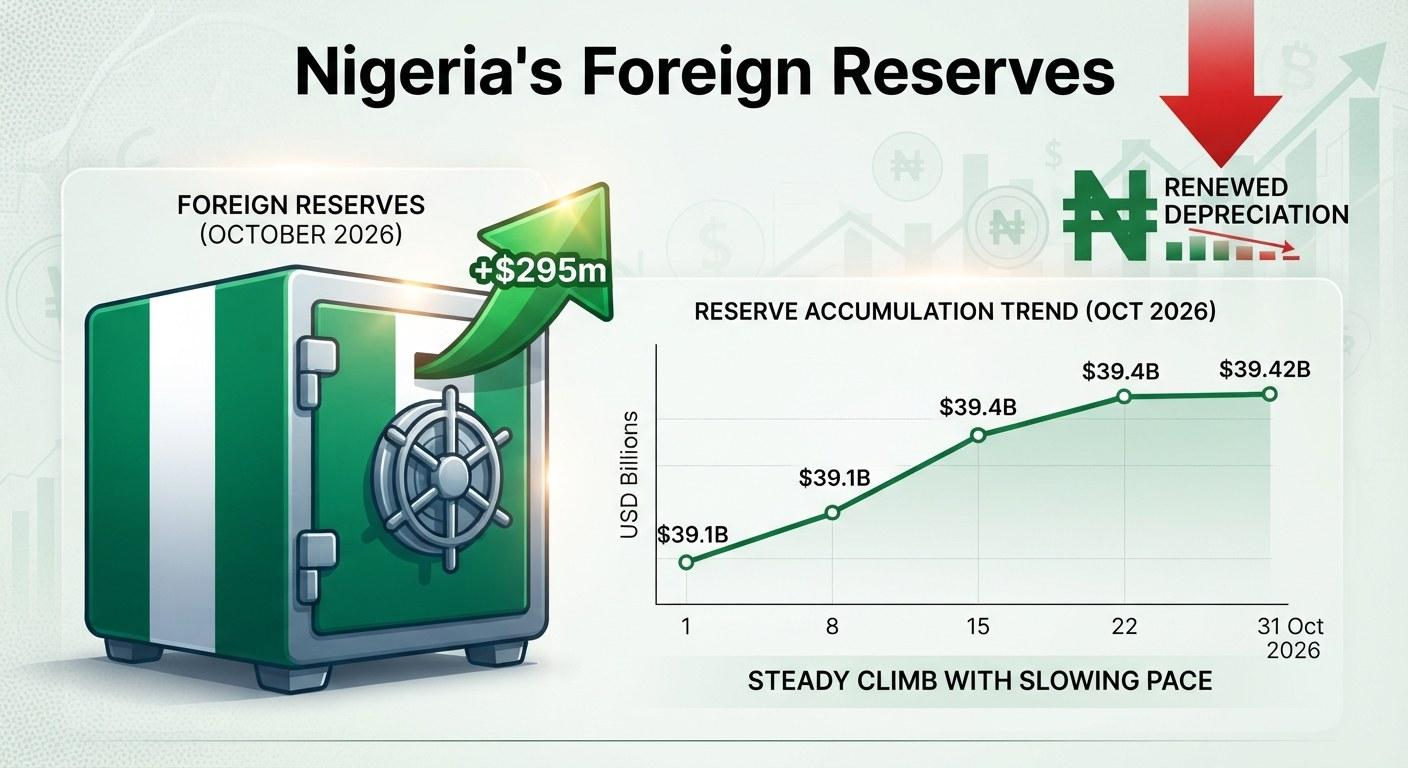
Nigeria’s gross foreign exchange reserves increased by $295.35 million in October 2026 to $55.22 billion, marking the slowest positive monthly growth this year. The moderation raises questions about the sustainability of reserve accumulation, foreign exchange supply, currency stability and the country’s capacity to withstand external economic shocks.
Nigeria’s foreign exchange reserves continued their upward trajectory in October 2026, but the pace of accumulation slowed significantly, highlighting the delicate balance between improving external liquidity and mounting pressures on the country’s foreign exchange market.
Data from the Central Bank of Nigeria (CBN) indicate that gross foreign exchange reserves increased by $295.35 million during the month, rising from approximately $54.93 billion at the end of September to $55.22 billion on October 30.
Although the increase represents another positive month for Nigeria’s external reserves, it is significantly smaller than the gains recorded in several preceding months. October’s performance therefore presents a mixed picture of the country’s external economic position: reserves are strengthening in absolute terms, but the momentum behind their accumulation appears to be weakening.
The development comes at a time when Nigeria is seeking to consolidate economic reforms, improve foreign exchange liquidity, stabilise the naira and restore investor confidence following years of volatility in the currency market.
The critical question is whether the current reserve accumulation trajectory can be sustained and whether the growing external buffer will translate into meaningful improvements in the wider economy.
Reserve Accumulation Loses Momentum
Nigeria’s foreign reserves have experienced considerable fluctuations throughout 2026, reflecting the changing dynamics of foreign exchange inflows, external obligations and monetary policy operations.
February was particularly strong, with reserves increasing by approximately $3.41 billion. This was the largest monthly accumulation recorded among the figures provided for the year.
However, the impressive performance was followed by contractions in March and April, when reserves declined by approximately $455.52 million and $874.45 million, respectively.
The reversal suggested that reserve accumulation was not yet firmly established as a consistent trend, with the country’s external position remaining vulnerable to fluctuations in foreign currency receipts and expenditure.
The situation improved in May, when reserves gained approximately $1.22 billion. June followed with an increase of $1.88 billion, while July recorded a more modest gain of $464.87 million.
August delivered another substantial increase of approximately $1.88 billion, followed by a $1.12 billion addition in September.
October’s $295.35 million increase represents a considerable slowdown compared with these preceding months.
The contrast is particularly striking when October is compared with February, June and August, when Nigeria recorded much stronger reserve accumulation.
While the October figures do not necessarily indicate an impending deterioration in the external position, they suggest that the forces supporting reserve growth may be weakening or that competing demands on foreign currency resources have increased.
For policymakers, the immediate challenge is to understand whether the moderation reflects temporary fluctuations or a more fundamental slowdown in foreign exchange earnings and inflows.
What The $55.22 Billion Reserve Position Means
Nigeria’s gross foreign reserves are among the most important indicators of its external economic strength.
They represent foreign currency assets held by the monetary authorities and provide resources that can support international payments, external debt obligations and foreign exchange market operations.
At $55.22 billion, Nigeria’s reserves remain substantial in absolute terms.
A strong reserve position can provide protection against external shocks, improve the country’s ability to meet international financial obligations and strengthen confidence among investors, creditors and trading partners.
It can also give monetary authorities greater flexibility in responding to excessive volatility in the foreign exchange market.
For an economy such as Nigeria’s, which depends significantly on imports and oil-related foreign currency earnings, maintaining adequate reserves is particularly important.
However, the size of gross reserves alone does not provide a complete picture of external economic sustainability.
The quality, accessibility and composition of reserves, alongside the country’s short-term foreign currency obligations, are equally important.
A reserve position that appears comfortable in headline terms may become less reassuring if foreign currency commitments increase substantially or if inflows become unstable.
This explains why the recent improvement in Nigeria’s net foreign reserves is attracting attention.
According to an earlier report, net reserves rose to a record $46 billion.
Net reserves offer a different perspective because they account for certain short-term foreign currency liabilities and other adjustments.
The distinction is important because investors and analysts increasingly assess the country’s capacity to withstand external pressures by looking beyond gross reserve figures.
The improvement in net reserves provides an additional positive signal, although maintaining the gains will require stronger and more predictable foreign exchange inflows.
The Naira’s October Reversal Raises Questions
One of the most significant developments accompanying the slowdown in reserve accumulation was the naira’s renewed weakness in October.
After strengthening during the preceding three months, the currency reversed approximately 42 per cent of its July–September gains.
The naira weakened from N1,329.50 per dollar at the end of September to N1,346 per dollar on October 30.
This development is important because reserve accumulation and exchange rate stability are closely connected, even though they do not necessarily move in the same direction at every point.
A country can increase its reserves while experiencing currency depreciation, particularly where foreign exchange inflows remain insufficient to satisfy market demand or where other factors influence currency pricing.
The October experience suggests that Nigeria’s growing reserve position has not completely insulated the naira from market pressures.
The currency’s performance indicates that foreign exchange market stability remains a work in progress.
For businesses, currency depreciation can increase the cost of imported raw materials, machinery, production inputs and finished goods.
Manufacturers may face higher operating expenses, while import-dependent businesses could experience pressure on profit margins.
These costs may eventually be transmitted to consumers through higher prices, potentially complicating efforts to reduce inflation.
The renewed pressure on the naira also creates uncertainty for investors attempting to assess the country’s exchange rate outlook.
Consequently, the challenge for monetary authorities is not simply to accumulate reserves but to ensure that foreign exchange supply becomes sufficiently dependable to support a more stable market.
Oil Revenues And Foreign Exchange Inflows
Nigeria’s ability to sustain reserve accumulation remains closely linked to the performance of its foreign exchange-generating sectors.
Crude oil exports remain a significant source of foreign currency earnings, making production levels, international oil prices and export receipts important determinants of the country’s external position.
However, relying heavily on petroleum-related earnings leaves Nigeria exposed to fluctuations in global oil markets.
A decline in international prices, disruptions in production or lower export receipts could weaken foreign currency inflows and limit the pace of reserve accumulation.
Similarly, improvements in oil prices may not automatically translate into stronger reserves if production challenges, domestic fiscal requirements and external obligations absorb a substantial portion of the proceeds.
This underscores the importance of broadening Nigeria’s foreign exchange earnings beyond crude oil.
Non-oil exports, manufacturing, agriculture, services, technology and tourism could contribute to a more diversified foreign exchange base.
Nigeria also needs to strengthen its ability to retain more foreign currency within the domestic economy.
Export-oriented industries could play a significant role in this process by generating foreign exchange while creating employment and supporting industrial development.
The broader objective should be to establish an economy capable of generating foreign currency through productive activities rather than depending excessively on commodity exports and external financing.
Foreign Investment And Capital Flows
Foreign investment remains another important factor in the country’s reserve outlook.
Nigeria’s economic reforms have been aimed partly at improving the attractiveness of the investment environment, strengthening market transparency and addressing distortions in the foreign exchange system.
A more predictable exchange rate regime could encourage foreign investors to increase their exposure to Nigerian assets.
However, investors remain sensitive to currency volatility, inflation, interest rates, political uncertainty and the ability to repatriate capital and investment proceeds.
The October slowdown in reserve accumulation does not necessarily indicate a reversal in investor sentiment, but it reinforces the need for policymakers to maintain confidence in the country’s external liquidity position.
Foreign portfolio investments can provide immediate liquidity, but they are often sensitive to changing global financial conditions.
Consequently, Nigeria cannot afford to rely excessively on short-term capital inflows to support its reserves.
Long-term foreign direct investment is potentially more beneficial because it can finance productive capacity, create jobs, transfer technology and improve export competitiveness.
The country’s ability to attract such investment will depend significantly on improvements in infrastructure, electricity supply, regulatory consistency and the ease of doing business.
Monetary Policy And The Reserve Challenge
The CBN faces a delicate policy balancing act.
On one hand, maintaining adequate reserves is essential for external stability and investor confidence.
On the other, monetary policy decisions must support domestic economic activity, control inflation and ensure that businesses can access foreign exchange at reasonable and predictable costs.
The October reserve figures suggest that policymakers should remain attentive to the relationship between foreign exchange liquidity, currency stability and domestic economic conditions.
A stronger reserve position can provide greater flexibility, but it cannot substitute for fundamental improvements in foreign currency supply.
The effectiveness of monetary policy will therefore depend partly on whether the CBN can sustain confidence in the foreign exchange market without undermining reserve adequacy.
At the same time, fiscal authorities must ensure that government borrowing, external debt servicing and expenditure commitments do not place excessive pressure on the country’s external resources.
Coordination between monetary and fiscal policy will be crucial in maintaining economic stability.
The Way Forward: From Reserve Growth To Economic Stability
Nigeria’s October reserve performance should neither be dismissed as a failure nor celebrated without qualification.
The increase to $55.22 billion represents a positive development, particularly when considered against the contractions recorded earlier in the year.
Nevertheless, the moderation in growth deserves attention because sustainable reserve accumulation is important for maintaining confidence in the economy.
The country must focus on strengthening the sources of foreign exchange earnings, improving export competitiveness, reducing dependence on imports where domestic production is viable and attracting stable long-term investment.
Efforts to improve oil production and revenue collection should be complemented by policies that encourage non-oil exports and industrial expansion.
The government must also address structural constraints that discourage investment, including unreliable electricity, inadequate infrastructure and high production costs.
Ultimately, the objective should be to build reserves through economic productivity rather than temporary inflows or financial engineering.
Conclusion
Nigeria’s foreign reserves remain above $55 billion, providing an important buffer against external economic shocks.
However, October’s $295.35 million increase, the slowest positive monthly growth recorded so far in 2026, highlights the need for caution.
The simultaneous weakening of the naira demonstrates that reserve accumulation alone cannot guarantee exchange rate stability.
The country’s economic outlook will depend increasingly on its capacity to generate sustainable foreign exchange earnings, attract productive investment and improve the competitiveness of domestic industries.
For the CBN and the federal government, the challenge is to convert the country’s growing external reserves into lasting economic confidence.
The real measure of success will not simply be how high Nigeria’s reserves rise, but whether the accumulation translates into a more stable naira, lower inflationary pressures, improved investor confidence and a stronger productive economy.