 PublicSphere Live
Capital Market
NGX ASI Edges Up 0.02% as Trading Activity Slows, Investors Adopt Cautious Position
The performance suggests that the market's overall resilience was driven by selective demand for certain equities rather than a broad-based rally across the Nigerian Exchange Limited .
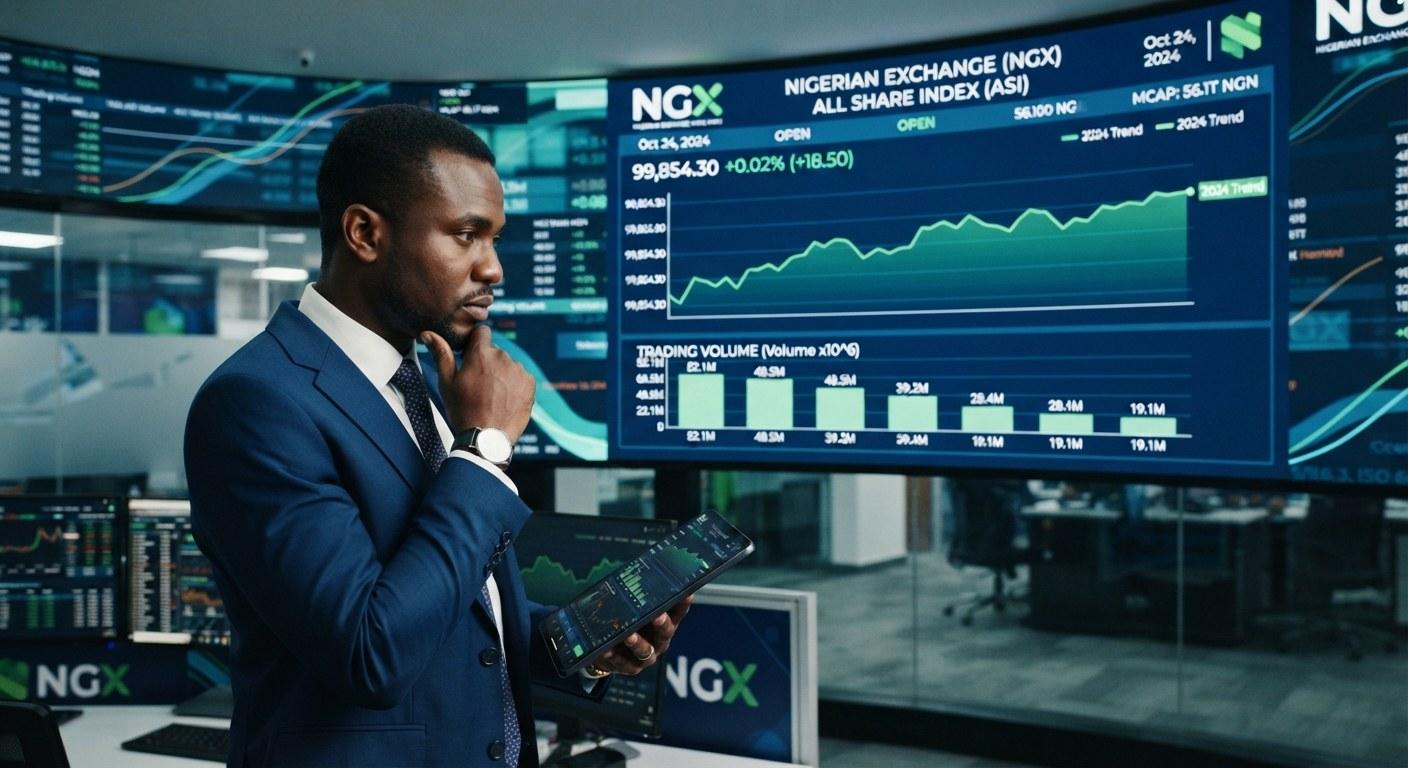
The Nigerian equities market sustained its positive trajectory on Tuesday, November 3, 2026, as the benchmark NGX All-Share Index (ASI) advanced marginally by 44.14 points, or 0.02 per cent, to close at 254,289.35 points. The modest appreciation reflected a market characterised by subdued trading activity, selective buying interest and persistent selling pressure across several listed equities.
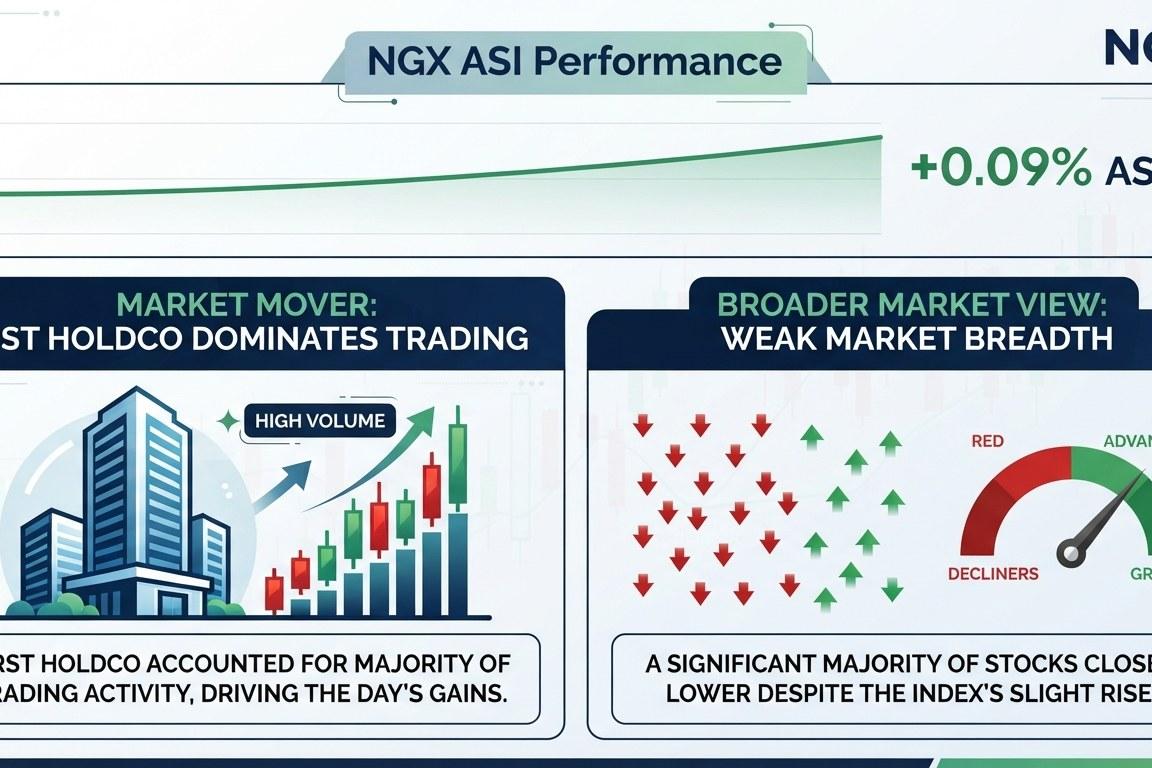
Although the ASI maintained its upward movement, the session presented a mixed picture of investor sentiment. Market breadth remained negative, with 32 equities recording price declines against 20 gainers, while trading volume, turnover and the number of deals all contracted significantly compared with the previous session.
The performance suggests that the market's overall resilience was driven by selective demand for certain equities rather than a broad-based rally across the Nigerian Exchange Limited (NGX).
The market's capitalisation remained at approximately ₦165.1 trillion, equivalent to about $123 billion, underscoring the substantial expansion in equity valuations recorded over the course of the year.
The latest session also demonstrated the importance of distinguishing between the movement of the benchmark index and the actual performance of individual stocks. While the ASI closed higher, a larger number of equities lost value, indicating that the positive index movement did not necessarily translate into gains for the majority of investors.
ASI Maintains Positive Momentum
The NGX All-Share Index closed at 254,289.35 points, gaining 44.14 points from the previous trading session. The 0.02 per cent increase extended the market's positive movement, although the appreciation was relatively insignificant compared with the substantial gains accumulated in previous months.
The benchmark recorded a one-week gain of 0.12 per cent and a four-week appreciation of 1.6 per cent. Its year-to-date return stood at an impressive 63.41 per cent.
The performance represents a remarkable recovery and expansion in market valuations during 2026. Despite periodic corrections, investors have continued to demonstrate interest in equities, supported by the search for returns and the potential for capital appreciation.
However, the marginal daily increase suggests that the market may be entering a period of consolidation following its strong year-to-date performance. Investors appear increasingly selective, with buying interest concentrated in particular stocks and sectors.
The ASI's positive close, despite the dominance of declining equities, also points to the influence of individual stocks with significant market weights. In a market where large-capitalisation companies can exert considerable influence on the benchmark, gains in a limited number of heavily weighted equities may offset losses elsewhere.
This explains why the index can appreciate even when more stocks decline than advance.
Trading Activity Contracts Significantly
The trading session recorded 398,434,319 shares exchanged in 39,025 deals, with a total market value of ₦20.42 billion.
Compared with Monday, November 2, trading volume declined by 23 per cent, turnover fell by 57 per cent, while the number of deals dropped by 28 per cent.
These contractions represent one of the most significant features of Tuesday's trading.
The decline in volume indicates that fewer shares changed hands, while the substantial reduction in turnover suggests that the value of transactions fell even more sharply.
The difference between the decline in volume and turnover could indicate that investors traded relatively lower-priced equities or reduced their exposure to higher-value transactions. However, the available market summary does not provide sufficient information to establish the precise cause.
The reduction in deals also suggests a moderation in trading participation or transaction frequency.
Nevertheless, the market still recorded nearly 400 million shares traded, demonstrating that investor participation remained substantial in absolute terms.
The combination of reduced turnover and a marginal ASI increase suggests a relatively quiet session in which limited buying interest was sufficient to support the benchmark.
Such conditions may reflect a temporary pause as investors reassess valuations, consider profit-taking opportunities and evaluate the direction of the market.
NGX Consumer Goods Index Leads Sector Performance
Among the reported sectoral and market indices, the NGX Consumer Goods Index emerged as the best-performing sectoral index on Tuesday, advancing by 0.18 per cent.
The performance placed consumer goods ahead of the banking and oil and gas indices, which appreciated by 0.03 per cent and 0.02 per cent, respectively.
The consumer goods sector's positive performance is particularly noteworthy given its exposure to Nigeria's domestic economic conditions, including household purchasing power, inflation, production costs and consumer demand.
A gain of 0.18 per cent is modest, but its relative outperformance suggests that investors showed greater appetite for consumer goods equities than for other major sectors represented in the summary.
The sector's performance could reflect selective positioning in companies considered capable of navigating current economic conditions. However, without detailed individual sector constituents' trading data, it would be premature to attribute the gain to a particular company or fundamental development.
The NGX Consumer Goods Index remains under pressure over the shorter term, having declined by 1.08 per cent over one week. Its year-to-date performance is also marginally negative at -0.11 per cent.
This means Tuesday's gain represents a daily improvement rather than evidence of a sustained sector-wide recovery.
For investors, the consumer goods sector remains an area to monitor for possible changes in market sentiment.
Banking And Oil And Gas Indices Record Modest Gains
The NGX Banking Index advanced by 0.03 per cent on Tuesday, bringing its year-to-date return to 57.46 per cent.
Despite the daily appreciation, the banking index has lost 7.29 per cent over the preceding week.
This divergence between daily and weekly performance indicates that the sector's latest gain has not yet reversed its recent weakness.
Banking equities remain important to the Nigerian market because of their substantial contribution to market capitalisation, liquidity and investor activity.
The sector's strong year-to-date performance reflects the broader strength of the equities market, although recent losses suggest that investors may be reassessing valuations or taking profits.
The NGX Oil and Gas Index also advanced by 0.02 per cent, bringing its year-to-date return to 119.4 per cent.
This was the strongest year-to-date performance among the sectoral indices highlighted in the trading summary.
However, the index declined by 3.78 per cent over one week, indicating that recent market activity has been less favourable.
The oil and gas sector's extraordinary year-to-date appreciation underscores the importance of energy-related equities in the market's overall performance.
Investors will nevertheless need to distinguish between historical returns and future prospects, particularly as short-term market corrections can occur after substantial price appreciation.
The NGX Main Board Index gained 0.01 per cent, while the NGX Top 30 Index advanced by 0.08 per cent.
The NGX Premium Index recorded a 0.03 per cent increase.
The Premium Index's year-to-date appreciation of 118.54 per cent and the Top 30 Index's 65.46 per cent return further illustrate the substantial gains accumulated by selected market segments in 2026.
University Press Leads Gainers As Omatek, International Breweries Follow
University Press emerged as the best-performing equity of the day, appreciating by 9.52 per cent to close at ₦4.60 per share.
The stock's performance placed it at the top of the gainers' table, reflecting strong buying interest during the session.
Omatek Ventures followed with an 8.59 per cent appreciation, while International Breweries gained 6.47 per cent. Royal Exchange completed the leading gainers with a 5.26 per cent increase.
Top Five Gainers
EquityDaily change
University Press+9.52%
Omatek Ventures+8.59%
International Breweries+6.47%
Royal Exchange+5.26%
The performance of these equities demonstrates that substantial opportunities for capital appreciation remain available within the market, even when the benchmark index records only marginal gains.
University Press and Omatek Ventures, in particular, recorded appreciations significantly above the ASI's 0.02 per cent increase.
However, investors should exercise caution when interpreting these gains. Strong daily price movements do not necessarily indicate sustainable upward momentum, particularly where trading liquidity, corporate fundamentals and valuation considerations have not been established.
International Breweries' 6.47 per cent appreciation is also notable against the broader consumer goods sector's positive performance.
Although the company's individual gain cannot explain the entire sector's movement, its performance may have contributed to positive sentiment in consumer-related equities.
Fortis Global Insurance Leads Losers
On the losing side, Fortis Global Insurance recorded the steepest decline, shedding 10 per cent to close at ₦1.53 per share.
Vitafoam Nigeria followed closely, losing 9.99 per cent, while UPDC Real Estate Investment Trust declined by 9.95 per cent.
Abbey Bank recorded a depreciation of 8.73 per cent.
Leading Losers
EquityDaily change
Fortis Global Insurance-10.00%
Vitafoam Nigeria-9.99%
UPDC REIT-9.95%
Abbey Bank-8.73%
The declines underscore the considerable pressure facing selected equities despite the market's positive overall close.
The near-double-digit losses recorded by Fortis Global Insurance, Vitafoam Nigeria and UPDC REIT suggest intense selling pressure in those stocks during the session.
However, the available trading summary does not establish whether the declines were driven by profit-taking, company-specific developments, valuation concerns or other market factors.
Investors should therefore avoid attributing the losses to particular developments without further information.
The negative market breadth, with 32 losers against 20 gainers, reinforces the view that the session was not broadly positive for equity holders.
Access Holdings Dominates Trading Volume
Access Holdings recorded the highest trading volume, with 42.6 million shares exchanged during the session.
Chams followed with 25.4 million shares, while VFD Group recorded 23.2 million shares.
International Energy Insurance completed the leading four with 19.5 million shares traded.
Most Actively Traded Equities By Volume
EquityVolume
Access Holdings42.6 million
Chams25.4 million
VFD Group23.2 million
International Energy Insurance19.5 million
Access Holdings' position at the top of the volume table highlights its continued importance to market liquidity.
The strong trading activity in Chams and VFD Group also demonstrates that investor attention was not restricted to the banking sector or the largest companies on the exchange.
However, trading volume alone does not indicate whether investors were accumulating or disposing of shares. A stock can record substantial volume during either buying or selling pressure.
The direction of price movement, together with transaction patterns and subsequent sessions, is therefore important in interpreting market activity.
Year-To-Date Performance Remains Impressive
Despite Tuesday's modest appreciation, the Nigerian equities market continues to deliver substantial year-to-date returns.
The ASI's 63.41 per cent appreciation places the market among the stronger-performing investment segments in the country this year.
The NGX Premium Index has gained 118.54 per cent, while the Oil and Gas Index has appreciated by 119.4 per cent.
The NGX Top 30 Index has advanced by 65.46 per cent, while the Banking Index has recorded a 57.46 per cent increase.
These performances demonstrate the scale of wealth creation that has occurred within selected segments of the equities market.
However, the substantial gains also raise questions about sustainability, valuation and the possibility of further profit-taking.
Investors who entered the market earlier in the year may be increasingly inclined to secure gains, particularly in equities that have appreciated significantly.
This could explain why individual stocks are experiencing sharp declines even as the broader benchmark remains positive.
Outlook: Market May Enter Consolidation Phase
The Nigerian equities market's performance on Tuesday reflects a combination of resilience and caution.
The marginal ASI appreciation, despite declining market breadth and weaker trading activity, suggests that investors remain selective rather than uniformly bullish.
The market's year-to-date performance remains impressive, but the latest session indicates that upward momentum may not be evenly distributed across sectors and individual equities.
Going forward, investors will likely pay greater attention to corporate earnings, valuations, dividend expectations, economic developments and liquidity conditions.
The Consumer Goods Index's relative outperformance may attract further attention, while the banking and oil and gas sectors remain important because of their substantial year-to-date returns.
Nevertheless, the recent weekly losses in these sectors suggest that investors should not assume that previous gains will automatically continue.
The contraction in turnover also deserves attention. Sustained reductions in trading activity could indicate weakening participation, although a single session is insufficient to establish a lasting trend.
Investors should therefore monitor subsequent sessions for evidence of renewed buying interest, stronger turnover and improved market breadth.
Conclusion
The NGX closed Tuesday's trading session marginally higher, with the ASI appreciating by 0.02 per cent to 254,289.35 points.
The Consumer Goods Index led the reported sectoral indices with a 0.18 per cent gain, while University Press emerged as the top-performing equity, appreciating by 9.52 per cent.
Fortis Global Insurance recorded the steepest decline at 10 per cent, while Access Holdings dominated trading volume with 42.6 million shares.
Although the market maintained its positive year-to-date performance, the dominance of losers and the substantial contraction in turnover suggest that investors are becoming increasingly selective.
The market's immediate direction will depend on whether buying interest broadens across equities or remains concentrated in a relatively small number of stocks.
For now, the Nigerian equities market remains firmly positive on a year-to-date basis, but Tuesday's session serves as a reminder that strong benchmark returns can coexist with significant losses in individual stocks.