 PublicSphere Live
Capital Market
NGX ASI Rises 0.19% To 254,762.81 As Market Capitalisation Holds At ₦165.4trn
Improved Trading Volume and Turnover Signal Renewed Investor Activity as Transcorp Power Leads Gainers
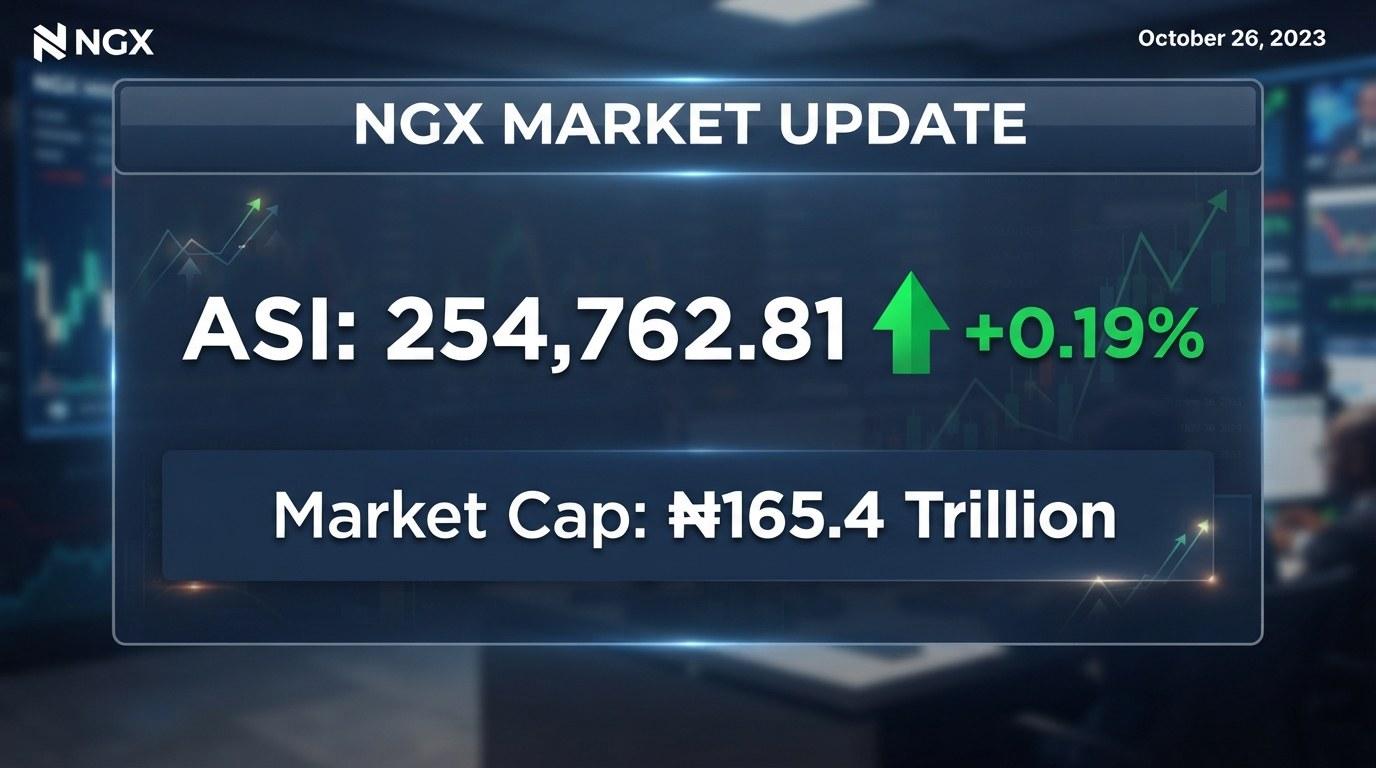
The Nigerian Exchange Limited (NGX) sustained its positive momentum on Wednesday, November 4, 2026, as the benchmark All-Share Index (ASI) advanced by 473.46 basis points, representing a 0.19 per cent appreciation, to close at 254,762.81 points. The modest increase reflected the market's continuing resilience, although the relatively narrow margin of appreciation suggested that investors remained cautious in positioning their portfolios amid prevailing market dynamics.
The latest trading performance further reinforced the Nigerian equities market's remarkable showing in 2026, with the ASI recording a year-to-date return of 63.72 per cent. This represents a substantial appreciation in market value and underscores the depth of the bullish run that has characterised trading activities on the Exchange throughout much of the year.
Market capitalisation remained at approximately ₦165.4 trillion, equivalent to about $123 billion, reflecting the considerable expansion in the valuation of listed equities and the growing significance of the Nigerian capital market within the country's financial system.
However, beneath the positive headline performance were indications of selective investment positioning, as investors continued to distinguish between stocks with attractive growth prospects and those facing profit-taking pressures.
Trading Activity Gains Momentum
Trading activities on Wednesday produced an encouraging improvement in market participation, with a total of 431.18 million shares exchanged in 32,815 deals, valued at ₦25.26 billion.
Compared with Tuesday's session, trading volume increased by eight per cent, while transaction value recorded a more impressive 24 per cent improvement. However, the number of deals declined by 16 per cent, suggesting that the increase in market activity was not necessarily accompanied by a corresponding expansion in the number of individual transactions.
This combination of rising volume and turnover alongside declining deals offers an interesting insight into the character of Wednesday's trading. It suggests that larger transactions and increased share accumulation by some investors contributed significantly to the improvement in market value.
The 24 per cent increase in turnover is particularly noteworthy because it indicates that investors committed more funds to equities during the session, notwithstanding the decline in the number of transactions.
Such developments may point to renewed institutional interest, portfolio adjustments and strategic positioning by investors seeking to take advantage of opportunities in selected counters.
Nevertheless, the sustainability of this momentum will depend on whether the increased financial commitment translates into broader market participation and consistent buying interest across different sectors.
A total of 133 listed equities participated in the day's trading, with 27 recording price appreciation and 23 closing in negative territory. The remaining stocks either maintained their previous closing prices or did not record price movements.
The market's positive breadth, although relatively modest, provided support for the ASI's upward movement.
Transcorp Power Leads Gainers
Transcorp Power emerged as the best-performing stock of the session, appreciating by 9.97 per cent to close at ₦203.00 per share.
The performance placed the electricity generation company at the forefront of Wednesday's gainers, reflecting sustained investor interest in the power sector and the investment opportunities associated with Nigeria's evolving energy landscape.
Caverton Offshore Support Group followed closely with a 9.84 per cent appreciation, while E-Tranzact International gained 9.68 per cent. Haldane McCall completed the leading four gainers with a 7.36 per cent increase.
The performance of these stocks demonstrates that investment interest was not restricted to the traditional heavyweight companies that dominate market capitalisation and trading activity.
Rather, investors appeared willing to explore opportunities across different segments of the market, including power, offshore support services and financial technology.
The strong showing by E-Tranzact is particularly interesting against the background of the growing importance of digital financial services, electronic payments and technology-driven financial transactions in Nigeria's economy.
Similarly, the appreciation recorded by Caverton suggests that selected companies within the maritime and offshore services segment continued to attract market attention.
These performances, however, should be evaluated against the fundamentals of the individual companies, including earnings prospects, business expansion, cash flows and their ability to sustain shareholder returns.
Eterna, Sovereign Trust Insurance Lead Losers
On the negative side, Eterna recorded the largest decline, shedding 9.94 per cent to close at ₦38.50 per share.
Sovereign Trust Insurance followed with a depreciation of 9.91 per cent, while Learn Africa declined by 9.84 per cent. Cornerstone Insurance also recorded a significant loss of 9.30 per cent.
The performance of these stocks reflected the continued presence of profit-taking and selling pressure in selected counters.
The declines recorded by two insurance companies, Sovereign Trust Insurance and Cornerstone Insurance, also highlighted the uneven nature of sectoral performance.
Investors should, however, distinguish between temporary market corrections and developments that may signal weakening corporate fundamentals. A decline in share price does not necessarily translate into a deterioration in the underlying business of a company.
For investors with longer investment horizons, such movements may create opportunities for reassessing valuations, provided the financial position and earnings outlook of the affected companies remain sound.
Access Holdings Dominates Trading Volume
In terms of trading volume, Access Holdings occupied the leading position with 53.7 million shares exchanged during the session.
Guaranty Trust Holding Company followed with 38.7 million shares, while Nigerian Exchange Group recorded 36.4 million shares. Zenith Bank completed the leading four most actively traded stocks with 29.7 million shares.
The dominance of these companies in trading activity reinforces the continuing importance of banking and financial services stocks in determining market liquidity and investor sentiment.
Access Holdings' leading position suggests considerable trading interest in the financial services group, while the participation of GTCO and Zenith Bank underscores the attraction of established banking institutions to investors seeking exposure to the sector.
The substantial volume recorded by Nigerian Exchange Group is also significant, given its position within the country's capital market infrastructure.
The concentration of trading activity among these companies demonstrates that investors continue to rely heavily on highly liquid and established stocks when making portfolio adjustments.
Banking Index Recovers As Sectoral Performance Remains Mixed
An examination of the sectoral indices revealed a mixed performance, although the banking sector provided one of the strongest positive contributions to the market's daily advance.
The NGX Banking Index appreciated by 0.72 per cent, outperforming the benchmark ASI's 0.19 per cent increase.
This performance suggests renewed buying interest in banking stocks, which have remained important drivers of market activity throughout the year.
However, the banking index's one-week performance remained negative at 4.37 per cent, indicating that Wednesday's appreciation had not completely reversed the recent weakness in the sector.
Its year-to-date gain of 58.59 per cent nevertheless demonstrates the substantial returns banking stocks have delivered to investors in 2026.
The NGX Pension Index advanced by 0.42 per cent during the session, while the NGX Main Board Index also gained 0.42 per cent.
The NGX Top 30 Index appreciated by 0.19 per cent, matching the benchmark's daily performance.
In contrast, the NGX Industrial Index recorded virtually no movement, while the NGX Oil and Gas Index declined marginally by 0.07 per cent.
The contrasting performances reveal that the market's positive direction was not uniformly supported by all sectors.
Of particular interest is the extraordinary year-to-date performance of the industrial sector, which has appreciated by 122.09 per cent. This makes it one of the strongest-performing segments of the Nigerian equities market in 2026.
The Oil and Gas Index has also delivered an impressive 119.25 per cent year-to-date return, despite its marginal decline on Wednesday.
These figures demonstrate that industrial and energy-related stocks have been major beneficiaries of the market's broader appreciation.
The Pension Index has gained 78.24 per cent year-to-date, while the Top 30 Index has appreciated by 65.77 per cent.
The banking sector's 58.59 per cent return and the Main Board Index's 41.42 per cent appreciation further illustrate the breadth of gains recorded across the Exchange.
Investors Must Look Beyond Short-Term Gains
The Nigerian equities market's 63.72 per cent year-to-date appreciation is undoubtedly impressive. However, the magnitude of the rally also makes prudent investment decisions increasingly important.
Following such substantial gains, investors must recognise the possibility of intermittent corrections as some shareholders seek to realise profits accumulated over the course of the year.
The market's performance on Wednesday suggests that buying interest remains present, but the relatively modest ASI appreciation, despite improved turnover, indicates that investors are not necessarily pursuing equities indiscriminately.
This selective approach may become more pronounced as investors increasingly examine corporate earnings, dividend prospects, balance-sheet strength and the ability of companies to withstand prevailing economic pressures.
The banking sector, in particular, will remain under close scrutiny as investors assess the implications of recapitalisation, lending conditions, asset quality and the capacity of financial institutions to sustain profitability.
Similarly, industrial companies will need to demonstrate that their impressive share-price performances are supported by improved production, operational efficiency and sustainable earnings growth.
The same considerations apply to the oil and gas sector, where investment decisions will increasingly depend on production performance, energy infrastructure, regulatory developments and the broader operating environment.
Outlook: Positive Momentum, But Selectivity Is Key
Going forward, the NGX is expected to remain influenced by liquidity conditions, corporate financial results, monetary policy developments and investors' assessment of the broader economic outlook.
The improvement in Wednesday's turnover provides an encouraging indication that investors remain active in the market. Nevertheless, the decline in the number of deals suggests that the increase in activity was concentrated in relatively fewer transactions.
For the bullish momentum to become more convincing, the market will need sustained improvements in both trading value and participation, supported by a wider distribution of gains across listed companies.
Investors should therefore avoid making investment decisions solely on the basis of recent price appreciation. Companies with strong fundamentals, credible earnings growth, attractive valuations and sustainable dividend policies are likely to offer more dependable opportunities over the longer term.
Ultimately, Wednesday's session reinforces the resilience of the Nigerian equities market and its capacity to sustain positive returns despite intermittent sectoral weaknesses and profit-taking.
With the ASI now at 254,762.81 points and market capitalisation standing at approximately ₦165.4 trillion, the Exchange remains firmly positioned within a remarkable year of expansion.
The challenge ahead is not merely to sustain the impressive numbers but to ensure that the market's growth is supported by stronger corporate performance, deeper investor participation and confidence in the long-term prospects of the Nigerian economy.