PublicSphere Live
Capital Market
NGX ASI Sheds 0.91% as Selling Pressure Deepens, Market Capitalisation Falls to ₦159.3trn
Market capitalisation settled at approximately ₦159.3 trillion, equivalent to about $120 billion, highlighting the scale of the value adjustment in a market that has nevertheless delivered substantial returns over the course of 2026.
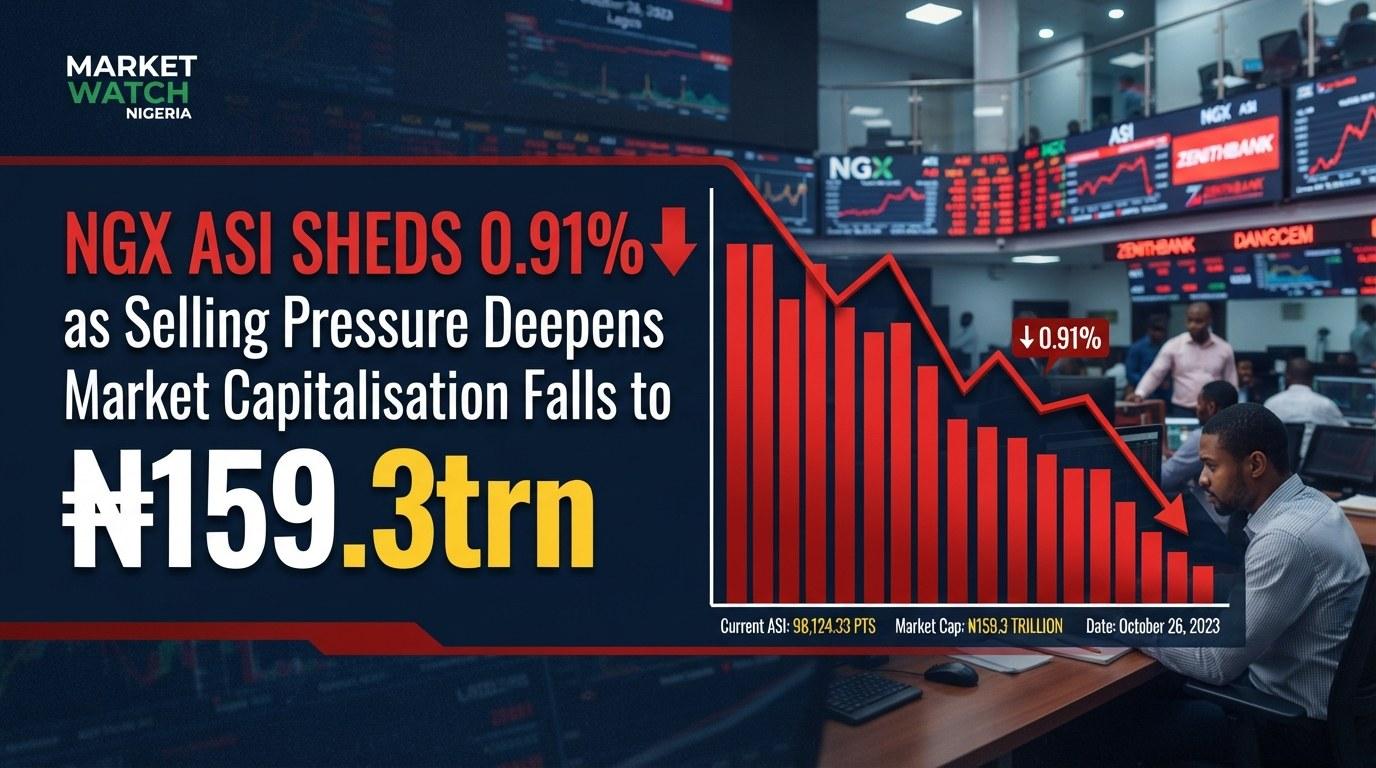
Nigeria’s equities market opened the new trading week on a bearish note on Monday as renewed selling pressure pushed the benchmark NGX All-Share Index (ASI) down by 0.91 per cent, even as trading activity improved significantly in volume, turnover and the number of deals executed.
The decline reflected a market in which increased participation did not translate into broad-based buying strength. Rather, the overwhelming balance between declining and advancing stocks suggested that investors remained cautious, with profit-taking, portfolio repositioning and selective demand shaping the direction of share prices.
The NGX All-Share Index lost 2,261.39 points to close at 245,278.34, down from the previous trading session’s 247,539.73 points. The decline reduced the market’s year-to-date gain to 57.62 per cent, while the four-week performance remained negative at 1.81 per cent. The market had also recorded a one-week loss of 0.99 per cent, indicating that the immediate pressure extended beyond Monday’s session.
Market capitalisation settled at approximately ₦159.3 trillion, equivalent to about $120 billion, highlighting the scale of the value adjustment in a market that has nevertheless delivered substantial returns over the course of 2026.
The session presented a significant contrast: investors traded more actively than they did on Friday, October 16, but the additional activity coincided with a pronounced decline in the benchmark index. This divergence between trading intensity and market direction offers an important insight into the changing balance of sentiment on the Nigerian Exchange.
Trading Activity Rebounds, But Buying Strength Remains Weak
The exchange recorded 349,343,580 shares traded in 43,115 deals, with a total transaction value of ₦17.99 billion. Compared with Friday’s session, share volume increased by 36 per cent, turnover advanced by 38 per cent, and the number of deals rose by 35 per cent.
These figures indicate a substantial recovery in market activity after the previous session recorded 257.67 million shares traded in 31,972 deals, valued at approximately ₦13.04 billion.
The increase in turnover is particularly noteworthy because it suggests that the stronger trading session was not driven exclusively by transactions in low-priced shares. Investors committed more money to equities, although the information available does not establish whether the additional transactions represented fresh investment, portfolio restructuring or the transfer of holdings between investors.
The average value traded per deal was approximately ₦417,500, compared with about ₦408,000 on Friday. This modest increase suggests that the average transaction size by value edged higher, although averages alone cannot establish whether institutional investors or retail traders were responsible for the additional activity.
More importantly, the improved liquidity did not produce a corresponding improvement in the overall direction of prices. Instead, the ASI fell by nearly one per cent, demonstrating that increased turnover can accompany a sell-off when the supply of shares offered for sale outweighs effective buying demand.
The session therefore requires a careful interpretation. Higher volume is not automatically bullish, just as a decline in the index does not necessarily imply that all investors are withdrawing from the market. Shares change hands during both accumulation and distribution, and the direction of prices, the breadth of the market and the composition of turnover provide a more useful assessment of sentiment than trading volume alone.
Monday’s figures point to a market with considerable transactional activity but insufficient buying pressure to prevent a broad decline.
Bears Dominate As 40 Stocks Decline Against 15 Gainers
The clearest indication of Monday’s negative market sentiment came from the breadth of performance across listed equities. Of the 134 stocks that participated in trading, 40 recorded price declines, while only 15 advanced.
This left the market with 25 more losers than gainers, a ratio of approximately 2.67 declining stocks for every advancing stock. The imbalance suggests that the weakness extended across several corners of the equities market rather than being confined exclusively to a handful of heavyweight companies.
Market breadth at a glance
Stocks traded
134
ASI decline
−0.91%
Gainers
15
Losers
40
The remaining 79 equities did not fall into either the reported gainer or loser categories.
The relatively small number of advancing stocks indicates that investors were unwilling, or insufficiently motivated, to support share prices across a broad range of companies. This can happen when investors seek to lock in profits after an extended rally, become concerned about valuations or redirect funds towards investments they consider more attractive.
However, the session's breadth does not establish a single cause for the sell-off. Without detailed investor-flow data and company-specific announcements, it would be premature to attribute the decline entirely to profit-taking or any particular macroeconomic development.
What the figures establish is that selling pressure was substantially more widespread than buying interest.
For investors, this distinction matters. A market can experience a decline in its headline index because a few large companies lose value, even when most stocks remain firm. Monday’s market, by contrast, recorded considerably more losers than gainers, suggesting a broader weakening of share-price performance.
The immediate challenge for the market is therefore not simply to recover the points lost by the ASI, but to demonstrate that demand is returning across a wider selection of listed companies.
Multi-Trex Leads Gainers As Vitafoam Suffers Sharp Decline
The day's individual stock performances revealed sharply contrasting fortunes among listed companies, with Multi-Trex Integrated Foods leading the gainers while Vitafoam Nigeria occupied the bottom of the losers' table.
Multi-Trex Integrated Foods appreciated by 10 per cent to close at ₦0.66 per share, emerging as the session's strongest performer. Its advance was followed by Critical Minerals Financing Corporation, which gained 9.97 per cent, Austin Laz & Company, up 9.93 per cent, and Thomas Wyatt Nigeria, which advanced by 9.92 per cent.
The gains recorded by these companies show that the market's overall weakness did not eliminate opportunities for selective appreciation. Even on a bearish day, stocks can attract buyers because of company-specific expectations, speculative interest, perceived undervaluation or technical trading patterns.
Nevertheless, the reported price increases alone do not establish the fundamental reasons behind the advances. Investors should distinguish between a stock's daily percentage gain and evidence of sustainable improvement in earnings, cash flow or business prospects.
The performance of Multi-Trex, in particular, illustrates how a stock can post a double-digit percentage gain while the wider market moves in the opposite direction. Such movements may attract short-term traders, but they also reinforce the importance of examining trading liquidity, available company information and the sustainability of price momentum before making investment decisions.
On the losing side, Vitafoam Nigeria declined by 10 per cent to close at ₦174.60 per share. Cutix followed with a loss of 9.79 per cent, while Omatek Ventures fell by 9.38 per cent. International Energy Insurance also came under pressure, shedding 6.48 per cent.
Vitafoam's decline was particularly significant because of the magnitude of its price adjustment. For shareholders holding the stock before the session, the 10 per cent fall represented a substantial one-day reduction in the market value of their holdings.
Yet, a single session's performance should not automatically be interpreted as evidence of deteriorating corporate fundamentals. Price movements can reflect several factors, including investors' expectations, liquidity conditions, portfolio adjustments and responses to company disclosures.
The appropriate response is to examine whether the weakness is accompanied by changes in earnings outlook, balance-sheet conditions, corporate announcements or other developments that could justify a reassessment of value.
The contrast between the strongest gainers and steepest losers reinforces the increasingly selective character of equity investing. In a market experiencing widespread declines, investors may need to place greater emphasis on the quality of individual businesses, valuation discipline and the ability of companies to sustain earnings.
Access Holdings, Livestock Feeds Lead Trading Volume
Access Holdings recorded the highest trading volume on Monday, with approximately 23.4 million shares changing hands. Livestock Feeds followed with 23.1 million shares, while United Bank for Africa recorded 22.8 million shares. Honeywell Flour Mill completed the leading group with 22.2 million shares traded.
The concentration of activity in these stocks suggests that investors continued to transact actively in companies with established market visibility or strong trading interest.
Access Holdings' position at the top of the volume table is notable because banking stocks are often important components of Nigerian market activity. Banks can attract substantial trading interest as investors assess their earnings prospects, capital positions, dividend potential and exposure to broader economic conditions.
United Bank for Africa's appearance among the most actively traded stocks further highlights the continuing importance of the banking sector to equity-market liquidity.
Livestock Feeds and Honeywell Flour Mill, meanwhile, demonstrate that activity was not confined to financial services. Their presence indicates that investors also traded actively in businesses exposed to agriculture, animal feed, food production and consumer demand.
However, high trading volume should not be confused with strong price performance. A heavily traded stock can rise, fall or remain unchanged, depending on the balance between buying and selling orders. The supplied figures do not establish the closing price movements of all four volume leaders, so their trading volumes should be interpreted as evidence of activity rather than as proof of investor confidence or pessimism.
For the market as a whole, the important question is whether the increased activity will be accompanied by stronger demand and improving breadth in subsequent sessions. If volume remains elevated while prices continue to fall and losers consistently outnumber gainers, the pattern could suggest continued distribution. Conversely, stabilising prices accompanied by renewed buying interest would provide a more encouraging signal.
At this stage, Monday's session establishes increased participation but not a confirmed change in the market's direction.
NGX All-Share Index Retreats As Four-Week Losses Widen
The NGX All-Share Index's 0.91 per cent decline was the defining feature of Monday's trading session. The benchmark fell by 2,261.39 points to 245,278.34, extending the market's negative short-term trajectory.
The index has now recorded a one-week decline of 0.99 per cent and a four-week loss of 1.81 per cent. These figures suggest that the market's immediate difficulties are not limited to the opening session of the new week but reflect weakness over a broader recent period.
Nevertheless, the year-to-date performance remains impressive. With the ASI still up 57.62 per cent since the beginning of 2026, the market has retained a substantial portion of the gains accumulated earlier in the year.
This creates a market environment in which two seemingly contradictory realities coexist: investors who entered the market earlier in the year may still be sitting on considerable paper gains, while those who bought at more recent, elevated prices may be experiencing losses.
The difference in investment entry points can influence trading behaviour. Investors with substantial accumulated gains may be more willing to sell and preserve profits when prices weaken, while those who entered later may prefer to wait for a recovery rather than realise losses.
Such competing decisions can contribute to volatility, especially when market valuations have risen substantially over an extended period.
The current year-to-date advance should therefore not obscure the significance of the recent decline. A market can remain strongly positive over a long period while undergoing corrections that test investor confidence and expose differences in the performance of individual stocks.
At the same time, the four-week decline of 1.81 per cent does not, by itself, establish that a prolonged bear market has begun. A more reliable assessment would require observing subsequent price movements, market breadth, turnover patterns and the performance of major sectors.
The coming sessions will be important in determining whether Monday's decline represents another phase of short-term consolidation or the beginning of a more sustained period of weakness.
Sectoral Performance Shows Different Pressures Across The Market
The performance of the sectoral and specialised indices revealed that Monday's weakness was broad but not uniform. The NGX Top 30 Index declined by 0.90 per cent, the NGX Oil & Gas Index fell by 0.06 per cent, the NGX Consumer Goods Index lost 0.16 per cent, and the NGX Main Board Index declined by 0.31 per cent.
The NGX Pension Index shed 0.78 per cent, while the NGX Insurance Index dropped by 0.89 per cent.
The differences in these movements are important because they suggest that the market did not experience an equally severe sell-off across every segment.
The NGX Top 30 Index's 0.90 per cent decline was broadly consistent with the ASI's 0.91 per cent loss. This indicates that large and actively followed stocks were also under pressure, rather than the decline being confined to smaller listed companies.
The Main Board Index's more moderate fall of 0.31 per cent suggests comparatively greater resilience among the stocks represented by that index during the session. However, the supplied figures do not establish which individual companies accounted for that relative performance.
Consumer goods stocks recorded a smaller decline of 0.16 per cent. Their relative resilience may be noteworthy in a market where investors are weighing the outlook for domestic consumption, household purchasing power and corporate profitability. Still, one day's index movement is insufficient to conclude that the sector has entered a recovery.
The insurance sector lost 0.89 per cent, bringing its year-to-date performance to negative territory at minus 10.04 per cent. It was the only one among the listed indices with a negative year-to-date return in the supplied summary.
That performance contrasts sharply with the NGX Pension Index, which has gained 79.75 per cent year to date, and the NGX Top 30 Index, whose cumulative advance stands at 58.99 per cent.
The differences underline the importance of sector selection in portfolio management. Investors holding diversified portfolios may experience returns that differ considerably from the headline ASI, depending on the industries and individual companies represented in their holdings.
The NGX Oil & Gas Index deserves particular attention. Although it declined marginally by 0.06 per cent on Monday, it recorded a positive one-week performance of 3.28 per cent and an exceptional year-to-date gain of 131.82 per cent.
Its short-term resilience and substantial cumulative appreciation distinguish it from several other market segments. Nevertheless, the modest daily decline shows that even a strongly performing sector can experience periods of consolidation.
Investors should also recognise that index returns do not necessarily reflect the performance of every company within a sector. Individual stock selection, valuation and exposure to company-specific risks remain important.
Oil And Gas Remains A Major Source Of Market Gains
The oil and gas sector's 131.82 per cent year-to-date appreciation stands out against the background of a 57.62 per cent gain for the ASI.
This substantial difference demonstrates how sector composition can shape overall market returns. Investors with meaningful exposure to leading oil and gas stocks may have experienced significantly different outcomes from those concentrated in insurance, consumer goods or other market segments.
The sector's performance also illustrates why investors should distinguish between the market's overall direction and the underlying forces driving particular industries.
Oil and gas companies can be influenced by crude oil prices, domestic refining developments, production levels, operating costs, foreign-exchange conditions, regulatory decisions and capital expenditure requirements. These factors do not affect every company in the same way, and the supplied market summary does not establish which of them drove the sector's performance in 2026.
The index's marginal daily decline should therefore be viewed alongside its substantial year-to-date appreciation, rather than treated as evidence that its longer-term momentum has disappeared.
At the same time, investors should be wary of assuming that strong historical returns will automatically continue. When a sector has appreciated considerably, valuations, earnings delivery and the durability of expected cash flows become increasingly important considerations.
The sector's ability to sustain its gains will depend on whether corporate performance and future earnings expectations can support prevailing share prices.
What Monday's Performance Means For Investors
Monday's trading session offers several lessons for investors navigating the Nigerian equities market.
First, increased trading activity does not necessarily indicate a bullish market. The 36 per cent rise in volume, 38 per cent increase in turnover and 35 per cent improvement in deals all occurred alongside a 0.91 per cent decline in the ASI.
The figures demonstrate that liquidity and price direction are different measures. A market may attract considerable trading while investors sell more aggressively than buyers are prepared to absorb.
Second, market breadth deserves close attention. The 40 losers against 15 gainers suggest that weakness was widespread. A sustainable recovery would be more convincing if advancing stocks increased and the balance between gainers and losers improved over successive sessions.
Third, investors should resist making decisions based solely on daily percentage changes. A stock that gains almost 10 per cent in one session may attract speculative attention, but its future performance will depend on factors beyond its immediate price momentum. Similarly, a sharp decline does not automatically make a stock cheap if its valuation remains excessive or its earnings prospects are deteriorating.
Fourth, the differences in year-to-date sectoral returns highlight the importance of diversification and disciplined asset allocation. The oil and gas sector's 131.82 per cent advance contrasts with the insurance index's 10.04 per cent decline. Such divergent outcomes reinforce the risks associated with concentrating investments in a single industry.
Investors should consider their investment horizon, tolerance for volatility, liquidity requirements and the underlying fundamentals of individual companies before changing portfolio positions.
Finally, the market's substantial year-to-date gain remains relevant, but it should not become a reason to ignore current risks. Past performance provides context; it does not guarantee future returns.
Outlook: Will The Market Stabilise Or Extend Its Losses?
The immediate outlook for the Nigerian equities market is cautious as investors assess the significance of the latest decline against the background of the market's strong year-to-date performance.
The combination of rising turnover and falling prices suggests that the next sessions will be important in determining whether buyers return with sufficient conviction to stabilise the benchmark index.
A recovery would become more credible if the ASI regained lost ground while market breadth improved, turnover remained healthy and buying interest spread across different sectors. Such a pattern would suggest that demand was broadening rather than being concentrated in a handful of stocks.
Conversely, continued declines accompanied by persistently weak breadth could indicate that investors remain more interested in reducing exposure than building new positions.
Attention should also remain on corporate earnings, dividend announcements, company disclosures, interest-rate conditions, inflation, foreign-exchange developments and other economic factors that influence the relative attractiveness of equities.
However, Monday's figures alone do not establish that any single economic development caused the sell-off. Investors should avoid attributing the market's performance to an unverified catalyst.
The next trading sessions will provide further evidence of whether the market is approaching a period of consolidation or facing additional selling pressure.
Conclusion
The Nigerian equities market began the week with a clear bearish signal as the NGX All-Share Index declined by 0.91 per cent to 245,278.34 points, while market capitalisation stood at approximately ₦159.3 trillion.
Although volume, turnover and deal count improved substantially compared with Friday, the gains in trading activity failed to translate into positive market performance. The 40 declining stocks against 15 gainers further demonstrated the breadth of the day's weakness.
Multi-Trex Integrated Foods led the gainers with a 10 per cent appreciation, while Vitafoam Nigeria suffered the steepest decline, also at 10 per cent. Access Holdings led trading volume, followed by Livestock Feeds, United Bank for Africa and Honeywell Flour Mill.
Sectoral performance remained mixed, with oil and gas retaining an exceptional year-to-date gain despite its marginal daily decline, while insurance remained negative for the year.
The market's 57.62 per cent year-to-date appreciation provides an important counterweight to the recent losses, but the short-term trend warrants close monitoring.
The central message from Monday's session is that activity is returning more strongly than buying confidence. Whether the market can regain upward momentum will depend on the return of sustained demand, an improvement in market breadth and continued investor confidence in the earnings prospects and valuations of listed companies.