 PublicSphere Live
Editorial
EDITORIAL : Single-Digit Inflation: FG Must Turn Its Promise Into Economic Relief
Yet these developments must not be mistaken for the completion of the recovery process. Inflation remains elevated, credit remains expensive and the financial difficulties confronting many households and businesses have not disappeared merely because the rate of price increases has slowed.
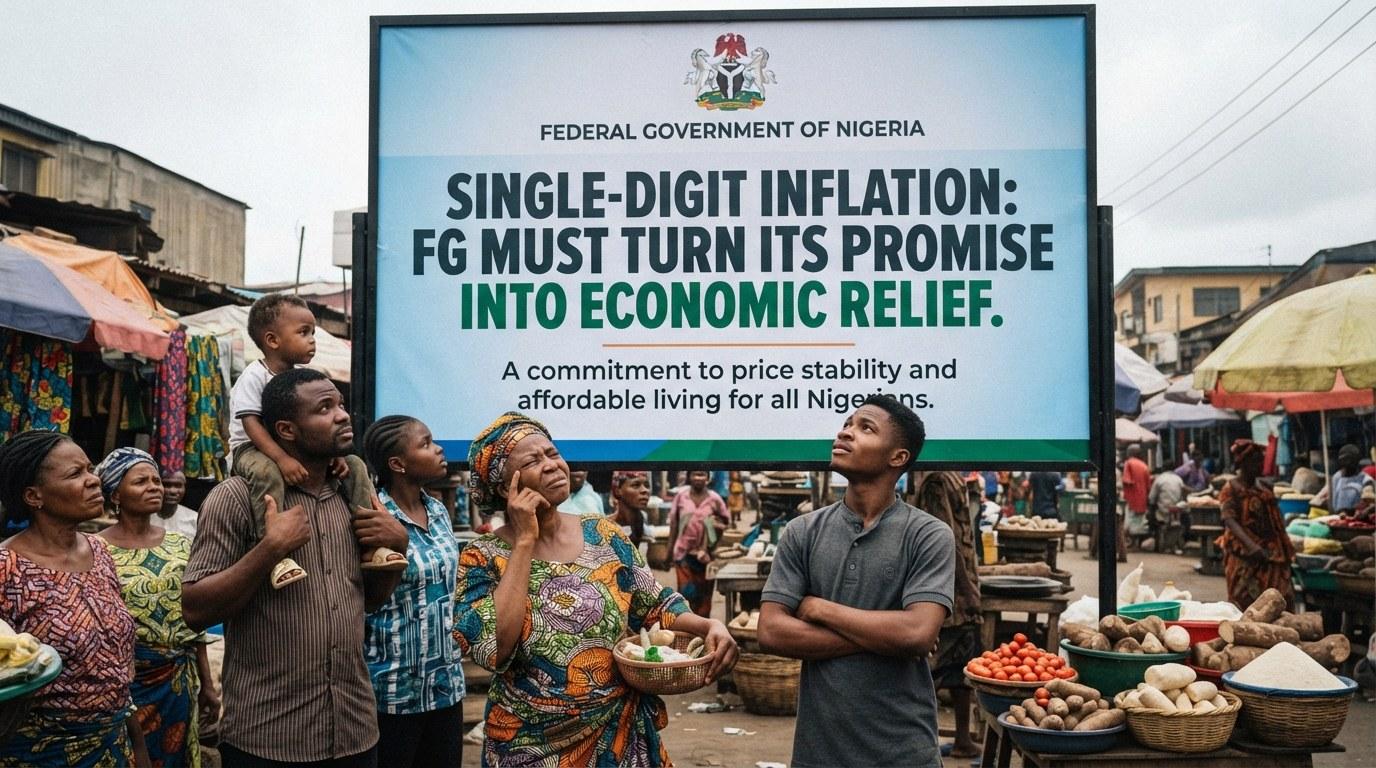
Nigeria’s ambition to reduce inflation to single-digit levels before the end of 2027 is a welcome declaration of intent, but it must be accompanied by a credible, measurable and sustainable programme capable of translating macroeconomic improvements into tangible benefits for citizens. The Federal Government deserves to be judged not merely by the targets it announces, but by its ability to make food more affordable, lower the cost of credit, stimulate productive investment and restore purchasing power to households that have endured prolonged economic pressure.
The Minister of Finance, Mr Taiwo Oyedele, announced the target at the Nigeria Economic Summit in Abuja, arguing that lower inflation would create room for reduced interest rates, cheaper borrowing and stronger economic growth. His observation that an economy growing at 4.43 per cent while businesses borrow at rates approaching 30 per cent is operating below its potential raises an important question about the relationship between the cost of capital and Nigeria’s productive capacity.
It is difficult to disagree with the underlying argument. No economy can fully realise its industrial and entrepreneurial potential when the cost of financing productive activity is prohibitively high. Manufacturers cannot expand efficiently when interest payments consume a substantial proportion of their earnings. Farmers cannot readily invest in modern equipment, irrigation and storage when borrowing costs make such investments commercially unattractive. Small businesses cannot create jobs at the pace the country needs if access to affordable credit remains beyond their reach.
Nevertheless, the government must recognise that reducing inflation is not simply a monetary-policy exercise. It is a broader economic undertaking requiring coordination among fiscal authorities, the Central Bank of Nigeria, agricultural producers, manufacturers, energy providers and other institutions responsible for the conditions under which goods and services are produced and distributed.
Nigeria’s headline inflation rate declined from 15.39 per cent in August to 14.63 per cent in September 2026, according to the figures presented in the report. The improvement is encouraging, particularly following years of severe price pressures. The CBN’s reduction of its benchmark interest rate from 26.50 per cent to 23 per cent also suggests that the moderation in inflation has created some room for a less restrictive monetary stance.
Yet these developments must not be mistaken for the completion of the recovery process. Inflation remains elevated, credit remains expensive and the financial difficulties confronting many households and businesses have not disappeared merely because the rate of price increases has slowed.
The government’s single-digit target is therefore a reasonable aspiration, but its credibility will depend on the policies, implementation mechanisms and economic conditions supporting it.
Lower Inflation Must Mean More Than Better Statistics
One of the persistent challenges in economic management is the gap between improvements in national indicators and the experiences of ordinary citizens. A reduction in inflation is important, but it does not automatically restore the purchasing power lost during previous periods of rapid price increases.
When the prices of food, transportation, rent, medicines and other essential goods rise substantially, households adjust their spending, often by sacrificing savings, reducing consumption or postponing important expenditure. Even when inflation subsequently declines, prices may remain far above their earlier levels.
This distinction must inform the government’s communication and policy priorities.
A decline in inflation means that prices are rising more slowly; it does not necessarily mean that goods and services are becoming cheaper. For families whose earnings have failed to keep pace with cumulative price increases, the difference is substantial.
The Federal Government should consequently avoid treating a favourable inflation report as sufficient evidence that economic hardship has been resolved. Instead, it should assess whether real household incomes are improving, employment opportunities are expanding and the cost of essential consumption is becoming more manageable relative to earnings.
The minister’s stated ambition to ensure that incomes grow faster than prices is particularly important in this regard. It identifies the outcome that citizens need, rather than focusing exclusively on the statistical measure of inflation.
However, the objective requires more than an announcement. It calls for policies that encourage productive employment, support enterprise development, improve agricultural output and enable workers to secure earnings that reflect changing economic conditions.
Cheaper Credit Is Essential, But It Must Reach Producers
Oyedele is right to draw attention to the consequences of expensive borrowing. Interest rates approaching 30 per cent can make otherwise viable projects difficult to finance, especially in sectors where returns emerge gradually rather than immediately.
Nigeria needs investment in manufacturing, agriculture, food processing, transport, housing, technology and other productive activities capable of creating employment and strengthening domestic supply. Such investment requires capital at rates that businesses can reasonably accommodate.
However, the relationship between the CBN’s policy rate and the interest rates charged by commercial banks must be understood. A reduction in the benchmark rate does not automatically compel banks to lower lending rates by the same margin. Banks also consider their funding costs, perceived credit risks, operating expenses and expectations about the economy.
The government and monetary authorities should therefore pay attention to how monetary easing is transmitted through the banking system. The ultimate objective should be to make productive investment more accessible, not merely to announce a lower benchmark rate.
There is also a strong case for improving credit access for small and medium-sized enterprises, which often lack the collateral, financial records or bargaining power available to larger corporations. These businesses are important sources of employment, innovation and local economic activity. If they remain excluded from affordable financing, the benefits of lower interest rates could be concentrated among a limited number of large borrowers.
Well-designed credit guarantees, transparent development-finance programmes and stronger mechanisms for assessing viable businesses could complement broader monetary easing. Such interventions must, however, be carefully administered to avoid political patronage, waste and the accumulation of bad loans.
Production Must Become The Centre Of The Anti-Inflation Strategy
Nigeria cannot sustainably defeat inflation if the supply of essential goods remains vulnerable to persistent constraints.
Food inflation, in particular, illustrates the importance of addressing the productive foundations of the economy. Agricultural output can be undermined by insecurity, inadequate storage, poor rural roads, expensive fertilisers, unreliable electricity and limited access to modern equipment. These difficulties raise production and distribution costs, which are ultimately reflected in market prices.
The government must therefore complement monetary policy with practical interventions that increase the availability of food and other essential commodities.
Farmers need secure access to their fields, affordable inputs, improved extension services, suitable storage facilities and reliable routes to markets. Food processors need energy, machinery and financing. Distributors need transport systems that reduce waste and avoid unnecessary costs.
The same principle applies to manufacturing. Businesses cannot consistently lower prices or expand production when electricity, logistics, imported inputs and financing remain expensive.
A serious anti-inflation strategy must therefore pursue a dual objective: managing demand and monetary conditions while increasing the economy’s capacity to supply goods and services.
This is where the proposed reduction in interest rates could become particularly valuable. If cheaper credit enables farmers and manufacturers to increase output, the economy could experience a reinforcing cycle in which improved supply helps moderate inflation while lower inflation creates further room for monetary easing.
That outcome, however, will require consistent implementation and the removal of structural obstacles that interest-rate adjustments alone cannot resolve.
Fiscal Discipline And Policy Consistency Matter
The government must also recognise the relationship between fiscal policy and monetary policy. Inflation cannot be controlled sustainably if public financial management, spending patterns and borrowing requirements continually work against the objectives of the monetary authorities.
Fiscal discipline does not mean abandoning essential public investment or social responsibilities. Rather, it requires ensuring that public expenditure is productive, transparent and consistent with the country’s available resources and development priorities.
Investment in electricity, transport infrastructure, agricultural development, education and healthcare can strengthen productive capacity over time. Wasteful expenditure, poorly designed interventions and inefficient public procurement, by contrast, can impose costs without delivering corresponding economic benefits.
Policy consistency is equally important. Businesses need confidence that the rules governing investment, taxation, trade and access to essential inputs will not change unpredictably. Uncertainty discourages long-term commitments and can increase the risk premium investors attach to Nigerian projects.
The minister’s assurance that the government remains willing to adjust measures that are not working is therefore welcome. Genuine policy flexibility should be a strength, provided changes are guided by evidence, transparently explained and implemented in a manner that does not create fresh uncertainty.
Constructive criticism should also be recognised as an essential part of sound economic governance. Citizens, professional associations, businesses and independent analysts should be able to question policies and present evidence of their effects without their concerns being dismissed as emotional reactions.
Economic reforms affect livelihoods, and public scrutiny can help authorities identify unintended consequences before they become more serious.
The Government Must Earn Public Confidence
The road to single-digit inflation will require patience, but patience cannot be demanded indefinitely without demonstrable progress.
Nigerians need to understand the measures being taken, the sacrifices expected of them, the milestones authorities intend to achieve and the indicators that will be used to evaluate performance. Regular publication of reliable data and clear explanations of policy decisions would strengthen accountability.
The government should communicate progress not only through headline inflation figures but also through information about food prices, employment, real wages, lending rates, industrial output and the performance of small businesses.
Such a broader assessment would provide a clearer picture of whether economic stabilisation is producing meaningful improvements across different segments of society.
It would also help policymakers identify areas where the benefits of recovery are slow to emerge and where additional interventions may be necessary.
Nigeria’s economic circumstances demand neither exaggerated pessimism nor premature celebration. The recent moderation in inflation provides grounds for cautious optimism, but the distance between the present position and the government’s target remains significant.
A Promise That Must Be Kept
The Federal Government’s intention to achieve single-digit inflation before the end of 2027 should be treated as a commitment requiring sustained effort, not as a guarantee that the desired outcome will automatically materialise.
The target can become an important milestone if it is supported by disciplined fiscal management, credible monetary policy, increased domestic production, improved infrastructure and a financial system capable of directing affordable credit towards productive enterprises.
The CBN must remain attentive to inflationary risks while assessing when further interest-rate reductions are justified. The fiscal authorities must ensure that government policies complement rather than undermine monetary stability. Businesses, in turn, need a predictable environment in which investment can generate competitive returns and employment.
Above all, the government must remember that the ultimate purpose of economic reform is to improve human welfare.
Success will not be measured solely by whether inflation falls below 10 per cent. It will be measured by whether families can afford adequate food, businesses can borrow at sustainable rates, young Nigerians can find productive employment and workers can retain more of the value of their earnings.
Nigeria has the entrepreneurial capacity, natural resources and human talent to build a more productive economy. What it requires is a consistent policy framework that turns those advantages into opportunities for citizens.
The single-digit inflation target offers an opportunity to demonstrate that economic reform can deliver more than improved statistics. The government must now show, through measurable results and sustained action, that the promise of lower inflation and cheaper credit can become a reality in the lives of Nigerians.