 PublicSphere Live
Editorial
EDITORIAL: Nigeria’s Borrowing Dilemma: Infrastructure Needs Must Be Balanced With Debt Sustainability
However, the importance of these objectives does not automatically justify every borrowing proposal. The central issue is whether the proposed loans represent prudent investments whose long-term benefits will outweigh their financial costs.
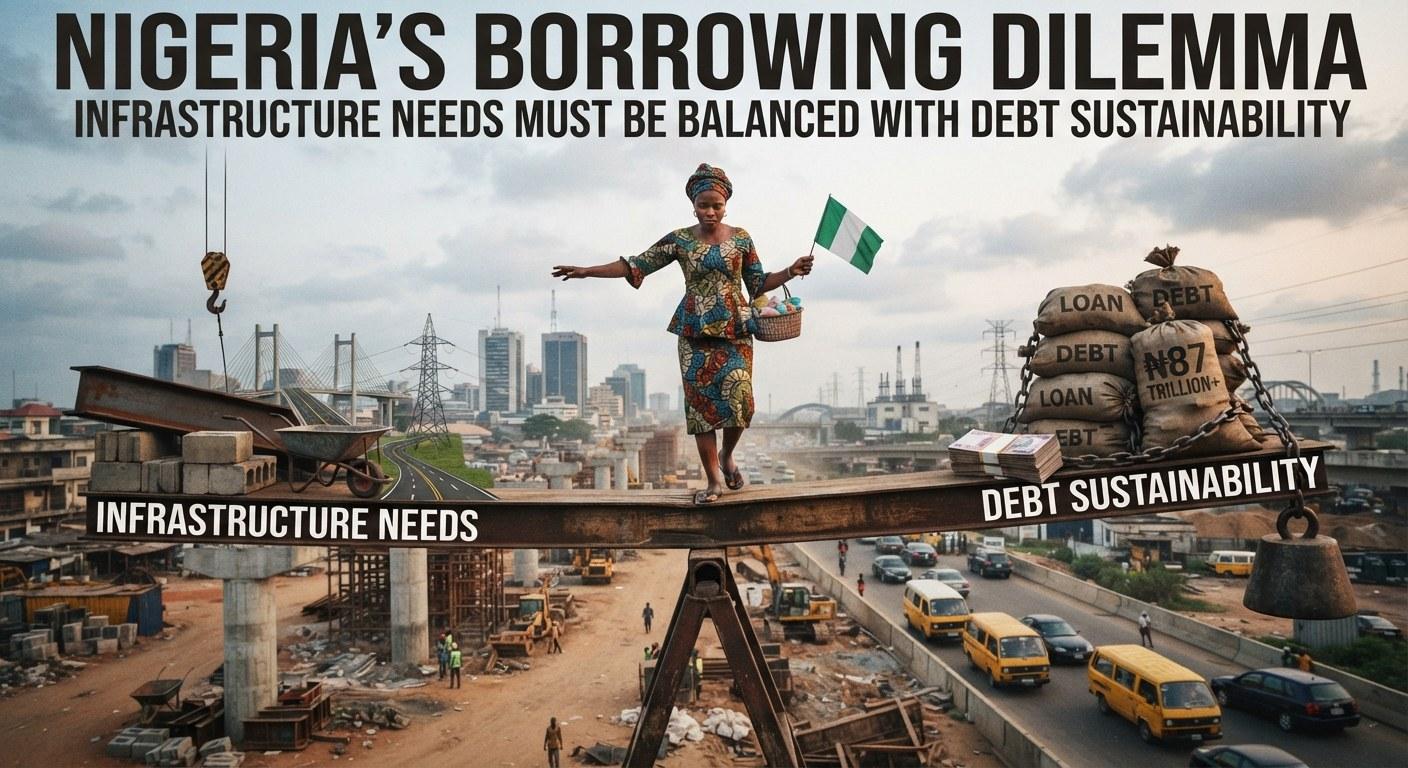
Nigeria’s development challenge presents a difficult but unavoidable question: how can a country with enormous infrastructure needs finance the investments required for economic growth without placing an unsustainable burden on future generations? President Bola Tinubu’s request for Senate approval to obtain $20.5 billion and €1.05 billion in external loans brings this question into sharp focus.
Estimated at approximately N29.12 trillion, the proposed borrowing is intended to finance projects under the Federal Government’s 2026–2027 supplementary borrowing plan. According to the presidential request, the funds are expected to support investments in power, transportation, healthcare, education, agriculture, water supply and other priority sectors.
These are legitimate areas of national concern. Nigeria needs reliable electricity, efficient transportation networks, accessible healthcare, quality education and improved agricultural productivity to strengthen its economy and improve citizens’ living conditions. However, the importance of these objectives does not automatically justify every borrowing proposal. The central issue is whether the proposed loans represent prudent investments whose long-term benefits will outweigh their financial costs.
The Senate’s responsibility, therefore, is not simply to approve or reject the President’s request. It is to establish, through rigorous scrutiny, whether the borrowing is necessary, affordable, transparent and supported by credible plans for implementation.
Borrowing For Development Is Not Inherently Wrong
External borrowing is a legitimate instrument of public finance when it is carefully structured and directed towards productive investments. Governments frequently borrow to finance infrastructure that requires substantial capital but generates economic benefits over many years.
A country should not necessarily postpone essential infrastructure until sufficient revenue accumulates to pay for every project from its annual budget. Such an approach could delay development, constrain economic activity and perpetuate the very weaknesses that prevent revenue growth.
For Nigeria, inadequate electricity supply raises production costs and limits the competitiveness of businesses. Poor transport infrastructure increases the cost of moving agricultural produce and manufactured goods. Insufficient investment in healthcare and education weakens human capital, while inadequate water infrastructure affects public health and productivity.
Well-designed investments in these sectors could address structural constraints and create conditions for sustained economic expansion.
If borrowed funds help improve electricity supply, lower logistics costs, expand agricultural output and increase industrial production, the resulting economic activity could strengthen employment, household incomes and government revenue. In that situation, borrowing would serve as a means of financing development rather than merely covering expenditure.
Nevertheless, the distinction between productive borrowing and expensive indebtedness lies in the quality of the projects, the terms of financing and the discipline with which the money is spent.
The government must demonstrate that the proposed projects are capable of delivering measurable benefits and that the benefits justify the financial obligations being undertaken.
The Size Of The Request Demands Close Scrutiny
The proposed $20.5 billion and €1.05 billion represent substantial external financing commitments. Their estimated naira equivalent of N29.12 trillion makes the request particularly significant in the context of Nigeria’s competing expenditure priorities.
The amount alone does not establish that the borrowing is excessive or unsustainable. That judgment requires a fuller assessment of the country’s revenue, existing debt obligations, repayment schedule, financing costs and expected economic returns.
However, the scale of the proposal makes it imperative that the government provide a comprehensive explanation of why such a large amount is required, how the figure was calculated and which specific projects will receive the funds.
Lawmakers should also determine whether the proposal introduces entirely new borrowing commitments or incorporates projects and financing arrangements previously considered under earlier borrowing plans. Senate President Godswill Akpabio has indicated that aspects of the framework featured in previous borrowing plans for the 2025–2027 period. This makes clarification particularly important.
There must be no ambiguity about the relationship between previous approvals and the current request. Nigerians deserve to know whether the proposal represents additional debt, a restructuring of existing financing plans or a combination of both.
Without such clarification, it would be difficult for legislators and the public to establish the government's actual financing requirements and the cumulative implications for public debt.
Debt Sustainability Must Remain Central
The principal concern surrounding external borrowing is not simply the amount owed but the government's capacity to meet its obligations without undermining essential public services or economic stability.
Debt sustainability depends on several factors, including the cost of borrowing, repayment periods, the government's revenue-generating capacity, economic growth and the composition of public expenditure.
Nigeria must therefore assess the proposed facilities in relation to its existing debt commitments and future financing needs.
External loans also introduce foreign-exchange considerations. Where borrowing is denominated in dollars and euros, repayments may become more expensive in naira terms if the domestic currency depreciates. Even when a project is economically useful, its financing structure can create additional pressure on public finances if the government earns revenue predominantly in naira but must repay lenders in foreign currency.
This risk does not mean that all foreign-currency borrowing should be avoided. It means that the currency denomination, repayment schedule and expected benefits of each facility must be examined carefully.
Where possible, projects with direct foreign-exchange earnings or demonstrable import-saving benefits may provide a stronger financial basis for external borrowing. Other projects, particularly those delivering essential social services, may justify public financing for broader economic and humanitarian reasons, even when they do not generate direct cash revenue.
The important consideration is that the government must recognise these differences when evaluating affordability and determining repayment strategies.
Equally, the authorities should disclose how much of future government revenue may be required for debt servicing and whether the projected obligations leave sufficient room for health, education, security and other essential expenditures.
A borrowing plan that finances development today but severely restricts public investment tomorrow would require reconsideration.
The Senate Must Go Beyond Routine Approval
President Tinubu has submitted the request to the National Assembly, and the Senate President has referred it to the Senate Committee on Local and Foreign Debts, chaired by Senator Haruna Manu, for detailed examination. The committees on Appropriations and Finance are also expected to contribute to the review.
This legislative process is essential. Borrowing on behalf of the country creates obligations that extend beyond the tenure of the administration undertaking it. The responsibility of lawmakers is therefore to protect the national interest, regardless of political affiliations.
The committees should demand a project-by-project breakdown showing the proposed allocations, implementation schedules, expected outputs and economic justifications. They should examine the feasibility studies supporting the projects and establish whether alternative financing arrangements could achieve similar objectives at lower cost.
The terms of the loans must also be made available for scrutiny. These include interest rates, arrangement fees, grace periods, repayment tenors, currency exposure and any conditions attached to the facilities.
Where concessional financing is available, the government should explain whether it has been considered. Where commercial borrowing is proposed, the economic rationale and capacity to meet the associated costs should be clearly established.
Lawmakers should further determine whether the projects can realistically be completed within the proposed implementation period and whether the government possesses the institutional capacity to manage them effectively.
The Senate should neither approve the request merely because it comes from the executive nor reject it simply because it involves additional debt. Its decision should rest on evidence, affordability and national priorities.
Transparency Must Continue After Approval
Even a well-prepared borrowing plan can fail if implementation is weakened by poor procurement, project delays, inflated costs or inadequate supervision.
For this reason, legislative scrutiny should not end when approval is granted. A credible accountability framework must follow the money from disbursement to project completion.
The government should publish the projects financed by the loans, the amounts allocated to each, the implementing agencies and the expected delivery dates. Regular public reports should disclose disbursements, expenditure, implementation progress and significant deviations from approved budgets.
Independent audits and effective legislative oversight would help establish whether contractors are delivering value for money and whether completed projects meet the required standards.
Where projects experience delays or cost overruns, the responsible agencies should explain the circumstances and identify corrective measures. Where funds are misapplied, appropriate accountability mechanisms must be activated.
These safeguards are not obstacles to development. They are essential conditions for ensuring that public borrowing produces the intended results.
Nigeria's experience with infrastructure spending demonstrates why the distinction between money committed and development delivered matters. Announced projects do not improve living standards until they are completed, functional and accessible to the people they are intended to serve.
Citizens Must See Tangible Benefits
Ultimately, the justification for the proposed loans will be judged by their impact on ordinary Nigerians.
Citizens need dependable electricity, safer and more efficient transport, functioning hospitals, better-equipped schools, reliable water supplies and stronger opportunities for agricultural production and employment.
The government should therefore establish measurable targets against which the performance of the financed projects can be assessed. These could include improvements in electricity availability, reductions in transport and logistics costs, increased agricultural output, expanded access to healthcare and education, and the number of sustainable jobs created.
Such indicators would help determine whether the borrowing is generating economic and social value.
The distribution of benefits also matters. Infrastructure investments should not be concentrated exclusively in locations or sectors that offer immediate political advantages. Project selection should reflect demonstrated needs, economic viability, regional considerations and the objective of broad-based national development.
Furthermore, the government must explain how the proposed investments fit into its existing development programmes and whether sufficient funding will be available to maintain completed infrastructure. Roads, power facilities, hospitals and water systems require continuing expenditure after construction. Failure to provide for maintenance can diminish the value of the original investment and leave taxpayers with debt obligations but inadequate public assets.
A Balanced Decision Is In The National Interest
The request for $20.5 billion and €1.05 billion in external loans presents both an opportunity and a responsibility. It offers the possibility of financing investments that could strengthen Nigeria's productive capacity, but it also creates obligations that must be managed carefully.
The appropriate response is neither automatic endorsement nor reflexive opposition. Nigeria's infrastructure deficit is real, and responsible borrowing may be necessary to address it. Equally, the country's development ambitions must remain consistent with its capacity to repay what it borrows.
The Senate should therefore insist on complete disclosure, credible project appraisals, favourable financing terms where available, clear implementation plans and enforceable accountability arrangements before reaching a decision.
The executive, for its part, should regard legislative scrutiny as an opportunity to demonstrate the soundness of its financing strategy rather than as an impediment to its development agenda.
If the evidence establishes that the proposed loans are affordable, appropriately structured and directed towards projects capable of delivering substantial public value, approval could be justified. If significant gaps emerge in the financing terms, project feasibility or debt implications, lawmakers should seek clarification, recommend adjustments or withhold approval where necessary.
The national interest requires a decision based on facts rather than political sentiment.
Nigeria must invest in its future, but it must also protect that future from avoidable financial risks. The ultimate test of the proposed borrowing will not be the amount secured or the number of projects announced. It will be whether the investments deliver lasting economic benefits, improve the lives of Nigerians and leave the country better equipped to meet its obligations.
Borrowing should be a bridge to sustainable development, not a substitute for fiscal discipline. That principle should guide both the Senate's deliberations and the government's implementation of any borrowing plan that eventually receives legislative approval.