 PublicSphere Live
Capital Market
NGX ASI Drops 1.98% As 36 Stocks Decline, Investors Trade N29.55bn
The Nigerian equities market closed Thursday's trading session on a negative note, as investors continued to adjust their portfolios amid renewed profit-taking and declining share prices across several sectors.
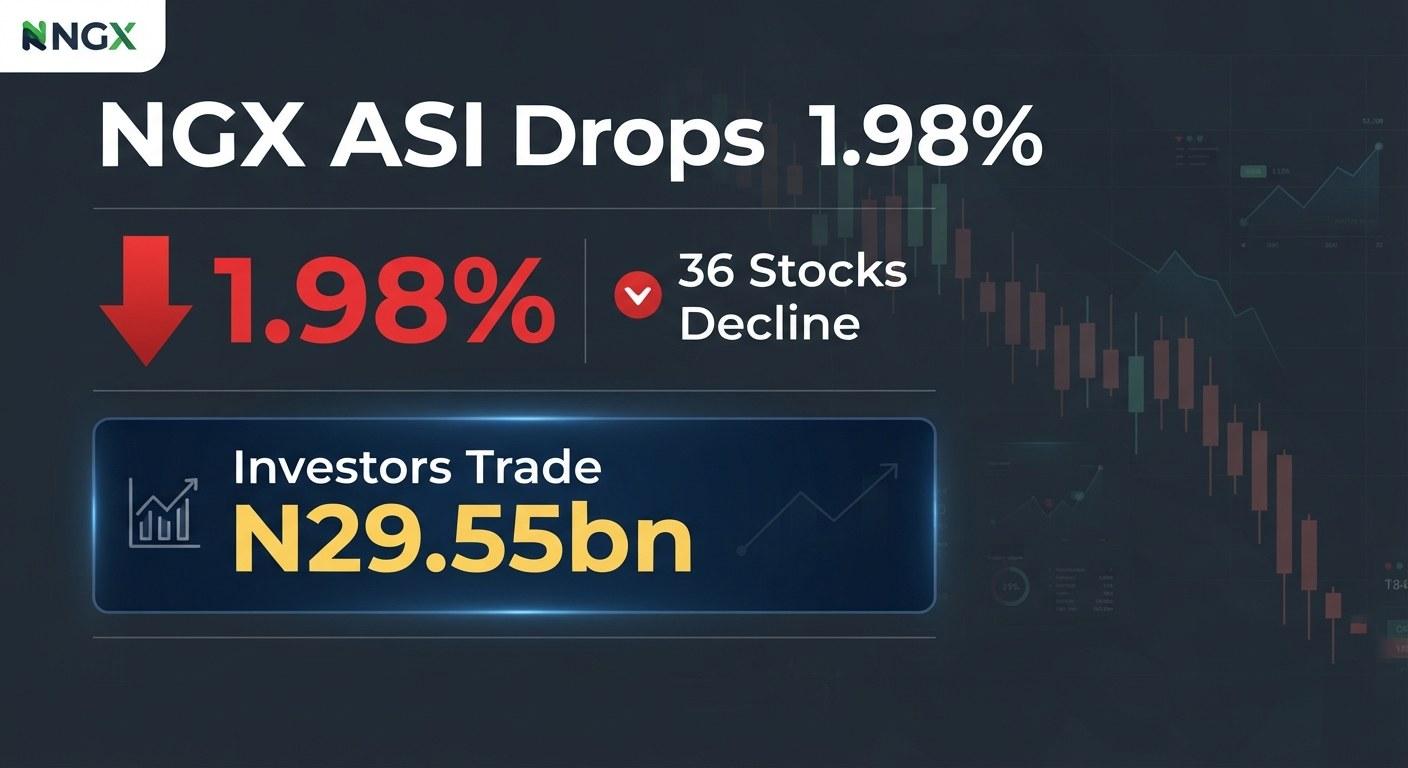
Nigeria’s equities market extended its bearish performance on Thursday, November 5, 2026, as the Nigerian Exchange All-Share Index shed 5,052.22 points to close at 249,710.59, representing a 1.98 per cent decline. Although trading volume contracted by 11 per cent, transaction value increased by 17 per cent to N29.55 billion, while 36 stocks recorded losses against 20 gainers, reflecting sustained selling pressure across the market.
The Nigerian equities market closed Thursday's trading session on a negative note, as investors continued to adjust their portfolios amid renewed profit-taking and declining share prices across several sectors.
The benchmark NGX All-Share Index (ASI) fell by 5,052.22 points, representing a 1.98 per cent decline, to close at 249,710.59 points.
The performance reflected a difficult trading session for equities investors, with declining stocks significantly outnumbering advancing counters and major market indices recording losses.
The market's negative performance also affected its overall valuation, with market capitalisation settling at approximately N162.1 trillion, equivalent to about $121 billion.
Trading statistics showed that investors exchanged 382,783,479 shares in 33,199 deals, valued at N29.55 billion.
Compared with Wednesday, November 4, trading volume declined by 11 per cent, while the total value of transactions improved by 17 per cent. The number of deals also increased marginally by one per cent.
The combination of lower trading volume and higher transaction value suggests that investors executed transactions involving relatively higher-value stocks, even as the number of shares exchanged declined.
A total of 132 listed equities participated in the day's trading activities, with 20 stocks appreciating in value and 36 recording losses.
The negative market breadth reinforced the bearish sentiment, indicating that selling pressure was more widespread than buying interest.
Computer Warehouse Group Leads Gainers
Despite the overall market decline, some equities attracted buying interest and recorded impressive price appreciation.
Computer Warehouse Group Plc emerged as the best-performing stock of the session, gaining 9.94 per cent to close at N17.15 per share.
Abbey Mortgage Bank Plc followed closely, appreciating by 9.84 per cent, while Honeywell Flour Mill Plc gained 9.82 per cent.
E-Tranzact International Plc completed the leading four gainers, recording a 9.71 per cent increase in its share price.
The performance of these stocks demonstrated that opportunities for price appreciation remained available in selected counters despite the broader market downturn.
Computer Warehouse Group's emergence as the session's strongest performer was particularly noteworthy, as the stock approached the 10 per cent daily appreciation threshold.
The gains recorded by Abbey Mortgage Bank, Honeywell Flour Mill and E-Tranzact also indicated pockets of positive investor sentiment across the financial services, consumer goods and technology-related segments of the market.
However, the relatively small number of advancing stocks compared with decliners suggests that these gains were insufficient to offset the wider market losses.
Presco, Dangote Cement Top Losers
On the losing side, Presco Plc recorded the steepest decline, shedding 10 per cent to close at N1,656.80 per share.
Dangote Cement Plc followed with an identical 10 per cent depreciation, making it one of the most significant contributors to the market's negative performance.
Coronation Insurance Plc declined by 9.91 per cent, while Austin Laz & Company Plc lost 8.57 per cent.
The losses recorded by Presco and Dangote Cement were particularly significant given their respective positions in the industrial and agricultural value chains.
Dangote Cement's decline also reflected the weakness affecting the industrial goods sector, which has been one of the major sources of pressure on the overall market.
The simultaneous depreciation of Coronation Insurance and other stocks suggests that the bearish sentiment extended beyond industrial and consumer-oriented companies.
For investors, the sharp movements in these counters highlight the importance of monitoring individual company fundamentals, valuation levels and market liquidity rather than relying exclusively on the direction of the benchmark index.
Access Holdings Leads Trading Volume
In terms of trading activity, Access Holdings Plc recorded the highest volume of transactions, with 30.5 million shares changing hands.
Chams Plc followed with 28.6 million shares, while Zenith Bank Plc recorded 21.7 million shares.
Honeywell Flour Mill Plc completed the leading four stocks by volume, with 21.2 million shares traded.
The participation of Access Holdings and Zenith Bank among the most actively traded stocks underscores the continued importance of banking equities to liquidity on the Nigerian Exchange.
Chams' significant trading volume also points to sustained investor activity in selected technology-related stocks, while Honeywell Flour Mill's position among the most actively traded counters reflects interest in the consumer goods segment.
However, high trading volume does not necessarily translate into positive price performance, as the direction of a stock depends on the balance between buying and selling interests.
The increase in aggregate transaction value, despite the decline in volume, similarly suggests that higher-value transactions played a greater role in determining the day's turnover.
Sectoral Indices Record Mixed But Predominantly Negative Performance
A review of the NGX sectoral and broader market indices showed that the downturn affected several important segments of the equities market.
The NGX Top 30 Index, which tracks the performance of the exchange's leading companies, declined by 2.08 per cent.
Its one-week performance stood at a negative 1.71 per cent, although it retained a year-to-date gain of 62.33 per cent.
The NGX Banking Index lost 0.66 per cent during the session, bringing its one-week decline to 2.97 per cent.
Despite the recent weakness, the banking index maintained a year-to-date appreciation of 57.55 per cent, indicating that the sector has retained substantial gains accumulated earlier in the year.
The NGX Oil and Gas Index also closed lower, shedding 0.04 per cent.
Its one-week performance showed a decline of 3.89 per cent, while its year-to-date return remained particularly impressive at 119.17 per cent.
The sector's performance is noteworthy because of the substantial appreciation recorded since the beginning of the year, despite the recent correction.
The NGX Consumer Goods Index declined by 0.14 per cent, bringing its one-week loss to 1.39 per cent.
Unlike several other indices, however, the consumer goods sector remained marginally negative on a year-to-date basis, with a decline of 0.36 per cent.
The NGX Main Board Index recorded a 0.22 per cent decline, while its one-week loss stood at 0.74 per cent. Its year-to-date appreciation remained positive at 41.11 per cent.
The NGX Pension Index also declined by 1.14 per cent during Thursday's session, bringing its one-week loss to 2.33 per cent.
Nevertheless, the index retained a strong year-to-date gain of 76.2 per cent.
The performance of these indices suggests that Thursday's decline was part of a broader market adjustment, although the extent of the losses varied across sectors.
Market Retains Strong Year-To-Date Gains
Despite Thursday's significant decline, the Nigerian equities market continues to maintain a substantial positive return since the beginning of 2026.
The All-Share Index's year-to-date appreciation stood at 60.47 per cent, demonstrating the extent of the market's gains before the latest correction.
Its four-week performance also remained positive at 0.67 per cent, even though the one-week return had slipped to negative 1.72 per cent.
This contrast between the market's short-term weakness and its longer-term positive performance suggests that the current downturn has not completely erased the gains accumulated during the year.
The NGX Top 30, Oil and Gas, Banking and Pension indices also maintained impressive year-to-date returns of 62.33 per cent, 119.17 per cent, 57.55 per cent and 76.2 per cent respectively.
The Oil and Gas Index's 119.17 per cent appreciation was particularly outstanding, reflecting the strong performance of the sector over the review period.
However, the recent weekly declines across several indices indicate that investors are becoming more selective in their investment decisions.
Outlook: Investors Watch For Market Stabilisation
The immediate outlook for the Nigerian equities market will depend largely on whether investors return to the buying side following Thursday's widespread losses.
The decline in the All-Share Index, combined with negative market breadth, suggests that the market is experiencing a period of consolidation after its impressive appreciation earlier in the year.
Investors will particularly monitor the performance of heavyweight stocks such as Dangote Cement and major banking equities because of their influence on market capitalisation and the benchmark index.
The ability of the market to sustain its year-to-date gains will also depend on corporate earnings, dividend expectations, interest-rate developments, foreign exchange stability and broader economic conditions.
The increase in transaction value, despite lower trading volume, is another development deserving attention. Subsequent sessions should reveal whether the higher turnover represents renewed institutional participation or remains concentrated in selected counters.
For investors, the current environment calls for greater attention to corporate fundamentals and stock-specific valuations.
While the market's 60.47 per cent year-to-date appreciation remains encouraging, Thursday's performance demonstrates that substantial gains can be accompanied by significant short-term volatility.
The coming sessions will therefore be important in determining whether the latest decline represents a temporary correction or the beginning of a more sustained bearish phase.
Ultimately, the Nigerian equities market remains significantly positive on a year-to-date basis, but investors will need renewed buying interest and improved market breadth to restore confidence in its immediate direction.